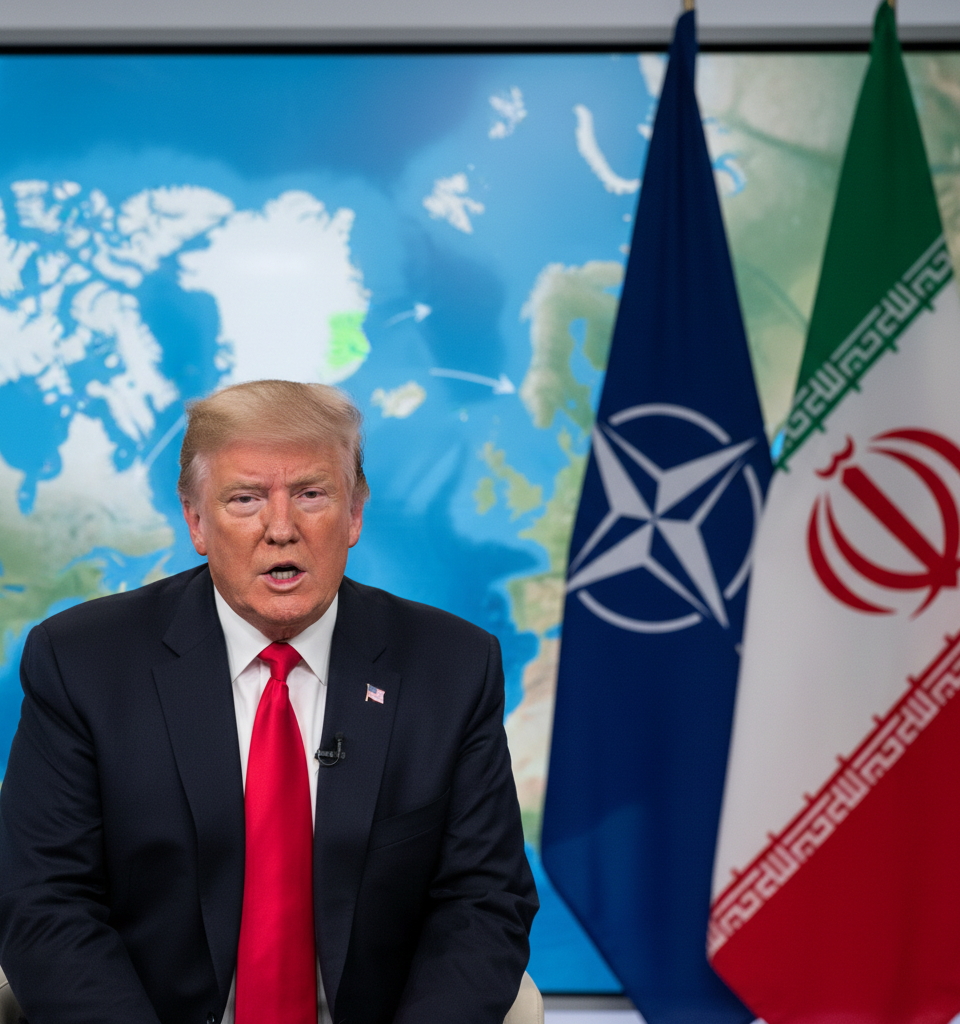
Former U.S. President Donald Trump has once again thrust the autonomous Danish territory of Greenland into the international spotlight, reigniting his controversial ambition to acquire the strategically vital landmass. In a characteristically provocative statement, Trump dismissed Greenland as a 'poorly run piece of ice,' a remark that has sent ripples through diplomatic circles and further exacerbated already strained relations within NATO. This renewed push for acquisition comes at a particularly volatile moment, with the Western alliance grappling with internal discord exacerbated by the escalating geopolitical tensions surrounding Iran.
A History of Unconventional Diplomacy
Trump's initial overtures to purchase Greenland in 2019 were met with a firm rejection from Denmark, leading to the former President canceling a state visit and publicly criticizing the Danish Prime Minister. At the time, the proposal was largely dismissed as a whimsical curiosity. However, its re-emergence now underscores a persistent strategic interest, viewed by some as an attempt to project American influence in the Arctic, a region increasingly contested by global powers. The Arctic's melting ice caps are opening new shipping routes and exposing vast reserves of natural resources, making control of the region a key geopolitical objective. Greenland, with its immense landmass and strategic location, is central to this evolving dynamic.
Geopolitical Fault Lines Deepen
Trump's latest comments on Greenland are not isolated; they intersect with a complex web of international anxieties. The ongoing conflict with Iran, characterized by heightened military posturing and economic sanctions, has exposed significant fault lines within NATO. European allies, particularly Germany and France, have often advocated for a more diplomatic approach to Iran, contrasting sharply with what some perceive as a more confrontational stance from Washington. This divergence in strategy not only weakens NATO's collective resolve but also creates opportunities for adversaries to exploit internal divisions. The Greenland proposal, seen by some as a unilateral U.S. ambition, further fuels perceptions of American exceptionalism and a disregard for multilateral consensus.
Economic and Strategic Implications
From an economic standpoint, Greenland possesses significant untapped mineral wealth, including rare earth elements crucial for modern technologies. Estimates suggest reserves could be worth trillions of dollars, a figure that undoubtedly fuels Trump's interest. However, the logistical challenges and environmental sensitivities surrounding large-scale extraction are immense. Strategically, an American acquisition of Greenland would significantly bolster U.S. military reach in the Arctic and North Atlantic, potentially enhancing its ballistic missile defense capabilities and providing a key vantage point in an era of renewed great power competition. However, this gain would come at the cost of alienating a key European ally and undermining the very principles of sovereign autonomy.
Expert Perspectives on a Fractured Alliance
Defense analysts are openly expressing concern over the current state of NATO. Dr. Eleanor Vance, a senior fellow at the Council on Foreign Relations, commented, "Trump's Greenland remarks, while seemingly outlandish, serve as a stark reminder of the fissures within the Western alliance. At a time when unity is paramount in addressing threats from Iran and Russia, such unilateral proposals only serve to alienate allies and undermine collective security." Similarly, Dr. Markus Schmidt, a European foreign policy expert, noted, "The perception of U.S. abandonment of traditional diplomatic norms, coupled with escalating geopolitical flashpoints, is pushing NATO to its breaking point. Trust, once the bedrock of the alliance, is eroding at an alarming rate."
Sovereignty vs. Strategy: A Delicate Balance
The Danish government has consistently reiterated that Greenland is not for sale, emphasizing the territory's right to self-determination. Mette Frederiksen, the current Danish Prime Minister, has publicly stated, "Greenland is not Danish. Greenland is Greenlandic." This unwavering stance highlights the delicate balance between historical ties, strategic imperatives, and the evolving aspirations of an autonomous population. Any future discussions, should they arise, would invariably need to address the complex legal, political, and cultural dimensions of such a transaction, beyond mere financial considerations.
The Road Ahead: Navigating a Shifting Geopolitical Landscape
Looking ahead, the implications of Trump's renewed interest in Greenland and the ongoing NATO-Iran tensions are significant. The potential for further destabilization in the Middle East and the Arctic is substantial. The future trajectory of NATO, an alliance historically defined by its unity, will hinge on its ability to reconcile internal differences and forge a cohesive response to multifaceted global challenges. While Trump's current influence is out of office, his comments reflect a segment of American strategic thought that prioritizes transactional diplomacy over traditional alliance-building, a perspective that continues to shape the geopolitical discourse. The world watches as this dramatic interplay of sovereignty, strategy, and shifting alliances unfolds, with Greenland at the heart of an increasingly complex and contested global chessboard.