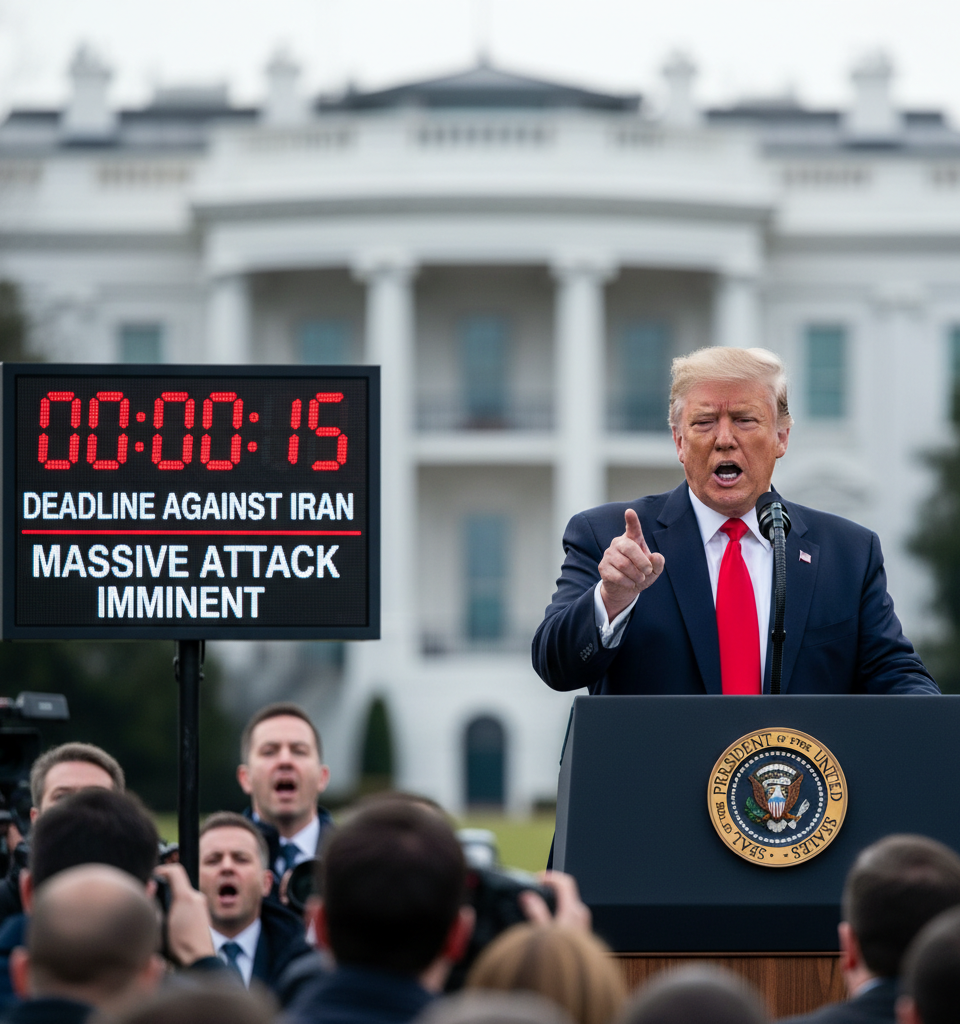
WASHINGTON D.C. — Former President Donald J. Trump has, a mere few hours before a self-imposed Tuesday evening deadline, vehemently rejected a proposed cease-fire agreement with Iran, branding it as "not good enough." The declaration comes with an ominous threat of a "massive attack" targeting a wide array of civilian facilities, including critical bridges and power plants, should his demands for a more comprehensive resolution not be met. This ultimatum marks a dramatic escalation in rhetoric, pushing the long-fraught relationship between Washington and Tehran to the precipice of open conflict.
The gravity of this pronouncement cannot be overstated. Should Trump's threats materialize, the targeting of civilian infrastructure could constitute a gross violation of international humanitarian law, particularly the Geneva Conventions, which protect civilians and their essential infrastructure during armed conflict. The current tensions are deeply rooted in a history of mistrust and strategic rivalry, exacerbated by the U.S. withdrawal from the Joint Comprehensive Plan of Action (JCPOA) in 2018 under Trump's previous administration. That move, which reimposed stringent sanctions on Iran, led to a tit-for-tat escalation that saw attacks on oil tankers, drone shoot-downs, and a heightened military presence in the Persian Gulf. This latest development threatens to unravel years of delicate, albeit often strained, diplomatic efforts.
Specific details regarding the rejected cease-fire proposal remain largely undisclosed, fuelling speculation about its scope and limitations. However, sources close to diplomatic discussions suggest that the proposal likely included provisions for de-escalation in regional proxy conflicts and perhaps a partial rollback of Iran's nuclear program. Trump's definitive dismissal, without publicly delineating his specific objections or counter-demands, leaves little room for further negotiation before his stated deadline. The former President's public statements often employ a strategy of brinkmanship, aiming to extract maximum concessions through pressure, a tactic previously observed in his dealings with North Korea and China. The question now is whether Iran will capitulate to the heightened pressure or stand firm.
The potential for conflict ripple effects through global markets, particularly in the energy sector. Oil prices demonstrated immediate volatility following Trump's comments, with Brent Crude futures rising by 2.5% to over $85 per barrel in early trading, and West Texas Intermediate (WTI) not far behind, gaining 2.2%. A full-scale military confrontation could severely disrupt global oil supply lines through the Strait of Hormuz, a critical chokepoint for approximately 20% of the world's oil supply. Shipping insurance premiums are already reportedly rising, signaling increased risk perception by maritime industries. Beyond energy, geopolitical instability can dampen global economic sentiment, deter foreign direct investment in the region, and introduce significant uncertainty for multinational corporations operating in the Middle East.
Defense analysts and foreign policy experts are largely unanimous in their concern. Dr. Evelyn Reed, a Senior Fellow at the Council on Foreign Relations, stated, "Threatening civilian infrastructure crosses a dangerous line that could precipitate a far wider and more destructive conflict. It also risks alienating international allies who uphold the principles of international law." Similarly, General Mark Bradley (Ret.), a former CENTCOM Commander, warned, "Any 'massive attack' would undoubtedly be met with a retaliatory response from Iran, potentially drawing regional actors and proxy forces into a broader, unpredictable conflict. The calculus of such an action is fraught with peril for U.S. strategic interests." These warnings highlight the significant risks associated with the potentially disproportionate nature of the threatened military action.
Looking ahead, the immediate hours leading up to Trump's Tuesday evening deadline will be critical. The international community, including key allies in Europe and Asia, will be watching closely for any diplomatic overtures or military maneuvers. The next steps could involve a last-minute reversal or modification of Trump's stance, a direct military strike, or a period of intense cyber warfare. The long-term implications are even more profound: a military clash could destabilize the entire Middle East, lead to a refugee crisis, and potentially reshape regional alliances for decades to come. The world holds its breath as the clock ticks down on an increasingly volatile situation, with the prospect of a major conflict looming large over the global horizon.