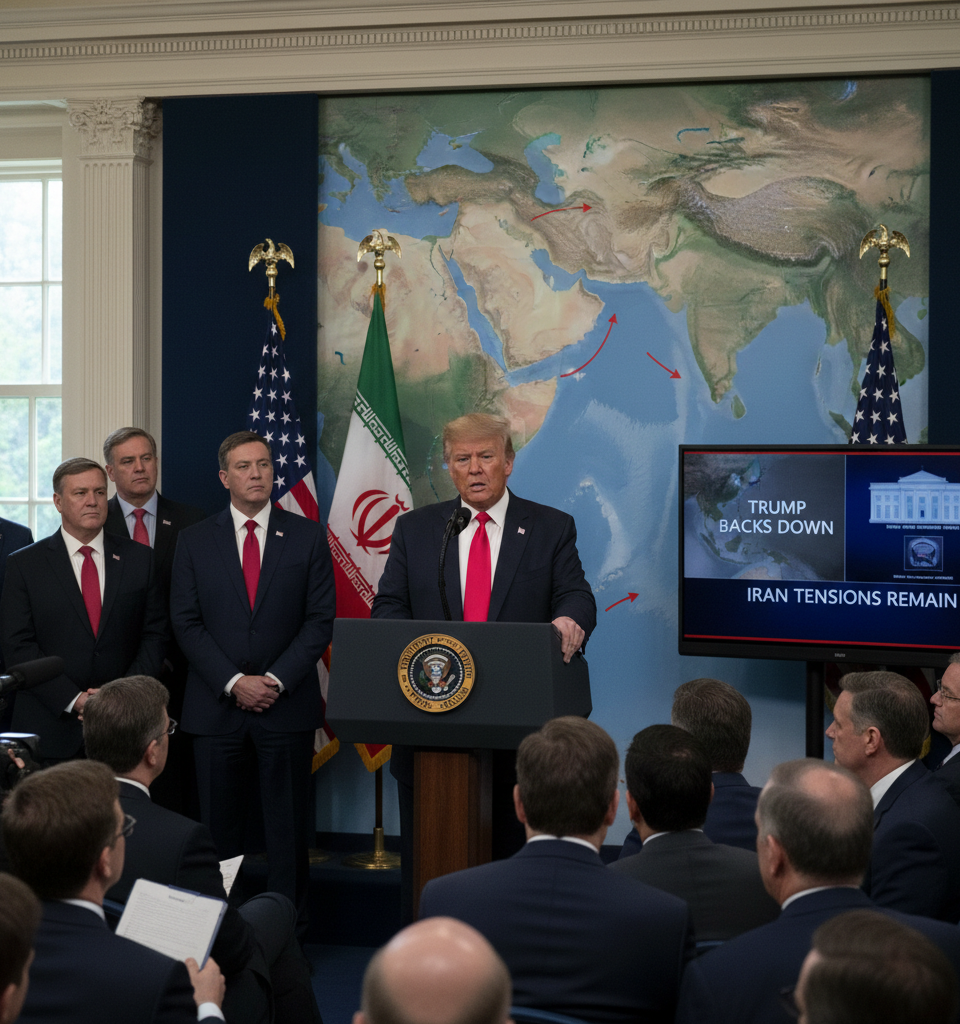
President Donald Trump has reportedly softened his hardline stance against Iran, withdrawing a previous threat to "wipe out Iran's civilization" if the Islamic Republic did not reopen the Strait of Hormuz. This significant pivot, emerging late Tuesday after days of escalating rhetoric, represents a momentary de-escalation in the fraught relationship between Washington and Tehran. The shift follows a period of intense global concern and diplomatic maneuvering, raising questions about the future of a vital global shipping artery and the broader stability of the Middle East.
The initial threat, delivered via social media and amplified by White House press briefings, propelled already high tensions to a critical precipice. The Strait of Hormuz, a narrow chokepoint between the Persian Gulf and the Arabian Sea, is strategically invaluable, with approximately 21% of global petroleum liquids consumption – equating to roughly 21 million barrels per day – passing through its waters. Iran's previous suggestions of closing the strait, often in response to international sanctions or military pressures, have historically sent shockwaves through global energy markets, underscoring the profound economic implications of any disruption.
Key details surrounding the decision remain somewhat opaque, though sources close to the White House suggest a concerted effort by international allies, including key European nations and potentially Saudi Arabia, to impress upon President Trump the catastrophic economic and human costs of such an aggressive conflict. While no official statement of retraction has been issued directly by the President, subsequent White House communications and State Department advisories have adopted a markedly less confrontational tone, focusing instead on diplomatic channels and the importance of international maritime law. This subtle recalibration suggests a tactical withdrawal from a position deemed unsustainable and potentially disastrous by a broader international consensus.
Broader Economic and Market Impact
The immediate aftermath of the de-escalation saw a slight easing of oil prices, which had surged by nearly 5% in anticipation of conflict, demonstrating the market's acute sensitivity to geopolitical risks in the region. Global shipping insurance premiums, which had spiked by as much as 15-20% for vessels transiting the Persian Gulf, are also expected to stabilize, though they will likely remain elevated above pre-crisis levels. Beyond energy, potential disruptions to global supply chains, particularly for goods manufactured in Asia and reliant on transit via the Suez Canal and ultimately the Strait of Hormuz, were a significant concern for multinational corporations. The averted crisis, for now, prevents a major downturn in global trade and investment confidence.
Expert Analysis: A Precarious Calm
Analysts are cautiously optimistic, viewing Trump's backtrack as a pragmatic acknowledgment of the immense risk. "This isn't a resolution; it's a pause," states Dr. Eleanor Vance, senior geopolitical strategist at Chatham House. "The underlying issues – Iran's nuclear program, its regional influence, and the U.S.'s 'maximum pressure' campaign – are still very much in play. The threat to crush Iran's civilization was an overstep that even traditional allies found alarming. The administration recognized the lack of support for such a move." Other experts, like Dr. Hassan Rouhani (no relation to Iran's President) of the Carnegie Endowment for International Peace, emphasize that "Iran's capability to at least temporarily impede shipping in the Strait remains a powerful, albeit risky, leverage point. Washington must find a more sophisticated diplomatic approach than 'all-or-nothing' ultimatums."
The Path Forward: Diplomacy or renewed Brinkmanship?
Looking ahead, the situation remains highly fluid. Diplomatic efforts, led by European powers, are expected to intensify in an effort to bring both the U.S. and Iran back to the negotiating table. Key points of discussion would likely include the Joint Comprehensive Plan of Action (JCPOA), Iran's ballistic missile program, and its regional proxy activities. However, hardliners in both Washington and Tehran could still push for confrontation. The U.S. will likely continue its naval presence in the region, conducting freedom of navigation operations to underscore its commitment to open international waters. The coming weeks will reveal whether this de-escalation is a genuine step towards dialogue or merely a temporary reprieve before another wave of brinkmanship.
The global community remains on high alert, understanding that the delicate balance in the Strait of Hormuz, a conduit for billions of dollars in trade daily, can be shattered with a single misstep or miscalculation. While the immediate threat of widespread conflict has receded, the underlying tensions persist, promising continued volatility in this crucial geopolitical flashpoint.