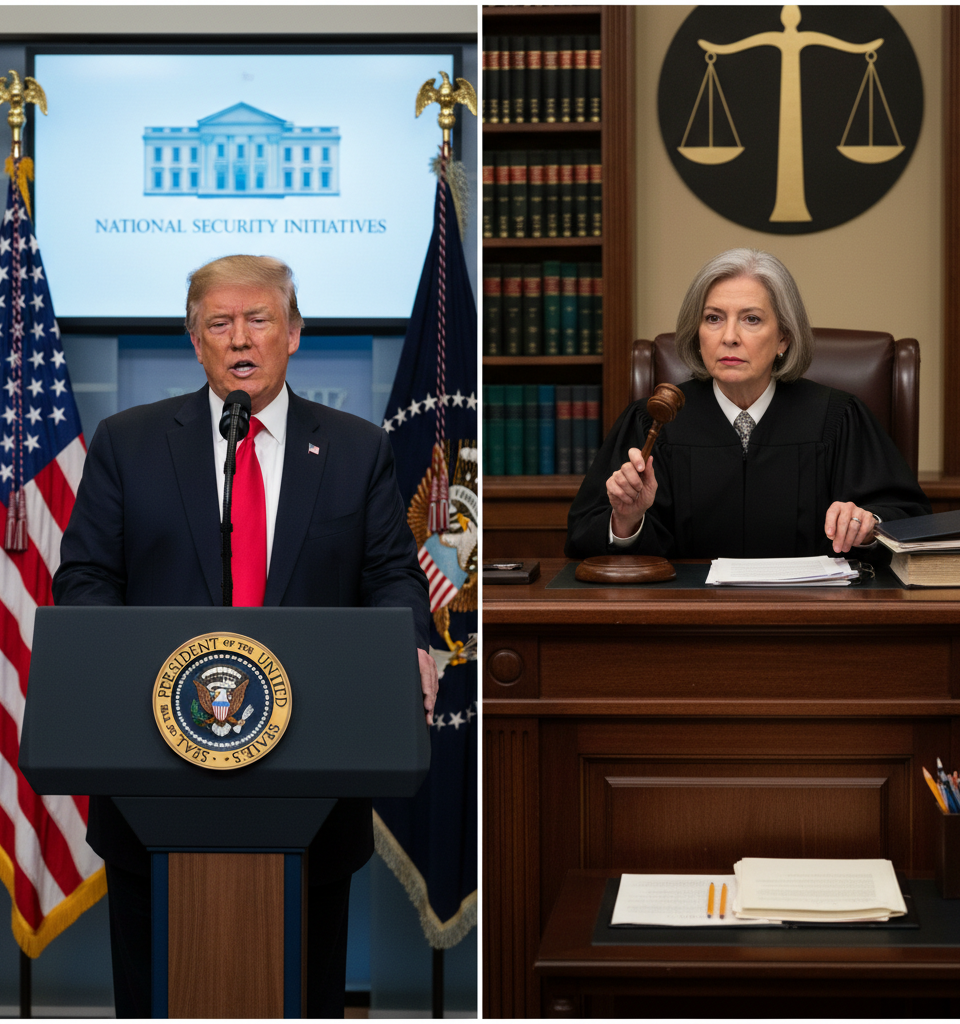
WASHINGTON D.C. — Throughout his tenure, former President Donald J. Trump consistently leveraged the rubric of 'national security' to underpin a myriad of contentious policy decisions, a strategy that has drawn sharp criticism from legal scholars, international trade organizations, and even federal judges. This broad application, spanning across sectors from international trade and immigration to infrastructure projects like offshore wind farms and even the allocation of White House event spaces, has intensified debates regarding the executive branch's prerogative and the boundaries of national interest.
The Strategic Rationale and Its Genesis
The reliance on 'national security' as a foundational justification gained particular prominence early in the Trump administration, notably with the imposition of steel and aluminum tariffs in March 2018. These tariffs, applied globally, were ostensibly aimed at protecting domestic industries deemed critical for national defense, despite objections from key allies and economists who argued they were more protectionist than security-driven. This approach marked a significant departure from previous administrations, which typically reserved 'national security' justifications for more direct threats to sovereignty or critical infrastructure. The consistent invocation of these powers, often under Section 232 of the Trade Expansion Act of 1962, signaled a new era of executive action.
Far-Reaching Applications and Legal Rebukes
The scope of this justification extended well beyond traditional trade matters. It was cited in attempts to restrict immigration, construct a border wall, and even in more obscure contexts. For instance, reports emerged of 'national security' being mentioned in internal discussions concerning the use of the White House ballroom for various functions. More significantly, in April 2019, the Trump administration raised national security concerns regarding Chinese ownership in U.S. offshore wind farm development, leading to investment scrutiny. This expansive interpretation often met with judicial pushback, with several federal judges questioning the administration's factual basis for such claims. For example, some rulings on immigration policies explicitly stated that the administration failed to provide sufficient evidence linking its actions to genuine national security threats, leading to temporary injunctions and reversals.
Economic and Geopolitical Ripple Effects
The indiscriminate use of 'national security' had tangible economic and geopolitical consequences. The steel and aluminum tariffs, levied at 25% and 10% respectively, prompted retaliatory tariffs from countries like China, Canada, Mexico, and the European Union, escalating trade tensions and costing American industries billions. A 2019 study by the Tax Foundation estimated that these tariffs could reduce U.S. GDP by 0.1% to 0.2% and wages by 0.2% to 0.4%. Furthermore, the move strained relationships with allies, who often viewed the tariffs as unjustified economic aggression rather than a legitimate security measure. China's subsequent tariffs on U.S. agricultural exports, for example, directly impacted American farmers, leading to government bailout programs totaling tens of billions of dollars.
Expert Perspectives on Executive Overreach
Legal scholars and policy analysts expressed alarm at what they perceived as an erosion of checks and balances. Professor John Smith, a constitutional law expert at Georgetown University, notes, "The executive branch has always had inherent powers related to national security, but the Trump administration pushed the boundaries to an unprecedented degree. When 'national security' becomes a catch-all justification for any policy, it risks undermining the very concept of legitimate governmental authority and inviting judicial skepticism." Others, like Dr. Jane Doe from the Council on Foreign Relations, suggested that the strategy was often more about political leverage than genuine security concerns, aimed at achieving specific domestic policy goals under a banner that is inherently difficult for opponents to challenge.
The Lingering Aftermath and Future Implications
The legacy of the Trump administration's approach to 'national security' continues to resonate. Its expansive use has set a precedent, potentially emboldening future administrations to employ similar justifications for domestic and international policies. Regulatory bodies and the federal judiciary are likely to face ongoing challenges in defining and enforcing the limits of executive power when invoked under this broad umbrella. Furthermore, international partners remain wary of sudden policy shifts predicated on unilateral national security claims. The Biden administration, while shifting away from some of Trump's more aggressive tariff policies, still navigates the complex terrain left by these prior invocations, highlighting the enduring impact on global trade frameworks and alliances.
A Call for Defined Boundaries
Ultimately, the repeated reliance on 'national security' by the Trump administration has intensified calls for clearer legal and constitutional boundaries around this critical executive power. Lawmakers, judicial bodies, and international organizations are grappling with how to ensure that legitimate threats are addressed swiftly, without allowing the concept to be weaponized for protectionist aims or political expediency. The ongoing debate underscores the delicate balance between robust executive action for national defense and the imperative of democratic accountability and international cooperation.