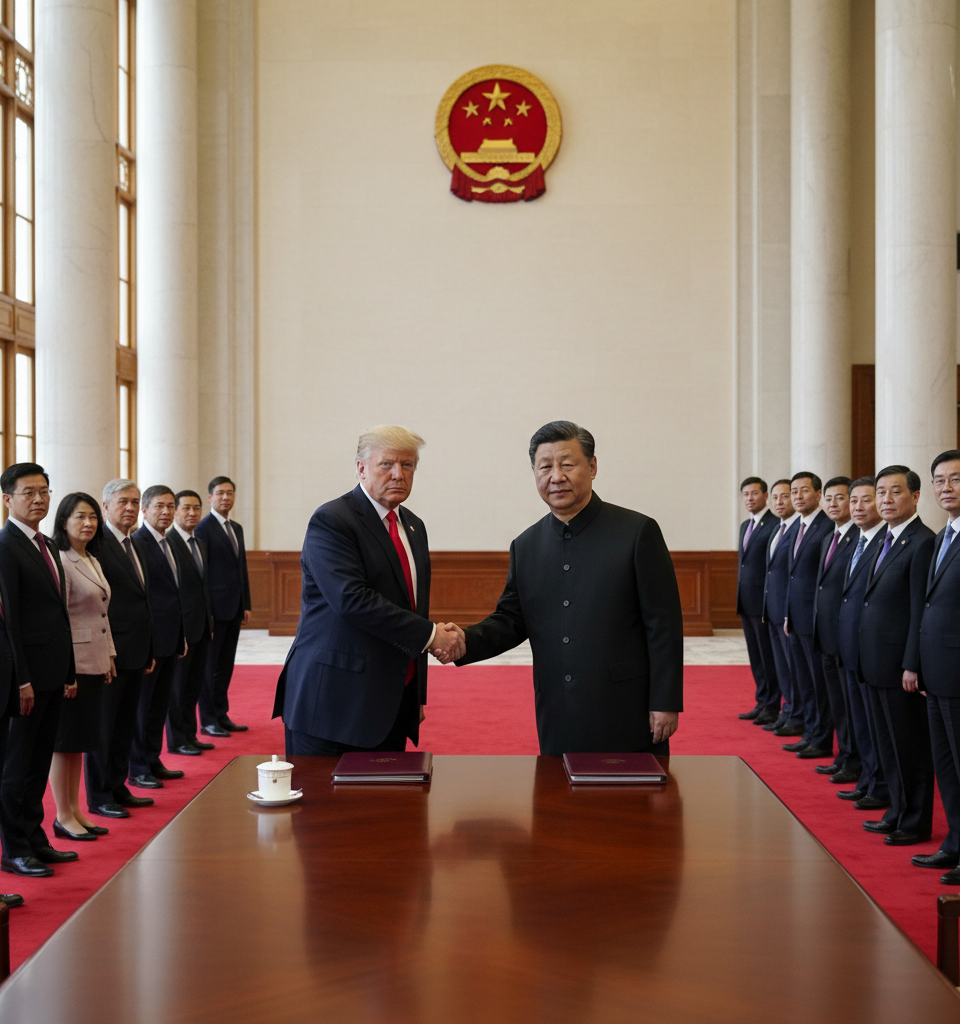
President Donald Trump's much-anticipated state visit to Beijing concluded recently, leaving a trail of warm greetings and elaborate photo opportunities, yet conspicuously lacking any concrete agreements or substantive policy shifts. The trip, framed by Trump as a demonstration of his unique ability to forge a personal connection with Chinese President Xi Jinping, underscores the inherent risks and limitations of a foreign policy approach rooted primarily in the belief that personal charm and force of will can unilaterally drive complex international relations.
The Promise vs. The Reality of 'Friendship'
The absence of tangible progress on critical issues such as trade imbalances, intellectual property theft, or North Korea's nuclear ambitions stands in stark contrast to the administration's initial hopes. Trump repeatedly referred to Xi as a "friend" and praised his leadership, a stark departure from his campaign-era rhetoric. This pivot was intended to create an environment conducive to breakthroughs, an approach that has been a hallmark of his engagement with other world leaders. However, the diplomatic dance in Beijing, while visually impressive, failed to translate into the substantive outcomes sought by American businesses and policymakers. The trip highlighted the fundamental disconnect between personal diplomacy and the deep-seated strategic interests that govern U.S.-China relations, which are often characterized by competition and, at times, confrontation.
Key Issues Remain Unresolved
The U.S. trade deficit with China, a consistent point of contention for the Trump administration, remained largely unaddressed in the form of new commitments. While several business deals totaling over $250 billion were announced, many of these were non-binding memoranda of understanding or previously negotiated agreements rebranded for the visit. Critics quickly pointed out that these deals, while significant in dollar value, did little to address the systemic trade imbalances or market access restrictions faced by American companies. Furthermore, progress on reining in North Korea's nuclear program, a top security priority, also appeared stalled, despite President Trump's insistence on China's crucial role. The lack of a firm joint statement or a clear path forward on these fronts demonstrates the deep-seated complexities that mere personal chemistry cannot overcome.
Implications for Global Trade and Geopolitics
The inconclusive nature of the visit sends mixed signals to global markets and international allies. For businesses operating in or with China, the uncertainty surrounding trade policy continues. The absence of a clear framework for addressing issues like forced technology transfer and intellectual property rights could dampen foreign direct investment and increase operational risks. Geopolitically, the muted outcomes on North Korea could embolden Pyongyang, while U.S. allies in Asia may perceive a weakening of American resolve or a lack of a coherent strategy. The trip did little to assuage concerns that the U.S. is drifting towards an 'America First' isolationism, even as it attempts bilateral engagement with major powers.
Expert Perspectives on Personality-Driven Diplomacy
Analysts have widely critiqued the administration's reliance on a personality-driven foreign policy, particularly concerning a nation as complex as China. Dr. Elizabeth Saunders, a professor of international relations, noted, "While personal relationships can open doors, they rarely resolve core strategic disagreements. China operates on a long-term strategic calculus, not on the whims of a single leader's personal likes or dislikes." Others pointed out that China's Communist Party structure and its highly centralized decision-making process are less susceptible to the kind of ad-hoc deal-making favored by the American president. The perceived lack of preparation or detailed policy proposals prior to the trip also contributed to the limited outcomes, suggesting an overreliance on the president's negotiating prowess alone.
What Lies Ahead for U.S.-China Relations
Looking ahead, the U.S.-China relationship is expected to remain a complex blend of cooperation and competition. Without substantial breakthroughs from the presidential visit, the administration may pivot to more aggressive trade enforcement actions or targeted sanctions, particularly if the trade deficit continues to widen or if North Korea escalates its provocations. The emphasis may shift from high-level personal diplomacy back to working-level negotiations and potentially, increased pressure tactics. The effectiveness of future engagement will likely hinge on whether the administration can pair its diplomatic overtures with a clear, consistent policy framework that addresses the structural issues at the heart of U.S.-China tensions, rather than solely relying on the power of a handshake and a smile.