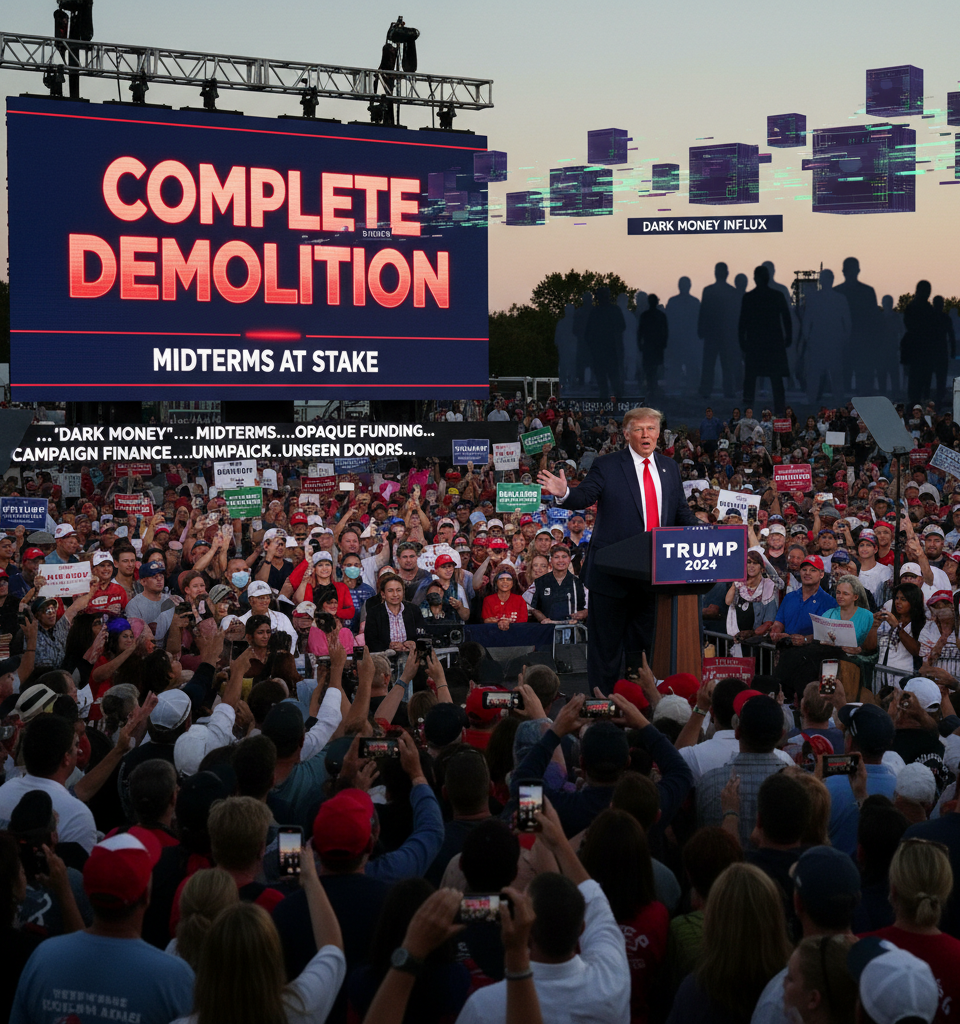
Former U.S. President Donald Trump has escalated political tensions with a cryptic warning of an impending 'complete demolition' set to occur by midnight, a declaration that has sent ripples of speculation through Washington D.C. and beyond. Issued via his social media platform, Truth Social, the statement has been widely interpreted as a veiled threat of significant political revelations or actions just ahead of the critical midterm elections. This highly charged rhetoric unfolds against a backdrop of unprecedented levels of 'dark money' — undisclosed political spending — flowing into key electoral contests, further muddying the waters of an already contentious political landscape.
Context and Background: A Precedent of Electoral Volatility
Trump's latest pronouncement is not an isolated incident but rather fits a pattern of last-minute, high-impact claims preceding significant political events, designed to galvanize his base and sow uncertainty among opponents. The timing, mere days before a nationwide vote that will decide control of Congress, amplifies its potential impact. Historically, such pre-election pronouncements have often been followed by significant media frenzies, irrespective of their substantive basis. Concurrently, the 2022 midterm cycle has witnessed a dramatic increase in non-transparent political spending, eclipsing previous records and drawing sharp criticism from campaign finance watchdogs who argue it undermines democratic accountability.
Key Details: Unveiling the Opaque Financial Landscape
While the specifics of Trump's 'demolition' threat remain deliberately vague, drawing parallels to his 'stop the steal' rhetoric of 2020, the influx of dark money is quantifiable. Non-profit organizations not required to disclose their donors, often termed 'dark money groups,' have reportedly spent upwards of $1.5 billion on federal elections this cycle, a significant portion of which has materialized in the final weeks before Election Day. This represents a nearly 30% increase compared to the 2018 midterms, according to data compiled by OpenSecrets. Key battleground states, including Pennsylvania, Arizona, and Georgia, have seen an outsized share of these undisclosed funds targeting crucial Senate and House races. These expenditures largely come from a mix of politically active 501(c)(4) 'social welfare' groups and 501(c)(6) trade associations, whose primary purpose, under IRS rules, is not political campaigning but which engage heavily in it indirectly.
Industry and Market Impact: Uncertainty and Regulatory Scrutiny
The confluence of politically charged threats and opaque financial flows introduces significant uncertainty into various sectors. Strategists in political consulting and advertising firms are grappling with rapidly shifting narratives and the challenge of countering messages funded by unknown sources. Financial markets, typically averse to political instability, may also react to further escalation or unexpected election outcomes. Furthermore, the sheer volume of dark money signals a growing trend of powerful, undisclosed interests attempting to shape public policy and election results, potentially influencing future legislative agendas on issues ranging from energy to healthcare. This sustained lack of transparency could erode public trust in electoral processes and impact corporate social responsibility movements seeking greater corporate transparency.
Expert Perspective: Erosion of Public Trust and Democratic Norms
Campaign finance experts and political scientists universally highlight the corrosive effect of undisclosed spending. Dr. Evelyn Reed, a senior fellow at the Brennan Center for Justice, stated, "The torrent of dark money essentially allows wealthy donors and corporations to exert influence without public scrutiny. When voters don't know who is funding the messages they see, it fundamentally undermines the principle of an informed electorate and degrades the integrity of our democratic process." Similarly, political analysts suggest that Trump's 'demolition' rhetoric, regardless of its factual basis, serves to deepen partisan divides and foster an environment of distrust, making rational political discourse increasingly difficult.
What's Next: Post-Election Repercussions and Calls for Reform
The immediate aftermath of Trump's deadline will undoubtedly involve intense media scrutiny and political reactions, whether or not a substantive 'demolition' materializes. More broadly, the 2022 midterms' record dark money spending is expected to reignite fierce debates over campaign finance reform. Advocacy groups are likely to intensify calls for greater transparency, including legislation that would mandate disclosure for all political spending. The Federal Election Commission (FEC), often criticized for its gridlock, may face renewed pressure to address the issue. Depending on the election results, the balance of power in Congress could either accelerate or stifle efforts to enact new regulations, setting the stage for ongoing battles over the future of money in politics and the safeguarding of electoral integrity.