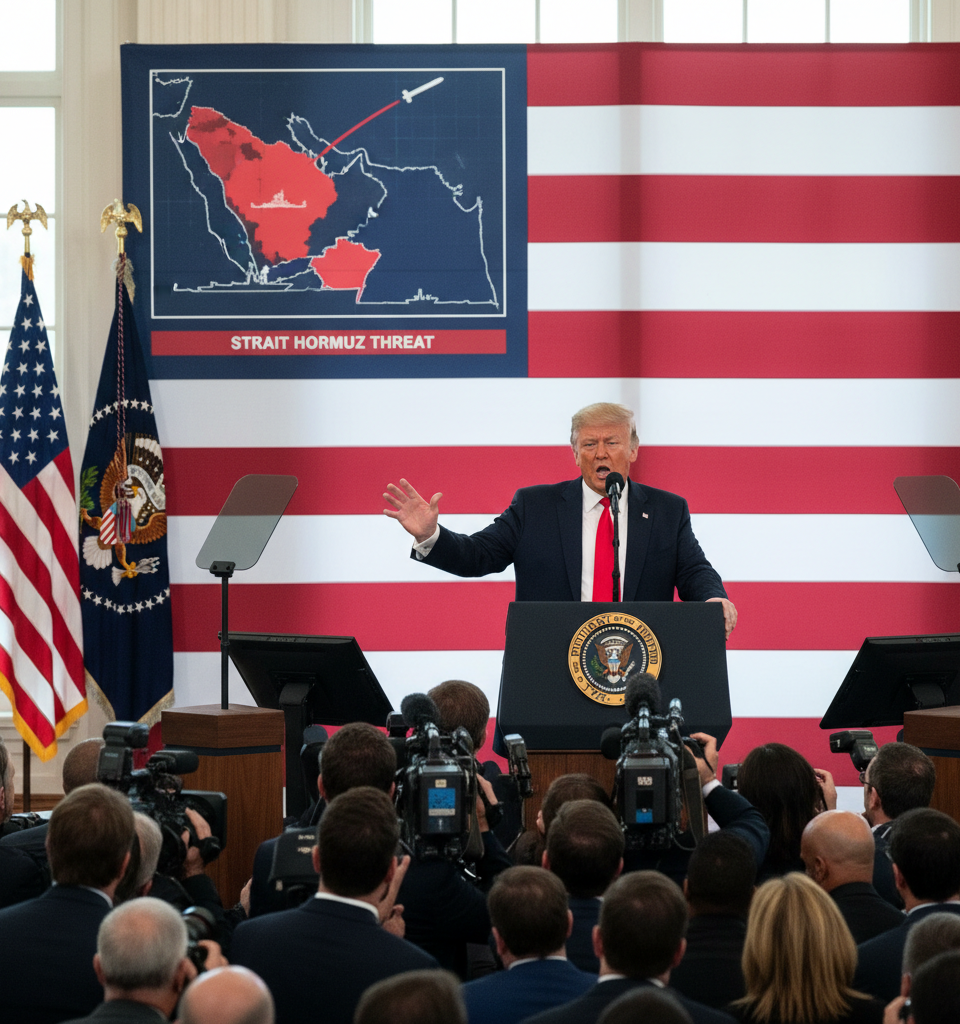
Former President Donald Trump has issued a stark warning to Iran, threatening severe military retaliation, including the bombing of critical infrastructure such as bridges and power plants, should Tehran attempt to close the Strait of Hormuz. The provocative declaration, delivered via a series of expletive-laden social media posts, follows a recent, undisclosed maritime incident that reportedly put American lives at risk. This forceful articulation of 'red lines' injects renewed instability into the delicate balance of power in the Middle East, signaling a potential return to a highly confrontational U.S. foreign policy approach toward the Islamic Republic.
Contextualizing the Enduring US-Iran Standoff
The enduring animosity between the United States and Iran has deep historical roots, marked by decades of intermittent conflict, sanctions, and proxy wars. The Strait of Hormuz, a narrow choke point between the Persian Gulf and the open ocean, is particularly sensitive. Approximately one-fifth of the world's total oil consumption, or about 21 million barrels per day, passes through this waterway, making it a critical artery for global energy markets. Past Iranian threats to close the Strait have invariably triggered international alarm, given the profound economic consequences such an action would entail. This latest declaration from a former, and potentially future, U.S. President harks back to previous periods of heightened tension, notably during Trump's first term when the U.S. withdrew from the Joint Comprehensive Plan of Action (JCPOA) and reimposed crippling sanctions.
Specifics of Trump's Provocative Statements
In his incendiary social media communication, which quickly garnered millions of views and widespread international condemnation, Trump reportedly stated, "If Iran closes the Strait of Hormuz, we will bomb their bridges and power plants into oblivion. Open it up, or suffer consequences you won't believe." While details of the specific maritime incident that reportedly precipitated this strong reaction remain scarce, sources close to the former administration indicate it involved a close encounter between an American vessel and Iranian fast boats in international waters. The use of such direct and aggressive language bypasses traditional diplomatic channels, signaling a preference for overt threats as a primary tool of foreign policy, a hallmark of Trump's previous presidency.
Global Repercussions for Energy and Security
The implications of such a threat, especially concerning the Strait of Hormuz, are immediate and far-reaching for global energy markets and regional security. An actual closure, or even the credible threat of one, would send crude oil prices soaring, potentially triggering an international economic crisis. Shipping insurers would immediately raise premiums, making maritime transport through the region prohibitively expensive. Geopolitically, such an act would likely draw a robust international response, potentially involving a multinational naval force to ensure freedom of navigation. Defense analysts suggest that any military engagement in this vital waterway risks escalating quickly into a broader regional conflict, pulling in various state and non-state actors.
Expert Analysis on Escalation Risks
Foreign policy experts and defense strategists are largely united in their assessment of the extreme risks posed by Trump's rhetoric. Dr. Evelyn Stone, a Middle East security specialist at the Council on Foreign Relations, commented, "Such a direct and non-nuanced threat severely curtails any room for diplomatic de-escalation and pushes both sides closer to a kinetic confrontation. While the U.S. clearly possesses superior military capabilities, the asymmetrical nature of potential Iranian responses, such as mining the Strait or utilizing swarm tactics, presents significant challenges and unpredictable outcomes." Others point to the potential for miscalculation, where a perceived slight or accidental engagement could swiftly ignite a full-scale conflict.
The Unpredictable Path Forward
Looking ahead, the consequences of this escalating rhetoric largely hinge on whether Trump's statements are interpreted as a pre-election posture or a genuine indication of future policy. Should he return to office, this aggressive stance suggests a significant departure from current diplomatic efforts, however strained, to contain Iran's nuclear program and regional activities. The international community will be closely watching for any immediate Iranian response, which could range from rhetorical condemnation to increased military exercises in the Persian Gulf. The ongoing saga underscores the fragility of stability in the Middle East and the profound impact of high-level political declarations on global security and economic prosperity. The specter of military conflict, once a distant possibility, now looms more prominently over the strategic waterway.