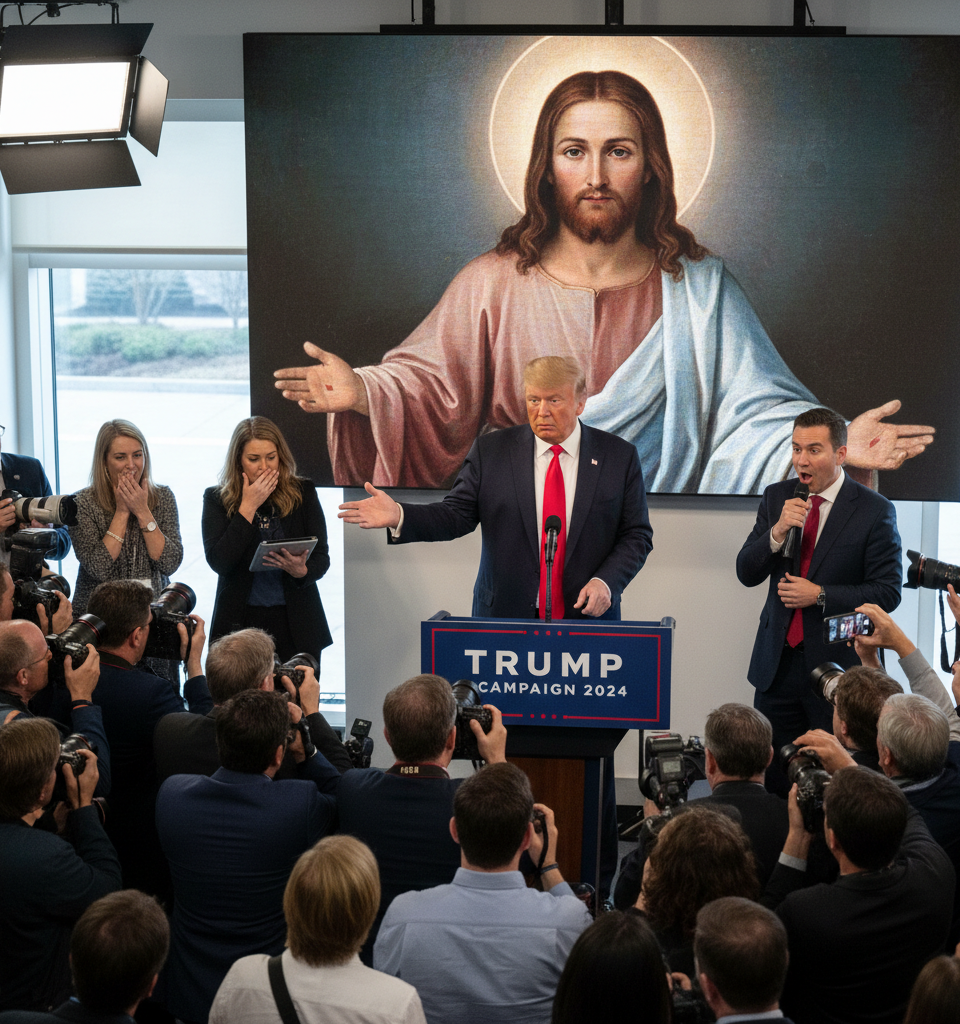
Former President Donald Trump has issued a notable clarification regarding an image that has garnered significant attention, portraying him bathed in divine light and clad in religious robes. Trump's interpretation diverges distinctly from popular perception, asserting that he believed the image depicted him in the role of a doctor, rather than as a figure akin to Jesus Christ.
The image in question, which surfaced and circulated widely across various platforms, presented a dramatically idealized rendition of the former President. It showcased him enveloped in an ethereal glow, draped in vestments that observers largely associated with religious iconography, specifically drawing parallels to traditional depictions of Jesus. This interpretation was widely understood by the public and commentators alike, leading to both critical discussion and viral dissemination.
Unpacking the Image's Origin and Interpretation
The precise origin of the image remains somewhat ambiguous in public discourse, though its visual characteristics suggest a digitally altered or artistically rendered piece rather than a candid photograph. Its rapid spread highlighted the potency of visual communication, particularly in political and cultural spheres, where imagery can quickly become a focal point of discussion, debate, and sometimes, misinterpretation. The divine light and religious robes were central to the prevailing view that the image aimed to cast Trump in a messianic light, a common rhetorical device employed by some of his more ardent supporters.
Trump's personal interpretation, however, introduces a unique dimension to this narrative. His assertion that he perceived the image as showcasing him as a medical professional, rather than a spiritual savior, significantly alters the subtext. This perspective, articulated directly by Trump, underscores a potential disjunction between the creator's intent (or public perception) and the subject's self-understanding or preferred public presentation. Such a discrepancy is not uncommon in the highly stylized and often propagandistic world of political imagery.
Broader Implications for Political Imagery
This incident provides a compelling case study in the subjective nature of visual interpretation, especially within the charged environment of contemporary politics. For supporters, the initial interpretation of Trump as a Christ-like figure might have been a source of inspiration or affirmation, framing him as a redeemer. His counter-explanation could, for some, either temper that specific association or, paradoxically, reinforce a different kind of benevolent, authoritative persona—that of a healer or a problem-solver in a medical context.
From a media and public relations standpoint, Trump's clarification demonstrates an active management of his public image. By re-framing the depiction, he attempts to steer the narrative away from overt religious veneration, which could be polarizing, towards a more practically-oriented role. This move might be seen as an effort to align his image with competence and care, rather than purely spiritual leadership, particularly in an era still grappling with public health issues.
Public Reaction and Future Narratives
The public's reaction to Trump's explanation has been varied, reflecting the deep divisions that often characterize political discourse. Some have found his explanation plausible, viewing it as an attempt to contextualize the image in a less controversial manner. Others have dismissed it as an implausible reinterpretation, suggesting it serves to deflect from what they perceive as an attempt to cultivate a messianic status. The incident contributes to the ongoing narrative surrounding Trump's public persona, which frequently involves grand gestures and unconventional explanations.
Looking ahead, this episode is likely to be referenced in discussions about political branding and the careful, or sometimes deliberately ambiguous, use of imagery in campaigning and public life. It highlights how even seemingly straightforward visual representations can be open to multiple, sometimes conflicting, interpretations depending on the viewer and the context provided by the subject themselves. The interaction between an image and its subject's stated intent will undoubtedly continue to be a fascinating aspect of political communication in the lead-up to future electoral cycles and beyond.