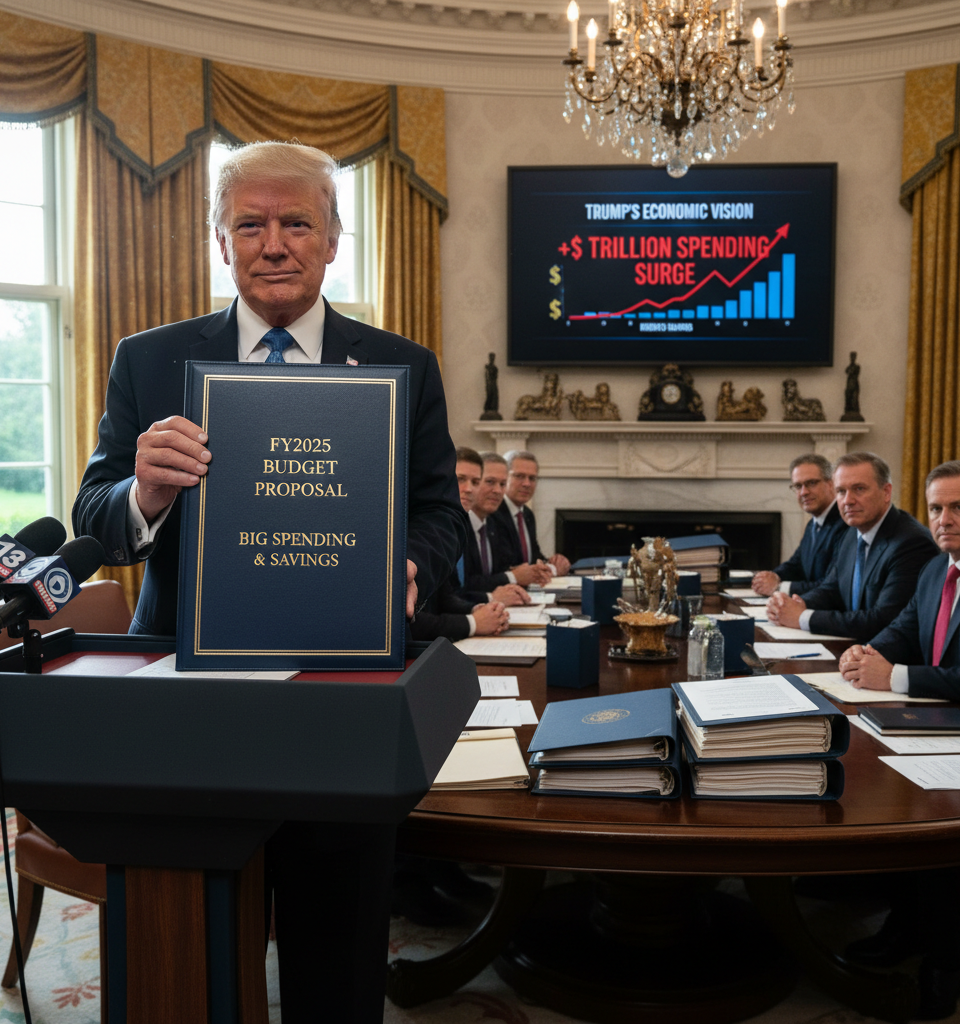
WASHINGTON D.C. – Former President Donald Trump's comprehensive budget proposal for Fiscal Year 2025 (FY2025), released this week, projects a substantial $1 trillion increase in federal spending, raising eyebrows among fiscal conservatives and economists alike. The blueprint, presented amidst a competitive presidential campaign, outlines ambitious plans for various federal programs and initiatives. This significant spending surge stands in stark contrast to previous campaign rhetoric emphasizing fiscal discipline and deficit reduction, with a promised savings initiative, dubbed 'DOGE,' slated to yield a comparatively meager $73 billion.
Unpacking the Fiscal Trajectory
This fiscal unveiling arrives at a pivotal moment, as the United States grapples with a national debt exceeding $34 trillion and persistent inflationary pressures. The proposed $1 trillion expenditure hike, if enacted, would represent a substantial expansion of government outlays. Historically, presidential candidates often present optimistic spending and revenue projections that rarely materialize fully. However, the sheer scale of this proposed increase signals a potential shift in fiscal policy, diverging from the more restrained approaches often championed by Republican administrations. Critics argue that such an increase could exacerbate the national debt and potentially fuel further inflation, while proponents suggest it's necessary to fund critical domestic and defense priorities.
Key Figures and Policy Specifics
The budget document details allocations across numerous sectors, though specific departmental breakdowns were not immediately public. The widely anticipated 'DOGE' savings program, which had been vaguely promoted as a significant source of fiscal relief, is now quantified at a modest $73 billion. This amount pales in comparison to the projected $1 trillion spending increase, representing less than 7.3% of the new proposed expenditures. Analysts are scrutinizing the specific cuts and efficiencies that constitute the 'DOGE' savings, with early indications pointing to administrative streamlining and targeted program reductions rather than overarching entitlement reforms or significant departmental overhauls. The document also suggests increased allocations for defense, infrastructure, and border security, aligning with Trump's stated policy objectives.
Broader Economic and Market Repercussions
The revelation of a $1 trillion spending boost is likely to send ripples through financial markets and provoke significant economic debate. Increased government spending, especially when not offset by commensurate revenue increases, typically raises concerns about rising interest rates, potential crowding out of private investment, and a depreciating dollar. Industries reliant on federal contracts, such as defense and construction, could see a boost, while sectors sensitive to interest rates, like housing, might face headwinds. Investors will be closely watching the bond market for reactions, as increased government borrowing could drive up yields and affect the cost of capital for businesses across the board.
Expert Commentary and Analysis
Economists and fiscal policy experts are offering a range of perspectives. Dr. Evelyn Reed, a senior fellow at the Peterson Institute for International Economics, commented, "A $1 trillion spending increase, especially against a backdrop of already high deficits, is a significant departure. While the details of the 'DOGE' savings are yet to be fully transparent, a $73 billion offset is simply not enough to meaningfully impact the deficit trajectory if such a large spending increase materializes." Others, like Dr. Marcus Thorne of the American Enterprise Institute, suggest that "while the top-line numbers are large, it's crucial to understand where these funds are allocated. Strategic investments in infrastructure or national security, if well-executed, could yield long-term economic benefits, even with an initial spending surge." However, the consensus appears to be that the proposed budget presents substantial fiscal challenges.
The Path Ahead: Congressional Scrutiny and Election Dynamics
As a presidential candidate's proposal, this budget blueprint serves more as a policy vision than an immediate legislative directive. However, its contents will undoubtedly become a significant talking point in the ongoing election campaign. It will face rigorous scrutiny from political opponents, analysts, and the media. Should Trump win the presidency, this proposal would serve as the foundation for his administration's actual budget submissions to Congress. Lawmakers, particularly those concerned with fiscal responsibility, are expected to push for more substantial deficit reduction measures. The interplay between campaign promises, economic realities, and congressional negotiations will shape the ultimate fiscal direction of the nation, with potential impacts on every facet of the American economy. The next few months will see intense debates as markets and voters digest the implications of this ambitious and potentially controversial fiscal plan.