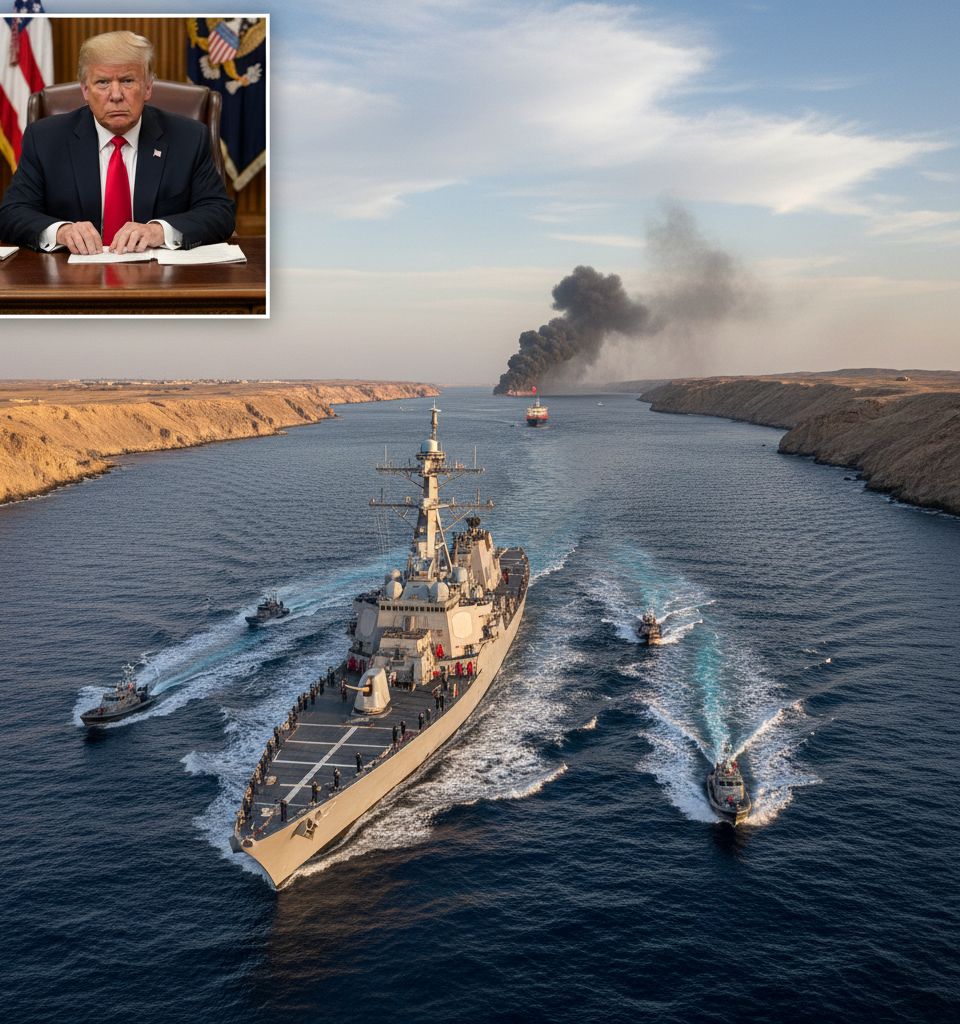
As the clock ticks towards Tuesday's critical deadline, the Trump administration stands poised on the brink of a potentially destabilizing confrontation concerning the Strait of Hormuz. The ultimatum, which demands Iran reopen the vital international shipping lane, places President Donald Trump in a delicate political position, with scant indication that Tehran is prepared to acquiesce. This high-stakes standoff, unfolding in one of the world's most strategic maritime chokepoints, threatens to plunge the global energy markets into turmoil and significantly escalate tensions in an already volatile Middle East.
The current crisis is deeply rooted in last year's unilateral U.S. withdrawal from the Joint Comprehensive Plan of Action (JCPOA), commonly known as the Iran nuclear deal, and the subsequent re-imposition of crippling sanctions. Iran, in response, has increasingly hinted at, and on occasion directly threatened, the closure of the Strait of Hormuz to shipping if its oil exports are stifled. Approximately one-fifth of the world's total oil consumption, translating to roughly 21 million barrels per day, passes through this narrow waterway, making any disruption a catastrophic blow to global supply chains and economic stability. The historical context of past naval skirmishes and regional proxy conflicts further underscores the gravity of the present moment.
The specifics of the U.S. ultimatum remain somewhat opaque to the public, though intelligence briefings suggest it demands an immediate cessation of Iranian naval maneuvers within the Strait and a commitment to unhindered international shipping. Recent satellite imagery analysis, however, reveals increased Iranian Revolutionary Guard Corps (IRGC) patrol boat activity and the deployment of anti-ship missile batteries along the coastline, signals interpreted as a clear defiance of Washington's demands. Diplomatic efforts, reportedly spearheaded by European intermediaries, have thus far failed to broker a de-escalation, leaving the pathway to a peaceful resolution increasingly narrow.
The potential closure or severe disruption of the Strait of Hormuz would send immediate and severe shockwaves through the global economy, particularly the energy sector. Oil prices, currently trading around $70 per barrel for Brent crude, could skyrocket by 30-50% within days, according to analysts at Goldman Sachs. Such a surge would trigger a global recession, severely impacting industries reliant on oil, from manufacturing and transportation to petrochemicals. Shipping insurance premiums have already seen increases of 15-20% for vessels traversing the contentious waters, reflecting the heightened risk environment and directly impacting global trade costs.
Experts and geopolitical analysts are deeply divided on the likely outcomes. Dr. Eleanor Vance, a senior fellow at the Council on Foreign Relations, notes, "The strategic ambiguity exercised by both sides creates a dangerous environment where miscalculation is a significant risk. Iran understands the economic leverage of Hormuz, while the U.S. cannot afford to be seen as backing down, particularly in an election year." Conversely, some defense strategists suggest that Iran's threats are primarily rhetorical, aimed at gaining negotiating leverage rather than provoking a direct military confrontation, which would be devastating for its own economy and military.
Looking ahead, the immediate aftermath of Tuesday's deadline will be critical. Should Iran remain defiant, the U.S. could escalate its naval presence in the region, potentially implementing a naval escort program for commercial tankers or even considering targeted sanctions on Iranian entities attempting to hinder shipping. The possibility of limited military engagements cannot be entirely ruled out, though both Washington and Tehran have expressed a desire to avoid outright conflict. International bodies, including the United Nations Security Council, are reportedly preparing contingency plans for a rapid response, though their influence is heavily constrained by the deep divisions among permanent members regarding Iran policy. The coming days will undoubtedly shape the diplomatic and economic landscape of the Middle East and beyond for years to come.
Economic Fallout and Global Supply Chain Disruption
Beyond oil price volatility, a Hormuz crisis would unleash a cascade of economic disruptions. Major Asian economies, particularly China, Japan, and South Korea, which are heavily reliant on Middle Eastern oil imports, would face severe energy shortages. Global maritime trade routes would be forced to seek costly and time-consuming alternative paths, such as the Suez Canal or the Cape of Good Hope, adding significant delays and increasing freight costs for goods ranging from consumer electronics to industrial raw materials. The ripple effect on global supply chains could lead to widespread inflation and a contraction of economic activity projected to reduce global GDP by an estimated 1.5% in the short term, according to a recent report by the International Monetary Fund.
Diplomatic Tightrope and Regional Alliances
The crisis places immense pressure on diplomatic efforts. European powers, notably France, Germany, and the UK, have been engaged in intense backchannel negotiations, attempting to salvage remnants of the JCPOA and de-escalate tensions. Their efforts are complicated by the U.S.'s 'maximum pressure' campaign, which leaves little room for concessions to Iran. Regionally, the situation is further exacerbated by the deep mistrust between Iran and its Sunni Arab rivals, particularly Saudi Arabia and the UAE. Any military action or perceived infringement on shipping rights could easily draw these regional players into a broader conflict, potentially transforming a localized standoff into a full-scale regional confrontation.