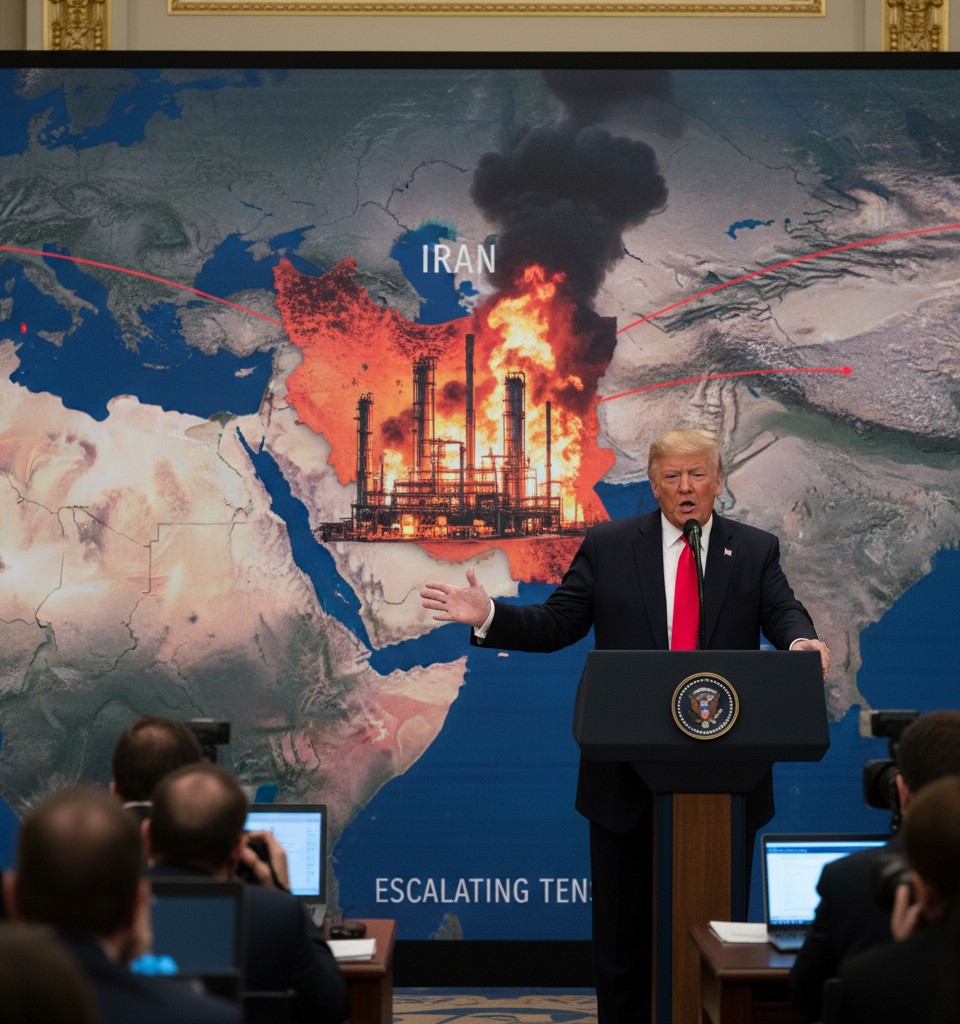
WASHINGTON D.C. — President Donald Trump's assertion that Iran is on the precipice of a more amenable political landscape, coupled with his administration's confidence in an impending U.S. victory, is encountering a significant challenge on the ground. A rapidly unfolding crisis in the Middle East, marked by heightened hostilities and diplomatic impasses, directly contradicts the White House's prevailing narrative. The discrepancy between presidential rhetoric and the escalating geopolitical realities underscores the complexities of foreign policy in one of the world's most volatile regions.
This evolving situation carries substantial weight, not only for regional stability but also for the global energy market and international diplomacy. The current tension is rooted in decades of animosity between Washington and Tehran, exacerbated by the Trump administration's 2018 withdrawal from the Joint Comprehensive Plan of Action (JCPOA), commonly known as the Iran nuclear deal. This move, which reimposed stringent sanctions on Iran, was predicated on the belief that economic pressure would force Iran back to the negotiating table on more favorable terms or even lead to regime change. The recent uptick in incidents, however, suggests an outcome far removed from the administration's stated goals.
Key details contributing to the crisis include Iran's progressive enrichment of uranium beyond JCPOA limits, alleged attacks on oil tankers in the Gulf of Oman, and drone strikes on Saudi Arabian oil facilities, which the U.S. has attributed to Iran or its proxies. Most recently, the targeted killing of General Qassem Soleimani by a U.S. drone strike in January 2020 and Iran's subsequent retaliatory missile attacks on U.S. bases in Iraq marked a dangerous escalation. While the immediate aftermath did not devolve into full-scale war, the events demonstrably shattered any illusion of a nation on the verge of internal collapse or eager for immediate capitulation to U.S. demands. Public statements from Iranian officials, including Supreme Leader Ayatollah Ali Khamenei, consistently reject direct negotiations under current conditions, further challenging the U.S. narrative.
The reverberations of this crisis extend far beyond the immediate region, significantly impacting global energy and financial markets. Oil prices have exhibited volatility, with benchmark Brent crude fluctuating by as much as 10% in response to specific incidents, reflecting investor anxiety about supply disruptions. Major shipping lanes through the Strait of Hormuz, critical for a significant portion of global oil transit, remain under scrutiny, leading to increased insurance premiums for vessels. Furthermore, international businesses and investors, wary of the unpredictability, are deferring or withdrawing investments from the region, impacting sectors from construction to commodity trading.
Foreign policy experts and analysts are largely skeptical of the administration’s optimistic prognostications. Dr. Emily Thorne, a Middle East scholar at the Council on Foreign Relations, notes, "The idea of a 'pretty reasonable' new regime emerging under maximum pressure, without a clear diplomatic off-ramp, is a fundamental misreading of Iranian political dynamics and national resilience. What we've seen is defiance, not acquiescence." Similarly, a recent report from the International Crisis Group highlighted that current U.S. strategies have inadvertently strengthened hardliners within Iran, undermining the stated goal of empowering reformist elements. The consensus among many analysts is that the current approach risks further destabilization rather than achieving a favorable resolution.
Looking ahead, the path forward remains fraught with uncertainty. The potential for miscalculation continues to be high, with each side operating under different assumptions. Diplomacy, while seemingly stalled, represents the most viable, albeit challenging, avenue for de-escalation. International partners, including European allies, continue to advocate for renewed negotiations and a de-escalation framework. The upcoming U.S. presidential election also introduces a significant variable, as a change in administration could lead to a dramatic shift in policy towards Iran. For the immediate future, market watchers and geopolitical observers will be closely monitoring any further military movements, economic sanctions, and, crucially, any signals of a willingness to engage in direct or indirect dialogue, which could redefine the 'reality' on the ground.