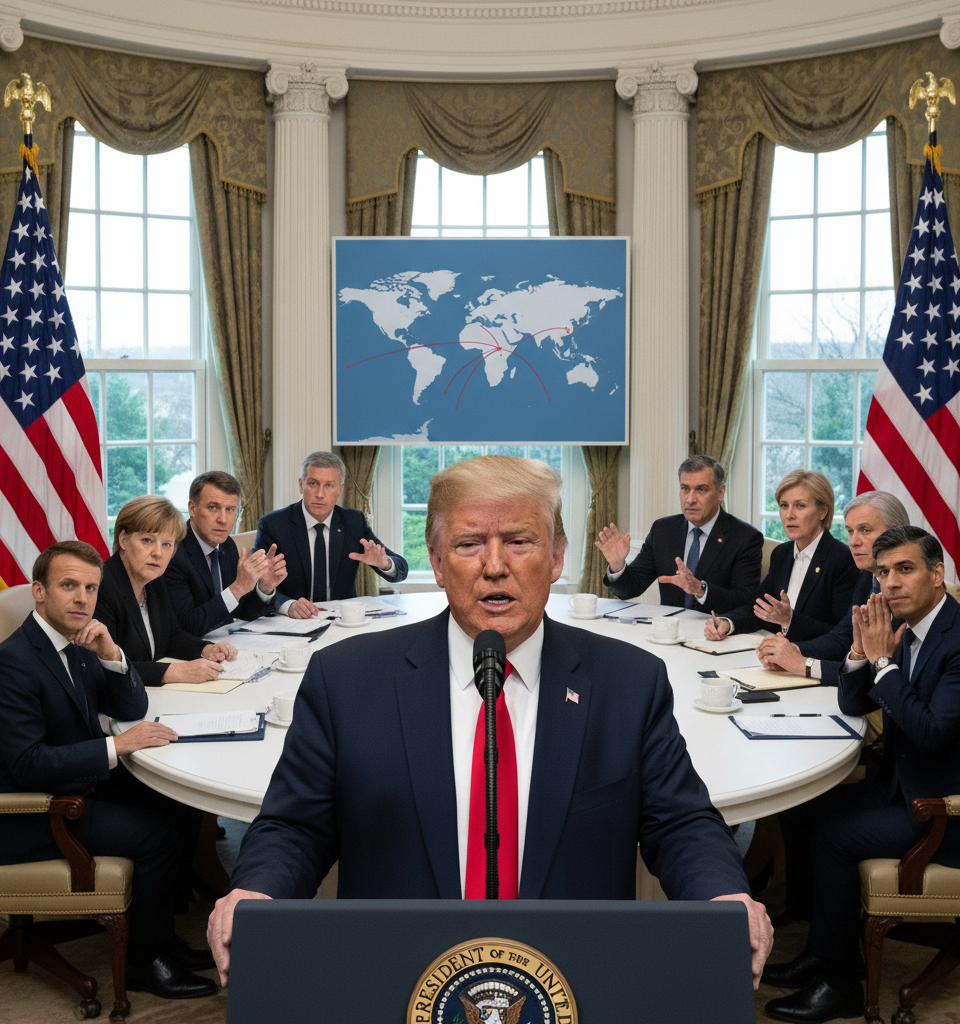
WASHINGTON D.C. – President Donald Trump's increasingly bellicose and often contradictory statements concerning Iran have plunged global diplomacy into a state of acute uncertainty, unsettling world leaders and defense strategists alike. The White House's fluctuating narrative, often delivered via social media, has created an environment of profound instability, leaving international allies and adversaries struggling to anticipate the next move in an escalating geopolitical drama that risks broader regional conflict.
A History of Escalation and Misdirection
This current state of unease is a culmination of years of escalating tensions, exacerbated by the Trump administration's 2018 withdrawal from the Joint Comprehensive Plan of Action (JCPOA), commonly known as the Iran nuclear deal. That decision, met with widespread international condemnation, dismantled a carefully constructed framework designed to curb Iran's nuclear ambitions. Since then, a series of punitive sanctions, drone attacks, and naval incidents have pushed the U.S. and Iran to the brink, with world powers like France, Germany, and the United Kingdom desperately attempting to mediate, often finding their efforts undermined by surprise pronouncements from Washington.
Unpredictable Threats and Diplomatic Dead Ends
Recent statements from President Trump illustrate this unpredictability starkly. One day, he might tweet a threat of "total obliteration" against Iran should it attack American interests, only to suggest days later that he is open to unconditional dialogue. This stark contrast in rhetoric, often within a 48-hour window, has sent shockwaves through the diplomatic community. European Union foreign policy chief Josep Borrell recently expressed his "profound concern" over the situation, noting that "the lack of a clear, consistent message from the highest levels of the U.S. government makes any de-escalation effort extraordinarily difficult." U.S. intelligence assessments typically characterize Iran's nuclear program as dormant for weapons development since 2003, a finding sometimes at odds with the administration's public narrative.
Global Markets and Energy Security on Edge
The ripple effects of this instability are keenly felt across global financial markets, particularly in the energy sector. Oil prices have seen significant fluctuations, with benchmarks like Brent Crude experiencing swings of up to 5% in response to perceived increases or decreases in Middle East tensions. Major shipping companies are rethinking routes through the Strait of Hormuz, a critical chokepoint for roughly 20% of the world's oil supply, leading to increased insurance premiums and logistical challenges. The prospect of even a limited conflict in the region could trigger a substantial spike in energy costs, potentially derailing an already fragile global economic recovery.
Expert Analysis: A Dangerous Game of Chicken
Foreign policy experts are largely united in their alarm. Dr. Sarah Miller, a senior fellow at the Council on Foreign Relations, describes the situation as a "dangerous game of chicken, where neither side fully understands the other's red lines." She adds, "The absence of a consistent backchannel or a clear diplomatic off-ramp, coupled with the U.S. administration's willingness to employ maximum pressure tactics, significantly raises the risk of miscalculation leading to accidental conflict." Analysts at Fitch Ratings recently reaffirmed their negative outlook for stability in the Persian Gulf, citing the ongoing U.S.-Iran standoff as a primary factor.
The Path Forward: Diplomacy or Deterioration?
The immediate future remains fraught with peril. International efforts, spearheaded by European powers, continue to focus on reviving a dialogue that could lead to de-escalation. However, Iran's insistence on sanctions relief as a precondition for talks, and the U.S.'s demand for broader concessions on its missile program and regional influence, present substantial hurdles. Without a clear and unified diplomatic strategy from the international community, and a more coherent approach from Washington, the world watches anxiously, bracing for potential further provocations and the ever-present threat of military confrontation in one of the world's most volatile regions.