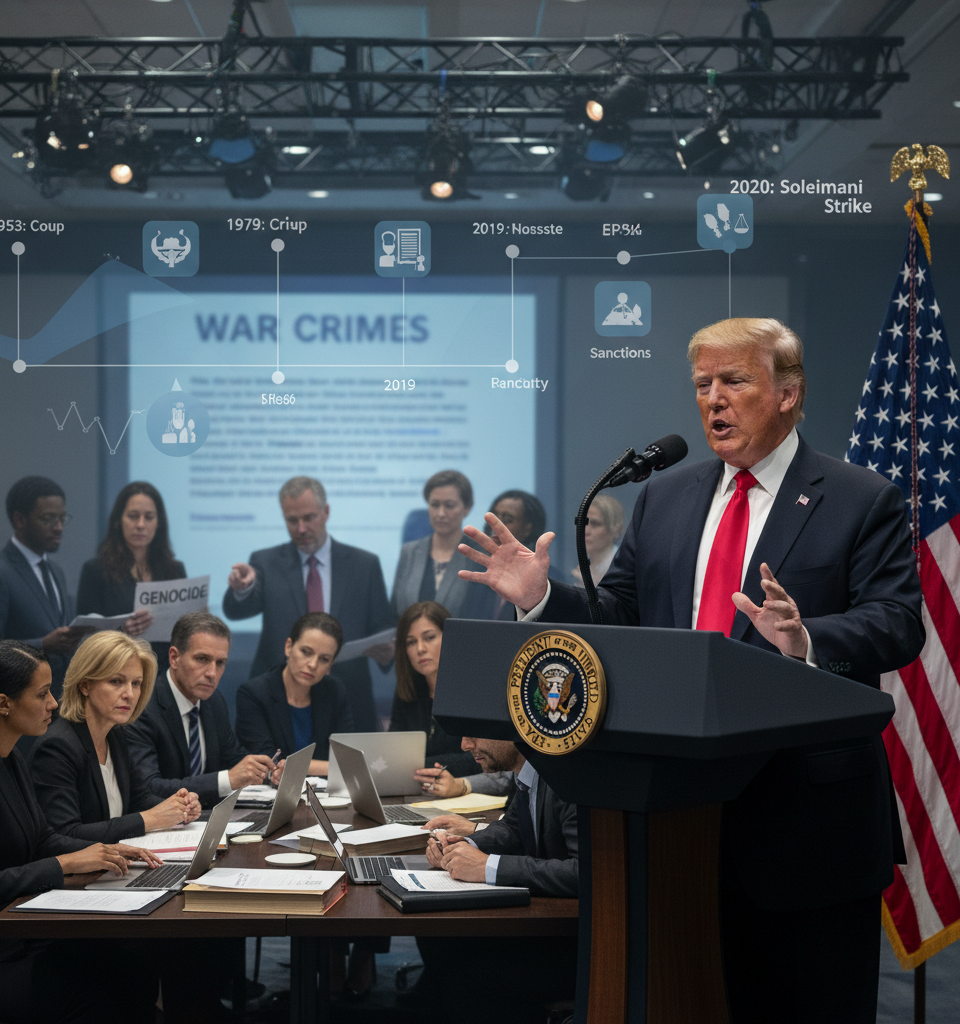
Washington D.C. – Former President Donald Trump's incendiary declarations regarding potential military action against Iran, which included explicit threats to obliterate civilian infrastructure and effectively annihilate the nation's civilization, have ignited a fierce debate among international legal scholars and human rights advocates. Critics contend that these statements, delivered during a period of heightened geopolitical tension, could inadvertently serve as direct evidence of an intent to commit war crimes, a grave violation under international humanitarian law. The remarks have triggered widespread condemnation and intensified calls for rigorous examination of the boundaries of executive power and the potential for accountability on the global stage.
Contextualizing the Controversy: A Dangerous Precedent
This controversy arises against a backdrop of decades of fraught relations between the United States and Iran, marked by sanctions, proxy conflicts, and periods of near-direct confrontation. Trump's past actions, including the unilateral withdrawal from the Iran nuclear deal (JCPOA) in 2018 and the targeted killing of General Qasem Soleimani in 2020, have consistently ratcheted up tensions. The current rhetoric transcends mere diplomatic bluster, however, by appearing to cross a critical line under the Geneva Conventions and other international legal frameworks that strictly prohibit the deliberate targeting of civilian populations and infrastructure. This escalation in language sets a dangerous precedent, potentially emboldening other state actors to disregard established norms of warfare.
The Specifics: Threats and Legal Ramifications
Trump's statements, made during public appearances and social media posts, were alarmingly explicit. He vowed that if Iran were to retaliate against U.S. interests, the response would involve striking “52 Iranian sites, some at a very high level & important to Iran & the Iranian culture.” Furthermore, his pledge to “systematically destroy” Iran’s civilian infrastructure and “annihilate” its civilization implies an intent that directly contravenes Article 51(2) of Protocol I to the Geneva Conventions, which states that “the civilian population as such, as well as individual civilians, shall not be the object of attack.” Legal analysts emphasize that such declarations, even if not immediately acted upon, can be interpreted as mens rea (criminal intent) in the context of international criminal law, should any such actions ever be pursued.
Geopolitical Ramifications and Market Instability
Beyond the legal battle, such bellicose statements carry significant geopolitical ramifications. They risk destabilizing an already volatile Middle East, potentially deterring diplomatic solutions and exacerbating regional conflicts. Economically, the rhetoric sends chills through global markets, particularly the oil sector. During previous periods of heightened U.S.-Iran tension, oil prices have seen spikes of 5-10% in a single day, reflecting fears of supply disruptions from a region responsible for approximately 25% of the world's crude oil production. Defense stocks too often see a temporary uplift, while broader equity markets exhibit increased volatility as investors shy away from perceived risk.
Expert Analysis: A Clear Violation of International Law
Professor Mary Ellen O'Connell, a recognized authority on international law at the University of Notre Dame, commented, “The explicit targeting of cultural sites and civilian infrastructure is a clear violation of international humanitarian law. When a head of state articulates such intentions, it creates a public record that could be used as evidence in future war crimes proceedings, whether at the International Criminal Court or potentially in domestic courts under universal jurisdiction principles.” Similarly, Human Rights Watch has unequivocally stated that any attack on cultural sites or civilian populations constitutes a war crime, reinforcing the view that Trump’s remarks are deeply problematic from a legal standpoint.
The Path Forward: Accountability and Deterrence
The long-term implications of these statements are multifaceted. Should any conflict emerge in the future that involves the targeting of civilian sites, these historical remarks would undoubtedly feature prominently in any subsequent investigations or prosecutions. The international community, through bodies like the United Nations and the International Criminal Court, faces the challenge of upholding international legal norms against such rhetoric. The pressure will be on these institutions to signal that such threats will not be tolerated, thereby attempting to deter future leaders from making similar pronouncements and reinforcing the foundational principles of humane conduct during conflict.
Lingering Questions on Presidential Conduct
The debate also reignites questions about the scope of presidential immunity and accountability for actions and statements made while in office, or aspiring to office. As the U.S. grapples with its role on the global stage, the shadow cast by Trump’s Iran threats serves as a stark reminder of the ethical and legal boundaries surrounding military engagement and the profound responsibility of leaders to adhere to international law, even in the face of perceived adversaries. The potential for these statements to be used as self-incriminating evidence underscores the gravity of presidential rhetoric and the enduring principles of justice and human rights that underpin the international order.
The Role of Domestic and International Courts
The legal ramifications extend to both domestic courts, through principles of universal jurisdiction allowing prosecution of war crimes regardless of where they were committed, and international bodies like the International Criminal Court (ICC). While the U.S. is not a signatory to the Rome Statute that established the ICC, its citizens could still face scrutiny if allegations are brought by other states or through UN Security Council referrals. This legal ambiguity adds another layer of complexity to the issue, highlighting the interconnectedness of national and international legal frameworks in addressing potential war crimes.
A Precedent for Future Leaders
The enduring impact of these threats will likely serve as a cautionary tale for future leaders. The scrutiny applied to Donald Trump's remarks sets a precedent for how presidential rhetoric on military action will be analyzed under international law. It reinforces the notion that words, particularly from those in positions of extreme power, carry significant legal weight and can have lasting consequences, not only for geopolitical stability but also for individual accountability in the pursuit of justice for war crimes. The global community remains vigilant, underscoring the critical importance of adhering to the rule of law in all conflicts.