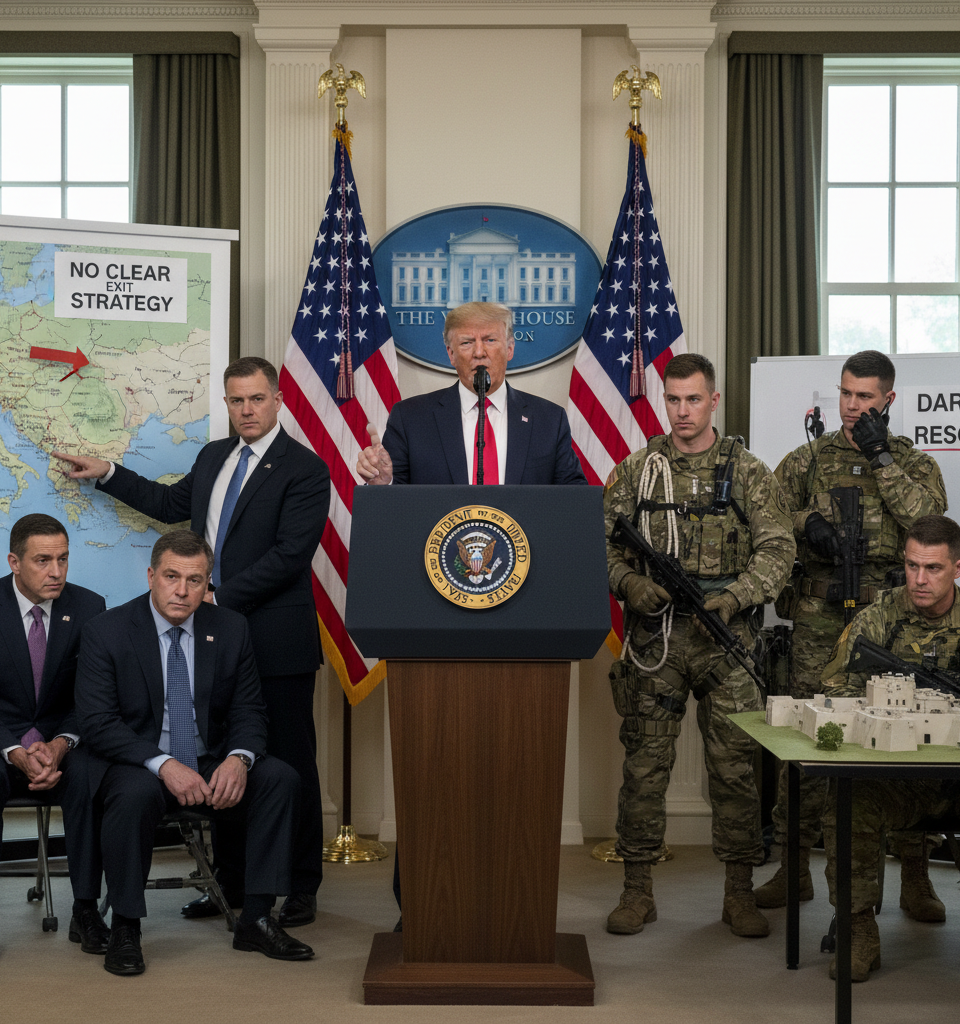
President Donald Trump held a pivotal news conference today, primarily addressing the escalating tensions with Iran, yet largely sidestepping a clear strategic pathway out of the ongoing conflict. The event, held in the East Room of the White House, saw the President recount a dramatic, high-risk mission to rescue an Air Force colonel whose F-16 fighter jet had been downed in a hostile territory. While the heroic narrative of the rescue captivated national attention, it also underscored a critical deficiency in the administration's articulated strategy for long-term peace and stability in the Persian Gulf region.
The Geopolitical Chessboard: A Legacy of Tension
This latest engagement with Iran comes against a backdrop of decades of complex and often adversarial relations between Washington and Tehran. The current heightened state of alert follows a series of destabilizing events, including the assassination of top Iranian General Qassem Soleimani and retaliatory missile strikes against U.S. bases in Iraq. The withdrawal from the Joint Comprehensive Plan of Action (JCPOA) in 2018, often referred to as the Iran nuclear deal, by the Trump administration, is widely cited by international observers as a key catalyst for the current precarious situation. This withdrawal reinstated crippling sanctions on Iran's economy, particularly its vital oil sector, leading to a tit-for-tat escalation that has brought both nations to the brink of open conflict.
The Rescue Mission: A Calculated Risk
The centerpiece of President Trump's address was the detailed account of the special forces operation to retrieve Air Force Colonel Michael J. Miller. Reportedly, Colonel Miller's F-16 was shot down by Iranian-backed militia SA-2 anti-aircraft missiles over western Iraq, a claim disputed by some independent military analysts who suggest a mechanical failure might have been the cause. The President lauded the bravery of the special operations forces, emphasizing the successful extraction under intense pressure and hostile conditions. This narrative, while showcasing American military prowess, served to underscore the immediate, life-or-death stakes of operating in the region without offering a long-term diplomatic solution.
Economic Repercussions and Global Markets
The persistent uncertainty surrounding U.S.-Iran relations continues to send ripples through global financial markets, particularly the energy sector. Oil prices, which saw an initial surge following the assassination of Soleimani, have remained volatile, with Brent crude fluctuating between $60 and $70 per barrel in recent weeks. Shipping lanes through the Strait of Hormuz, a critical chokepoint for global oil supply, remain a significant concern for international trade. Analysts from JPMorgan Chase estimate that a full-scale conflict could see oil prices spike to over $100 per barrel, leading to substantial global economic disruption and potentially triggering a recession in multiple industrialized nations.
Expert Dissolution: A Strategy Vacuum?
Security experts and foreign policy analysts have largely expressed bewilderment at the administration's apparent lack of a coherent long-term strategy for Iran. Dr. Evelyn Farkas, a former Deputy Assistant Secretary of Defense for Russia, Ukraine, and Eurasia, noted in a recent televised interview, "While the immediate rescue operation was a success, the President failed to articulate any substantive plan beyond military deterrence. There's no clear diplomatic off-ramp, which risks an accidental escalation." Similar sentiments were echoed by Dr. Vali Nasr, a professor of international affairs at Johns Hopkins University, who highlighted the absence of any indications of back-channel negotiations or proposals for de-escalation.
The Uncharted Path Ahead: Diplomacy or Further Confrontation?
As the immediate crisis surrounding the downed pilot appears to have been averted, the broader question of the U.S. strategy toward Iran remains unanswered. Future developments are likely to hinge on a combination of factors: the endurance of current sanctions, any potential shifts in Iran's nuclear enrichment activities, and the upcoming U.S. presidential election. Without a clear diplomatic initiative, the risk of further military encounters remains high. Observers will be closely watching for any signs of overtures from either side, or conversely, further provocative actions that could plunge the region into a wider, more devastating conflict, with significant humanitarian and economic consequences globally. The international community continues to press for de-escalation and a return to diplomatic engagement to find a sustainable resolution to this intractable geopolitical challenge.