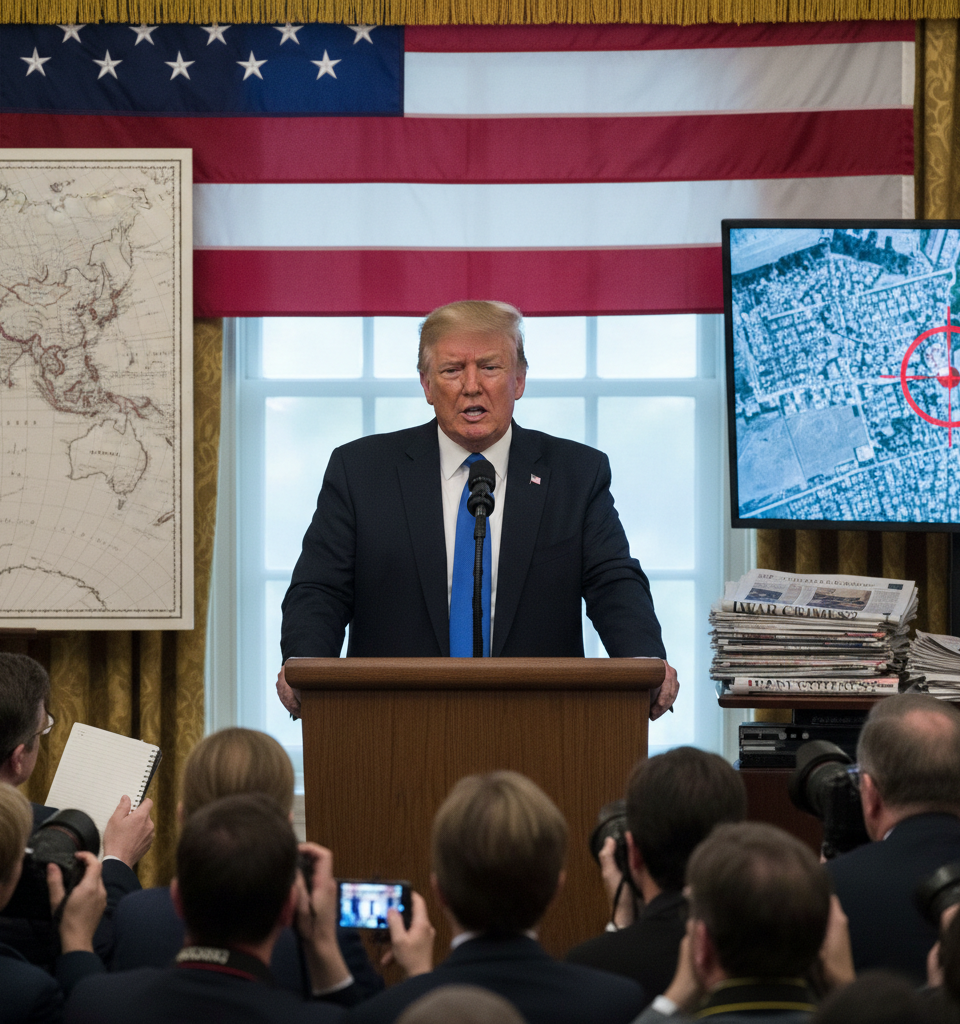
President Donald Trump's recent pronouncements regarding potential military actions against Iran, notably his public threats to target cultural sites, have precipitated a significant international outcry and reignited critical discussions surrounding the definition and enforcement of illegal conduct in warfare. These remarks, delivered via social media and presidential addresses in early January, directly contradict long-standing international humanitarian law, specifically the Geneva Conventions and the 1954 Hague Convention for the Protection of Cultural Property in the Event of Armed Conflict, which explicitly prohibit the targeting of non-military sites and civilians. The implications of such statements are profound, challenging the foundational principles of modern warfare and placing the United States under intense global scrutiny regarding its adherence to established norms.
A History of Ambiguity: US Stance on Civilian Protection
This isn't the first instance where the United States' interpretation of civilian targeting has been a point of contention. While officially endorsing international law, past U.S. military operations, particularly in regions like Iraq and Afghanistan, have featured disputes over what constitutes a legitimate military target versus what falls under civilian infrastructure. The U.S. has historically sought a degree of leeway in defining 'dual-use' targets – facilities with both civilian and potential military applications – and has faced criticism from human rights organizations regarding collateral damage. Trump's explicit mention of cultural sites, however, marks a stark departure from even these nuanced interpretations, pushing the boundaries into territory widely considered unambiguous war crimes. This current controversy underscores a persistent tension between military objectives and humanitarian obligations that has plagued international conflict for decades.
International Law vs. Presidential Rhetoric: Key Details Unpacked
The core of the controversy lies in the stark contrast between President Trump's rhetoric and codified international law. Article 53 of Protocol I of the Geneva Conventions explicitly states that "it is prohibited to commit any acts of hostility directed against the historical monuments, works of art or places of worship which constitute the cultural or spiritual heritage of peoples." Similarly, the 1954 Hague Convention, to which the U.S. is a signatory, forbids attacking cultural property. Trump's statement on January 4th, asserting that the U.S. had identified "52 Iranian sites, some at a very high level & important to Iran & the Iranian culture," with the warning that "those targets, & Iran itself, WILL BE HIT VERY FAST AND VERY HARD," drew immediate condemnation. Experts such as Agnes Callamard, UN Special Rapporteur on extrajudicial executions, unequivocally labeled such actions as "war crimes." Critics argue that such threats not only undermine international legal frameworks but also serve as a propaganda victory for adversaries and diminish America's moral standing.
Geopolitical Instability and Market Reactions
The President's aggressive posturing has sent ripples through global geopolitical landscapes and financial markets. The escalating tensions in the Persian Gulf region, exacerbated by these threats, have led to heightened volatility in the oil market, with crude oil prices seeing approximately a 4% increase in the immediate aftermath of the initial threats as investors priced in geopolitical risk. Defense contractors, conversely, often see a temporary uplift in stock values during periods of heightened conflict. Beyond immediate market shifts, there is a broader concern that such rhetoric erodes international trust and cooperation, potentially isolating the U.S. on critical global issues, especially with key European allies who are often more vocal in their defense of international humanitarian law. This instability creates an unpredictable environment for international trade and investment.
Expert Consensus: A Dangerous Precedent
Legal scholars and international relations experts are largely in agreement that targeting cultural sites or civilians constitutes a war crime. "These are not grey areas of international law," stated a prominent international law professor at a recent foreign policy conference. "The prohibition against targeting cultural heritage and civilian populations is absolute." Many analysts emphasize that even the threat of such actions can be damaging, as it normalizes discourse around illegal conduct and could potentially embolden other states to disregard established norms. The consensus is that upholding the rule of law in conflict is not merely a moral imperative but a strategic one, preventing a descent into unbridled brutality that ultimately damages all parties involved and undermines the global security architecture.
The Unfolding Narrative: Future Implications and Diplomacy's Role
The immediate future of U.S.-Iran relations remains highly uncertain. While subsequent statements from U.S. officials have attempted to walk back or clarify President Trump's initial threats, emphasizing adherence to laws of armed conflict, the initial remarks have already been etched into the diplomatic record. The international community will closely monitor any future U.S. military actions in the region, with heightened scrutiny on targeting protocols. The episode also underscores the critical role of diplomacy and clear communication in de-escalating tensions, rather than heightening them through potentially illegal threats. The balance between deterrence and adherence to international law will continue to be a defining challenge for U.S. foreign policy, with significant implications for global stability and the future of armed conflict.
Ultimately, this event serves as a potent reminder of the fragility of international norms and the constant need for vigilance in upholding the principles of ethical conduct in warfare. The debate will undoubtedly continue, shaping perceptions of American leadership and its commitment to the rules-based international order for years to come.