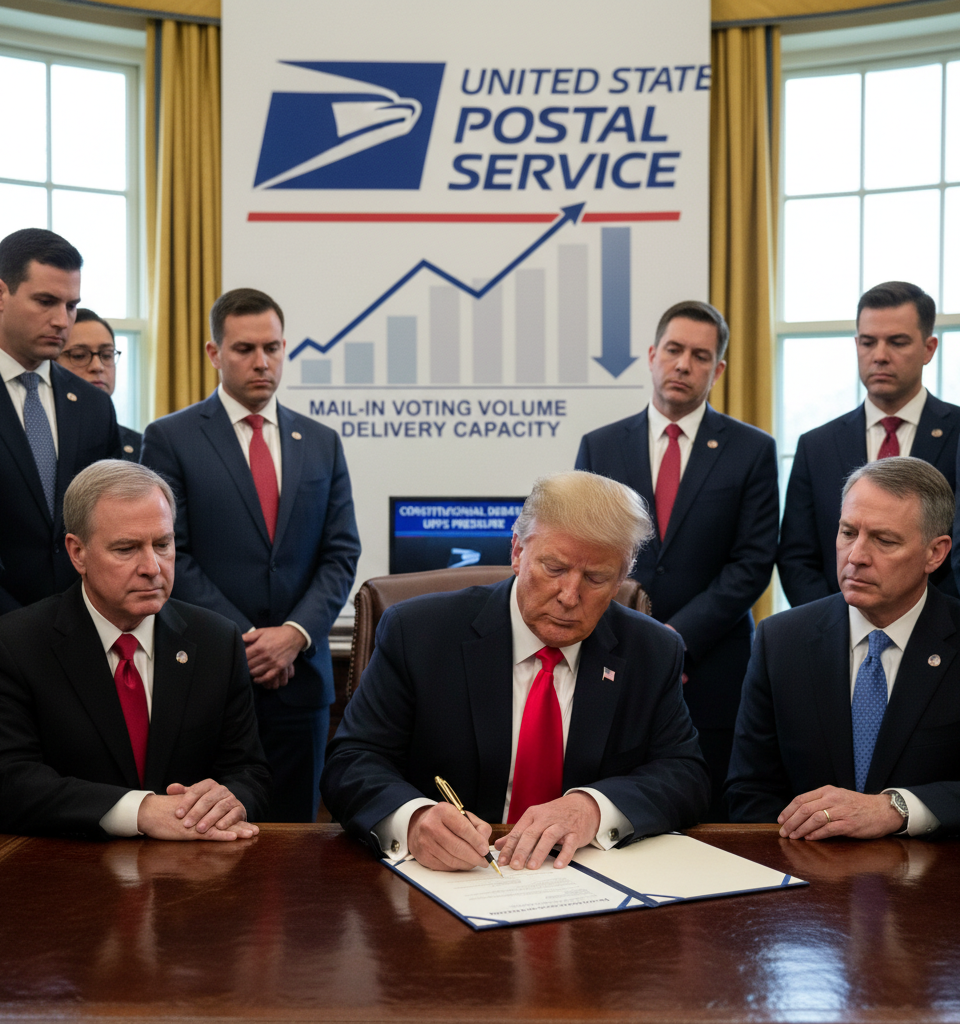
WASHINGTON D.C. — President Donald Trump's executive order, issued this past Monday, is set to drastically alter how the United States Postal Service (USPS) handles mail-in ballots, instructing the agency to deliver only those deemed eligible. This unprecedented directive, announced amidst ongoing concerns about election integrity and the financial stability of the USPS, has immediately ignited a fierce constitutional debate and drawn sharp criticism from voting rights advocates and Democratic lawmakers. The order, which effectively grants federal authority to restrict the delivery of certain ballots, casts a long shadow over the upcoming general election, placing immense pressure on an already struggling postal service grappling with budget cuts and logistical challenges.
A Nation Divided: Context and Historical Precedent
The move comes at a time of heightened political polarization, with mail-in voting becoming a central flashpoint in the national discourse. While vote-by-mail has a long history in many states, championed for its accessibility and convenience, President Trump has repeatedly claimed, without substantial evidence, that it is rife with fraud. This executive order represents a significant escalation in his administration's efforts to influence electoral processes. Historically, the administration and oversight of elections, including ballot handling and eligibility, have been firmly within the purview of individual states, as outlined in the U.S. Constitution. Critics argue this order directly infringes upon states' rights to manage their own elections and could lead to widespread disenfranchisement.
Unpacking the Order: Eligibility and Legal Challenges
The executive order's core tenet mandates that the USPS limit its delivery services to only those mail-in ballots whose legitimacy can be verified, though the specific mechanisms for this verification remain vaguely defined by the order itself. According to sources familiar with the directive, the White House intends to collaborate with state election officials to establish protocols, a proposal that many states, particularly those governed by Democrats, are likely to resist vehemently. Legal challenges are already being mounted by civil rights organizations and several state attorneys general, arguing that the order is an unconstitutional overreach of presidential power and interferes with the fundamental right to vote. Experts point to Article I, Section 4 of the Constitution, which grants state legislatures the power to prescribe the "Times, Places and Manner of holding Elections."
Industry Impact: A Strained Postal Service on the Brink
For the USPS, an agency already facing an estimated $160 billion deficit over the next decade and reeling from recent operational changes that have caused mail delays, this directive adds another layer of profound operational complexity and political scrutiny. The agency is expected to handle a record number of mail-in ballots in the upcoming election, potentially exceeding 80 million. Implementing a system to differentiate between "eligible" and "ineligible" ballots would require significant new infrastructure, training, and potentially thousands of additional personnel, all without clear funding or guidance. This operational burden, combined with the legal uncertainties, threatens to further slow down mail processing and could significantly impact the timely delivery of all mail, not just ballots.
Expert Analysis: Constitutional Concerns and Electoral Integrity
Constitutional scholars and election law experts are largely unified in their assessment that the executive order faces a formidable legal battle. "This order appears to directly contradict the Tenth Amendment and well-established precedent regarding states' control over elections," stated Professor Lena Horowitz, a constitutional law expert at Georgetown University. "The logistical nightmare of identifying 'eligible' ballots without clear federal authority or state cooperation could create chaos and erode public trust in the electoral process." Concerns also extend to the potential for political weaponization of the USPS, transforming a vital public service into an instrument of partisan control over election outcomes.
The Road Ahead: Courts, Congress, and the Election
The immediate future will likely see a rapid escalation of legal challenges, with federal courts becoming the primary arena for determining the order's validity. Congressional Democrats have denounced the order, with House Speaker Nancy Pelosi calling it "another brazen attempt to suppress votes." While legislative action to block the order might be attempted, it faces an uphill battle in a divided Congress. The ultimate implications for the 2024 general election are profound: should the order be upheld, it could create unprecedented delays and confusion, potentially disenfranchising millions of voters. If struck down, it might still leave a lingering perception of federal interference, further eroding public confidence in the integrity of the election process. The coming weeks will undoubtedly be critical in shaping the future of mail-in voting and the democratic process itself.
Broader Implications: Federal Power vs. States' Rights
Beyond the immediate electoral concerns, this executive order also reignites a fundamental debate regarding the balance of power between the federal government and individual states. If the President can unilaterally dictate how states conduct elements of their elections, it sets a dangerous precedent that could undermine the principle of federalism. This particular order, therefore, is not merely about ballot delivery; it's about the very architecture of electoral governance in the United States and the extent to which the executive branch can assert control over processes traditionally managed by state legislatures and election commissions. The outcomes of the impending legal battles will have lasting consequences for American democracy.