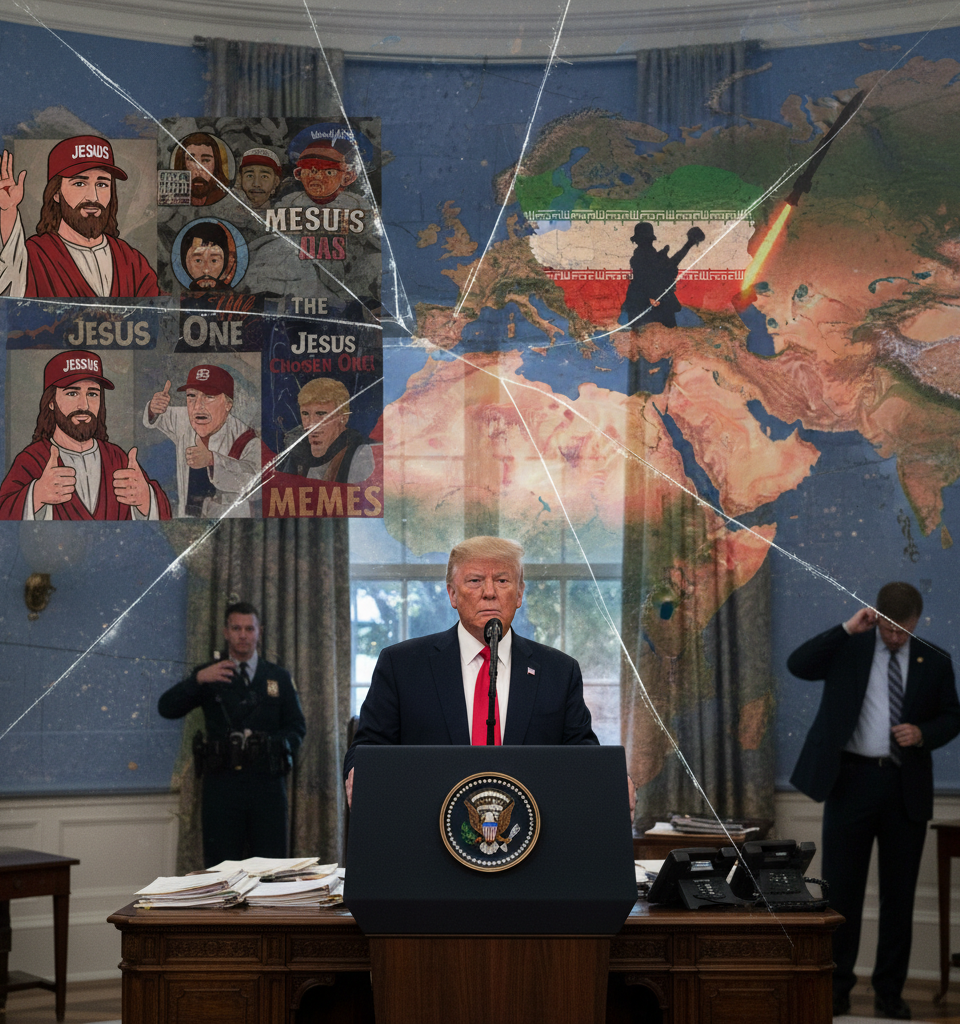
President Donald J. Trump's administration is currently navigating a period of unprecedented domestic political turmoil and heightened international uncertainty, exemplified by his public lashing out at perceived adversaries, critical allies, and even religious figures like Pope Francis. This escalating rhetoric, characterized by unconventional communication tactics, including the sharing of provocative 'Jesus memes,' has significantly diverged from traditional presidential discourse. This approach, unfolding against the backdrop of a crucial midterm election year, has complicated Republican efforts to maintain focus on their core economic agenda, forcing them instead to address a constant deluge of controversy generated directly from the Oval Office.
This current climate is not an isolated incident but rather a continuation of a pattern that has defined much of Trump's time in office. From the earliest days of his campaign, Trump employed a confrontational style that resonated with a segment of the electorate but alienated many others. His use of social media, often bypassing traditional media outlets, has fundamentally altered the communication landscape for a U.S. President. The current wave of controversies, however, appears amplified, occurring concurrently with significant geopolitical challenges, including escalating tensions with Iran, and persistent domestic investigations affecting his administration and personal conduct.
Key among the recent flashpoints is the administration's aggressive posture toward Iran. Following the U.S. withdrawal from the Joint Comprehensive Plan of Action (JCPOA) in May 2018, sanctions were reimposed, leading to a palpable increase in regional instability and threats of military action. Internally, the President's personal attacks, such as labeling certain media outlets as "enemies of the people" and his public spats with figures ranging from political opponents to international leaders, have drawn widespread criticism. The recent sharing of a 'Jesus meme' depicting him as a divine figure, while seemingly benign to some, was widely interpreted as an attempt to rally his evangelical base and further solidify his image as a persecuted leader, raising concerns about the separation of church and state and the dignity of the presidential office.
Economically, the administration's focus on tax cuts and deregulation has yielded mixed results. While the unemployment rate reached a 50-year low of 3.5% in September 2019 and GDP growth hovered around 2.1% in Q3 2019, the ongoing trade war with China has introduced significant uncertainty. The imposition of tariffs on over $360 billion worth of Chinese goods has impacted various sectors, with agricultural exports seeing a sharp decline and manufacturing facing rising input costs. These economic anxieties are often overshadowed by the President's ongoing political battles and pronouncements, making it challenging for Republican candidates to articulate a consistent economic message to voters.
Political analysts are increasingly grappling with the long-term implications of this unconventional presidency. Dr. Sarah Jenkins, a professor of political science at Georgetown University, notes, "President Trump's strategy is a high-stakes gamble. While it energizes his base, it also alienates moderate voters and creates a fractured political environment. The constant stream of controversy makes it almost impossible for any policy achievement to receive sustained positive attention." Others argue that Trump's direct communication style, while unorthodox, is a deliberate tactic to bypass what he views as a biased media and connect directly with his supporters, thereby solidifying his political capital despite criticism.
Looking ahead, the volatility is unlikely to subside. The ongoing investigations stemming from the Mueller report, along with continuous foreign policy challenges, particularly regarding Iran and North Korea, will continue to test the administration's resolve. The looming 2020 presidential election will undoubtedly intensify these pressures, with both domestic political skirmishes and international crises likely to become even more pronounced. The administration's ability to pivot from these continuous controversies to a more cohesive policy message will be crucial in defining its legacy and determining the Republican Party's electoral fortunes.
The trajectory of President Trump's second half of his term appears set to be as unpredictable and tumultuous as its beginning. The confluence of domestic political polarization, a highly visible and unconventional presidential communication style, and complex international challenges ensures that both political observers and the public will remain captivated by the ongoing saga. The question remains whether this strategy of constant confrontation can translate into sustained policy successes or whether it risks further eroding the institutional norms and international standing of the United States.
The Lingering Spectre of Impeachment
Beyond the daily headlines, the spectre of impeachment continues to loom. While efforts in the House of Representatives have been largely partisan, the release of the Mueller report and subsequent congressional testimony have kept the issue alive. The President's direct challenges to congressional oversight, including refusing to comply with subpoenas, have led to a constitutional clash that could have lasting ramifications for the balance of power between the executive and legislative branches. The Democrats' strategic calculations regarding impeachment will undoubtedly be influenced by public opinion and the perceived impact on the upcoming election cycle.
Global Repercussions: Allies and Adversaries
The impact of Trump's presidency extends beyond domestic borders. Allies have expressed increasing frustration with his "America First" approach, evidenced by disagreements on trade, climate change, and international agreements. Conversely, adversaries have sought to exploit perceived divisions within the Western alliance. The ongoing tensions with Iran, characterized by strategic rhetoric and military posturing, remain a critical concern, with the potential for miscalculation carrying significant global risks. The international community watches intently as the U.S. navigates these complex relationships under a highly unconventional leadership.
The Role of Social Media
President Trump's prolific use of social media, particularly Twitter, has fundamentally reshaped political communication. His direct, often unfiltered, messages bypass traditional media filters, allowing him to communicate directly with his base. However, this approach also amplifies controversies, provides ammunition for critics, and can contribute to the spread of misinformation. The immediate and unmediated nature of these communications means that policy shifts, personal opinions, and even potentially inflammatory statements are broadcast instantly to millions, often driving the news cycle and setting the political agenda.