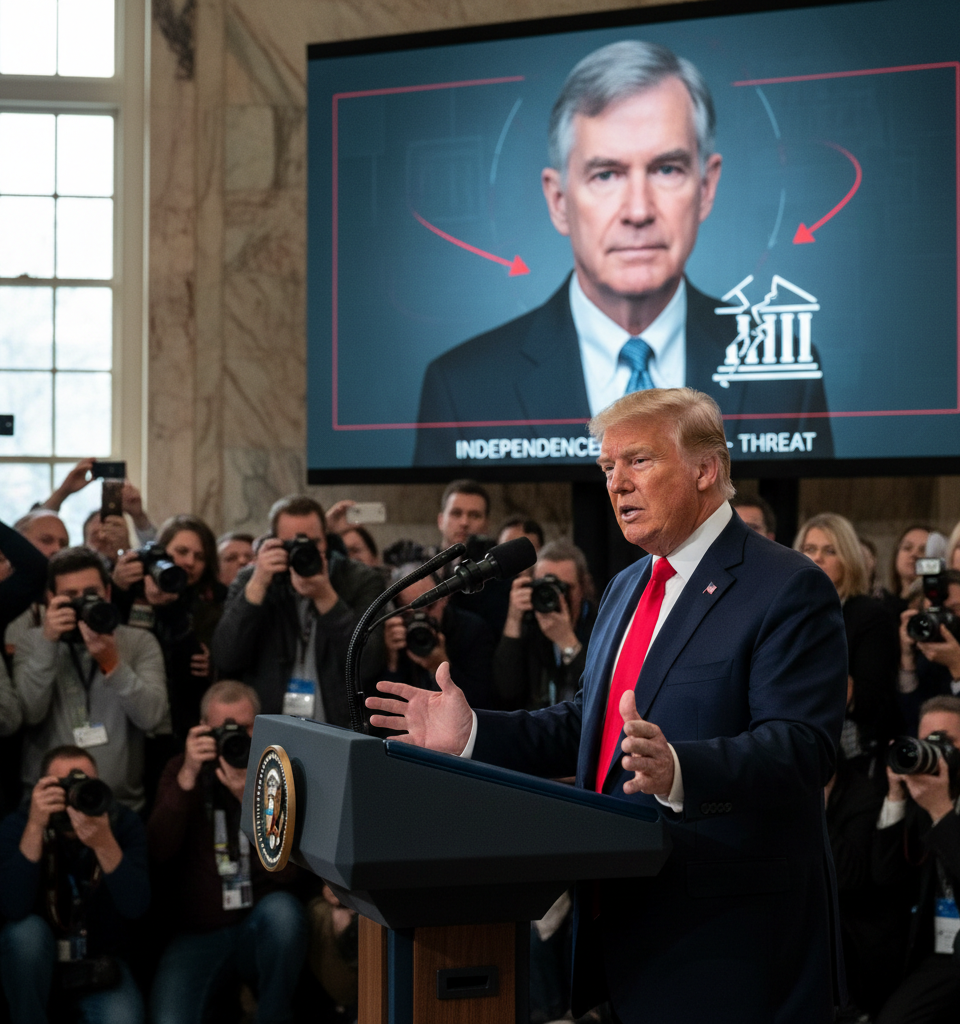
Former President Donald J. Trump has publicly threatened Federal Reserve Board Chair Jerome Powell, implying that Powell should voluntarily resign his post or risk being fired if Trump is re-elected to the presidency. This provocative statement, delivered recently, represents a significant escalation in political rhetoric targeting the nation's central bank and challenges a decades-long tradition of respecting Fed independence. The unprecedented nature of this ultimatum has sent ripples through financial markets and reignited debates over the critical separation between monetary policy and political influence.
A History of Presidential Scrutiny, But Never Direct Threats of Dismissal
While presidential administrations have historically expressed views, and at times dissatisfaction, with Federal Reserve policies – often concerning interest rates or economic growth – direct threats of dismissal are highly unusual and largely without modern precedent. Article II, Section 2 of the U.S. Constitution grants the president the power to appoint, with Senate consent, Federal Reserve governors, who serve 14-year terms. The Fed Chair's four-year term is also appointed by the president. While the Federal Reserve Act does not explicitly state that a president can fire a Fed chair, legal interpretations and historical practice have cemented the understanding that such a move would be a severe breach of institutional norms and could face significant legal challenges. Notably, while Presidents typically appoint their own Fed Chairs, current chairs, like Powell, usually complete their terms even if a new President takes office.
Powell's Stance and the Spectre of Political Intervention
Jerome Powell, appointed by then-President Trump in 2017 and later re-appointed by President Biden in 2022, has maintained a professional silence regarding his future plans, despite previous speculation about his voluntary departure. This steadfast impartiality has been a hallmark of his tenure, navigating periods of significant economic volatility, including the COVID-19 pandemic and subsequent inflationary pressures. Trump's recent comments echo sentiments he expressed during his first term, when he frequently criticized Powell for raising interest rates, often calling the Fed the nation's "biggest threat." The implications of a President attempting to directly oust a Fed Chair extend beyond a single individual, striking at the core of the central bank's ability to make decisions free from short-term political pressures.
Market Jitters and the Risk to Economic Stability
The financial markets generally react unfavorably to perceived threats to central bank independence. Investors rely on the Fed's autonomy to make objective, data-driven decisions that prioritize long-term economic stability over political expediency. Any indication that monetary policy could become politicized introduces significant uncertainty, potentially leading to increased market volatility, capital flight, and a loss of investor confidence. Historically, emerging market economies have often faced such challenges, where political interference in central banking has led to runaway inflation and economic instability. While the U.S. has a strong institutional framework, even a perceived weakening could have tangible effects on Treasury yields, the dollar's value, and overall economic sentiment.
Expert Consensus: A Dangerous Precedent for the Dollar's Hegemony
Economists and political analysts are largely united in their condemnation of such political posturing. Dr. Sarah Chen, a professor of political economy at a leading university, stated, "Threatening to fire the Fed Chair sets a dangerous precedent. It undermines faith in the U.S.'s institutional strength and sends a message that our economic policy might be subject to the whims of political office, rather than sound economic principles. This could have profound long-term consequences for the dollar's status as the global reserve currency." Many commentators highlight that such actions could erode the credibility that the Federal Reserve has painstakingly built over decades, potentially leading to higher borrowing costs for the U.S. government and businesses.
The Path Forward: Will Powell Hold Firm? What's Next for the Fed's Independence?
The immediate future hinges on several factors: the outcome of the upcoming presidential election, and should Trump win, the legal and political landscape surrounding a potential attempt to remove Powell. While Powell has not publicly responded to the threats, his past actions suggest a commitment to his role and the Fed's mandate. Should he choose to remain, a re-elected Trump administration would face a significant constitutional and political battle. Conversely, a voluntary resignation under such pressure could also set a problematic precedent. The incident underscores growing concerns about the politicization of independent institutions and will undoubtedly be a central theme in discussions about U.S. economic governance in the months and years to come, potentially leading to calls for legislative clarification regarding presidential powers over the Federal Reserve Chair appointment and dismissal.
Impact on Future Monetary Policy Decisions
The mere discussion of such a scenario could influence the perception of future Federal Reserve decisions, regardless of who occupies the Oval Office. Future interest rate hikes or cuts, quantitative easing or tightening, could be scrutinized through a political lens, further complicating the Fed's task of maintaining price stability and maximum employment. This situation creates a challenging environment for the Fed, as it must steadfastly uphold its independence while navigating intense public and political scrutiny, all while keeping the U.S. economy on a stable footing. The ongoing saga serves as a critical test of the resilience of one of the nation's most vital economic institutions.