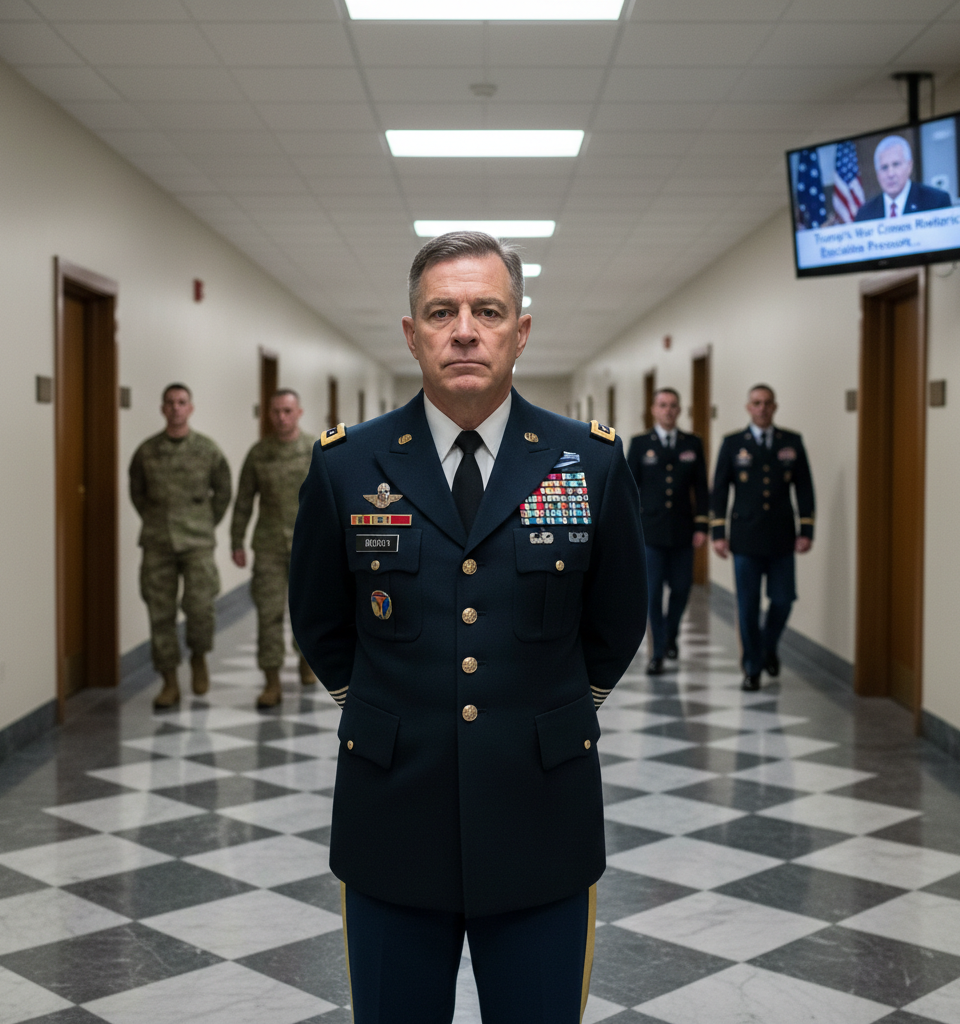
Washington D.C. – President Donald Trump's recent pronouncements, including threats to target cultural sites and authorize actions widely considered war crimes under international law, have significantly amplified pressure on General Douglas Caine, Chairman of the Joint Chiefs of Staff. This fraught situation, unfolding in the wake of escalating geopolitical tensions, forces General Caine to confront a stark dilemma: uphold the military's constitutional and ethical obligations or execute directives that could compromise the honor and legal standing of U.S. armed forces. The crisis underscores a growing chasm between the executive's often-apocalyptic rhetoric and the enduring principles governing military conduct.
The Precedent and Peril of Presidential Directives
This is not the first instance of a U.S. President pushing the boundaries of military engagement, yet the frequency and severity of Trump's threats present a unique challenge. Historically, the Chairman of the Joint Chiefs serves as the principal military advisor to the President, responsible for ensuring that all military operations adhere to domestic and international law, including the Geneva Conventions and the Uniform Code of Military Justice (UCMJ). The prospect of direct orders that could be construed as war crimes places General Caine in an ethically unchartered territory, testing the very foundations of civilian control over the military, juxtaposed with the military's inherent duty to refuse unlawful orders.
Specifics of the Standoff: Rhetoric vs. Reality
The President's statements, delivered via public rallies and social media platforms, have included threats to target "cultural sites" within adversarial nations, a move explicitly prohibited by international treaties such as the Hague Convention. Furthermore, suggestions of employing disproportionate force or targeting non-combatants have echoed through his public addresses, prompting widespread condemnation from human rights organizations and former military officials. While specific directives to implement such actions have not been publicly confirmed, the mere articulation of these threats creates an environment of profound uncertainty and unease within the armed forces, raising concerns about potential individual accountability for service members executing perceived unlawful orders.
Global Repercussions and Alliances on Edge
The ripple effects of this rhetorical offensive extend far beyond domestic politics. Key U.S. allies, already wary of America's shifting foreign policy, are closely monitoring the situation. A perceived willingness by the U.S. to flout international law could severely undermine global alliances, erode diplomatic leverage, and embolden adversaries. NATO partners, for instance, rely on a shared commitment to international norms and humanitarian law. Any deviation by the U.S. could jeopardize joint operations and intelligence sharing, potentially costing billions in lost cooperation and increased military expenditures while degrading the efficacy of collective security efforts.
Expert Analysis: A Test of Military Integrity
"General Caine faces an unprecedented test of leadership and moral courage," states Dr. Evelyn Reed, a leading expert on military ethics at the Center for Strategic and International Studies. "His role is not merely to execute orders, but to advise the President on their legality and strategic wisdom. If push comes to shove, his primary allegiance is to the Constitution and the laws of war, not to any individual's unlawful directive." Legal scholars concur, noting that a service member's duty to refuse an unlawful order is a bedrock principle, however difficult it may be to enact against the highest authority. The potential for a high-profile resignation, while extreme, cannot be entirely dismissed if the ethical line is fundamentally crossed.
The Unfolding Path: What Lies Ahead for Caine and the Pentagon
The coming weeks will be critical. General Caine's actions, or inactions, will set powerful precedents for the relationship between the executive branch and the military, and for the U.S.'s standing on the global stage. Observers anticipate Caine will continue to leverage his advisory role to privately counsel the President against unlawful actions, while publicly maintaining a posture of military professionalism and adherence to established protocols. However, should an explicit, unlawful order be issued, the potential for a constitutional crisis looms large, placing General Caine and the leadership of the U.S. military in an unenviable spotlight, with the integrity of the armed forces hanging in the balance.