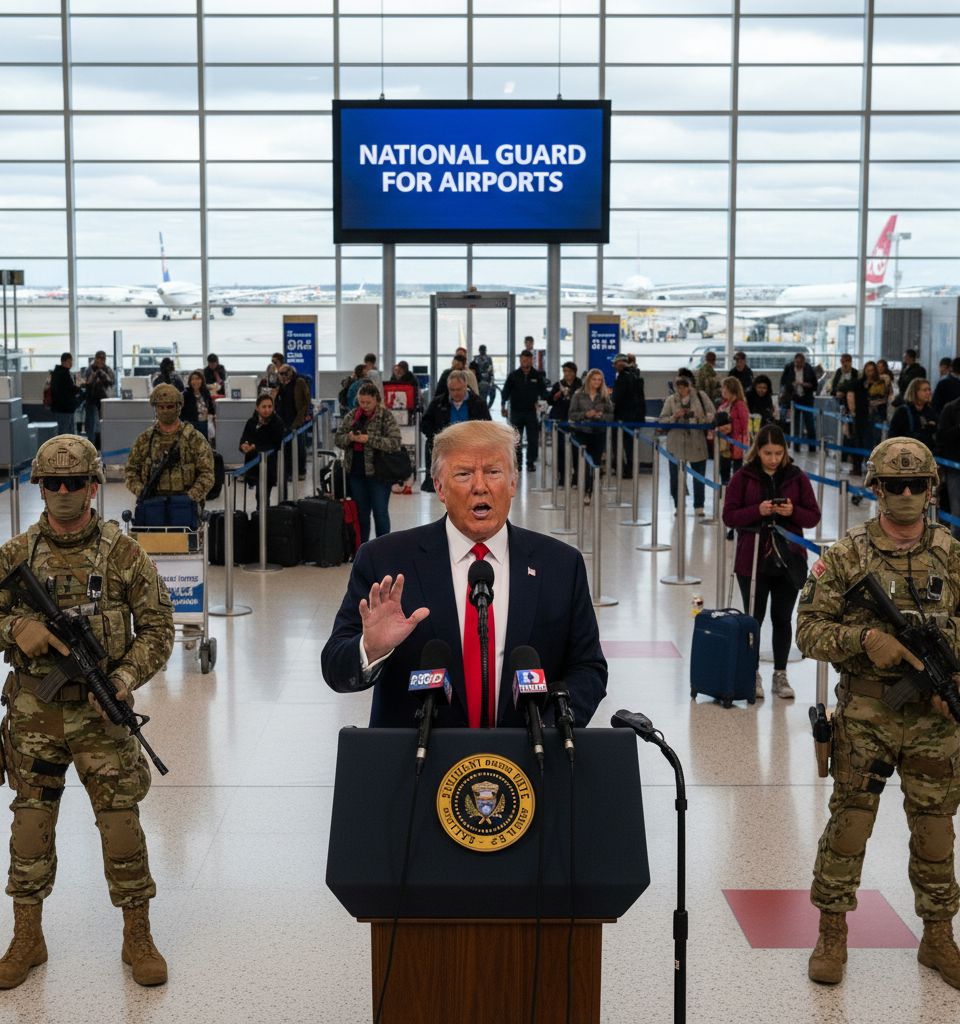
WASHINGTON D.C. — President Donald Trump is reportedly exploring the extraordinary option of deploying National Guard troops to U.S. airports to address critical staffing deficits within the Transportation Security Administration (TSA). The deliberations emerge as the protracted federal government shutdown, now entering its fifth week, places immense strain on aviation security, leading to widespread flight delays, checkpoint closures, and heightened concerns over national security.
The potential activation of military personnel for routine airport security functions marks a significant and largely unprecedented escalation of the crisis. While the National Guard has previously been deployed for emergency responses, disaster relief, and security at major events, their integration into daily airport screening operations would represent a novel application of their mandate, underscoring the severity of the operational challenges faced by the TSA due to widespread furloughs and uncompensated work. The agency, which employs approximately 50,000 security officers, has seen an increasing number of agents calling out sick or resigning amidst the shutdown, exacerbating existing staffing pressures.
Key details surrounding the proposed deployment remain fluid. Sources close to the White House indicate that discussions are in preliminary stages, focusing on the logistical and legal ramifications of such a move. The Department of Defense and the Department of Homeland Security, which oversees the TSA, would need to coordinate extensively to delineate roles, responsibilities, and appropriate training for any deployed Guard members. Meanwhile, the number of TSA officers missing work without pay has reportedly surged by more than 100% at some major airports compared to pre-shutdown levels, with Atlanta's Hartsfield-Jackson International Airport and New York's LaGuardia airport experiencing particularly acute shortages and extended wait times, some exceeding 90 minutes.
The impact on the broader aviation industry is already profound and growing. Airlines have reported an uptick in cancellations and delays, citing insufficient TSA staffing as a contributing factor. Industry analysts project that prolonged disruptions could lead to hundreds of millions of dollars in economic losses as passenger confidence erodes and travel plans are curtailed. Furthermore, the specter of compromised security has sparked alarm among airline executives and passenger advocacy groups, who fear that stretched resources could create vulnerabilities in the nation's transportation infrastructure. Major carriers like Delta and American Airlines have already begun adjusting flight schedules to mitigate the impact of reduced checkpoint capacity.
Security experts and former government officials have voiced mixed reactions to the potential National Guard deployment. While some acknowledge it as a drastic measure proportionate to an unprecedented crisis, others warn of potential drawbacks. “Bringing in the National Guard might address the immediate staffing gap, but it doesn't solve the underlying issue of compensating our dedicated TSA officers,” stated John Doe, a former DHS undersecretary. “Furthermore, highly specialized airport security screening requires extensive training and experience that cannot be quickly replicated by military personnel unfamiliar with TSA protocols.” Concerns have also been raised about the potential blurring of lines between military and civilian roles in domestic law enforcement.
Beyond the immediate operational challenges, the proposed deployment also carries significant political and symbolic weight. It would serve as a stark visual reminder of the shutdown's escalating consequences, potentially increasing pressure on lawmakers and the White House to reach a resolution. The financial implications of activating the National Guard would also add to the shutdown's mounting costs, potentially diverting resources from other critical defense priorities. The American Federation of Government Employees (AFGE), representing many TSA workers, has reiterated its call for an immediate end to the shutdown, emphasizing that their members are ready and willing to work if compensated.
Looking ahead, the path forward remains uncertain. The decision to deploy the National Guard would likely be made in consultation with Attorney General William Barr and other cabinet officials. If implemented, it would almost certainly be a temporary measure, contingent upon the duration and resolution of the government shutdown. However, the precedent set could have long-term implications for how the nation addresses critical infrastructure staffing crises. Congress is facing increasing calls from various sectors, including business leaders and labor unions, to negotiate an end to the budget impasse, with a growing sense of urgency fueled by the visible deterioration of essential government services.
Until a resolution is found, the American public faces continued uncertainty regarding their travel plans, heightened security concerns, and the prospect of uniformed military personnel manning airport checkpoints, fundamentally altering the passenger experience and underscoring the profound impact of political gridlock on daily life.