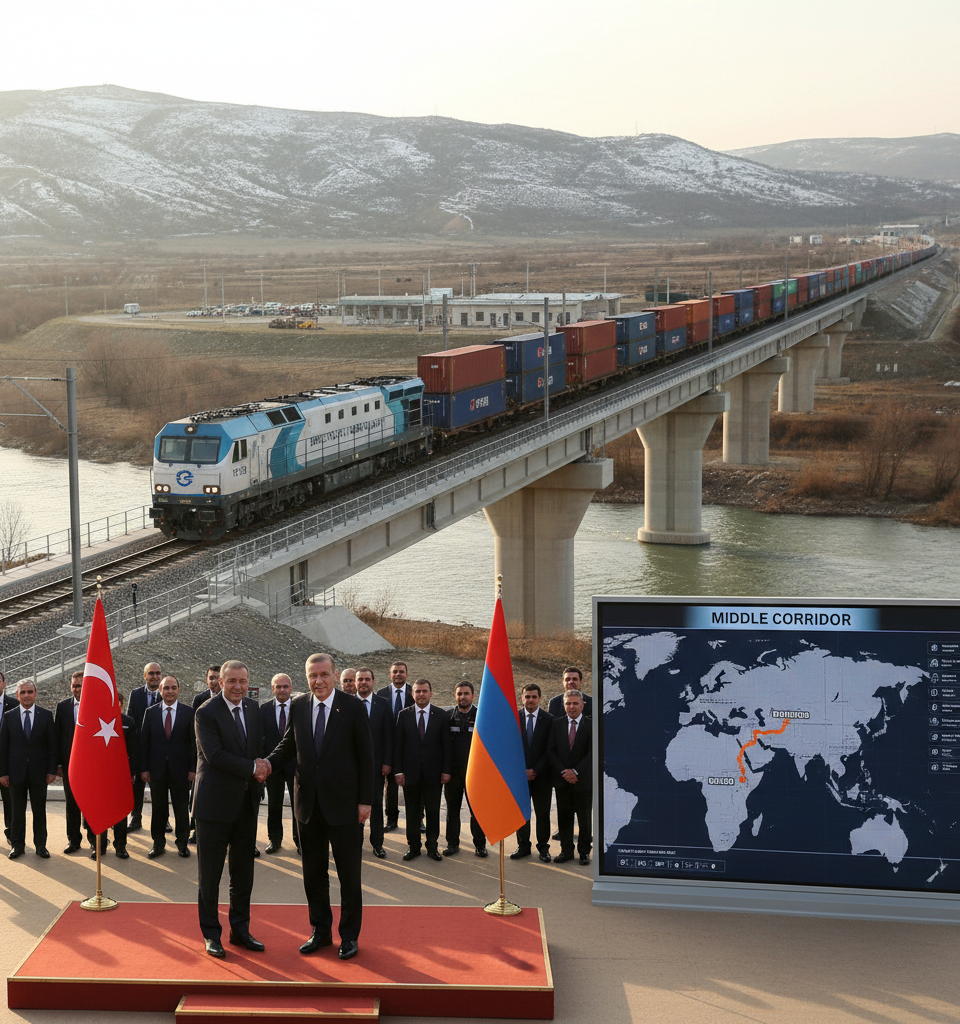
Ankara, Turkey – In a significant geopolitical and economic maneuver, Turkey is actively championing the development and utilization of the 'Middle Corridor,' an ambitious trans-Caspian trade route designed to connect Europe with Asia. This strategic push, which includes the politically charged reopening of its land border with Armenia, aims to establish a robust alternative to existing global trade choke points, most notably the fraught Strait of Hormuz, and unlock substantial economic benefits for the region. The move capitalizes on renewed global interest in diversified supply chains and leverages existing infrastructure while projecting Turkey's growing influence as a key Eurasian hub.
Geopolitical Stakes and Historical Context
This initiative arrives at a pivotal moment, with global supply chains under immense pressure from geopolitical tensions, natural disasters, and the lingering effects of the pandemic. The Strait of Hormuz, a critical maritime passage for approximately a fifth of global oil consumption and significant volumes of liquefied natural gas, remains vulnerable to regional instability. The Middle Corridor offers a compelling land-based alternative. Historically, Turkey's relationship with Armenia has been fraught with tension, including a closed land border since 1993 due to the Nagorno-Karabakh conflict. The proposed reopening, championed under the previous Trump administration as a means to unlock Western-backed trade routes, signifies a potential thawing of relations and a strategic realignment driven by shared economic interests and the broader geopolitical landscape. This move underscores a calculated effort by Ankara to project stability and connectivity in a historically turbulent region.
Key Details of the Middle Corridor Initiative
The Middle Corridor, formally known as the Trans-Caspian International Transport Route (TITR), spans approximately 4,250 kilometers (2,640 miles) by land and 500 kilometers (310 miles) by sea. It commences in Turkey, traverses Georgia and Azerbaijan by rail, crosses the Caspian Sea by ferry to Turkmenistan or Kazakhstan, and then continues by rail through Central Asia to China. Key infrastructure developments, such as the Baku-Tbilisi-Kars railway line, opened in 2017, already provide crucial links. The reopening of the Kars-Gyumri railway line, connecting Turkey directly to Armenia, is seen as the next critical step. This alone could reduce transit times and costs significantly, potentially diverting truck traffic from longer routes through Iran or Russia. While exact investment figures for the border reopening are not publicly detailed, the broader Middle Corridor initiative has seen billions in infrastructure investments from various international partners, including the European Union and China's Belt and Road Initiative.
Industry and Market Impact: A New Trade Artery
The activation of the Middle Corridor, especially with the Armenian connection, promises transformative impacts on regional and global trade. For European economies, it offers a faster and more secure route to Central Asian markets and China, bypassing an increasingly congested and politically sensitive Suez Canal. Logistics firms anticipate reduced transit times, potentially cutting travel from China to Europe to under 15 days, compared to 30-45 days by sea. This efficiency gain could significantly lower inventory costs and improve supply chain resilience. The initiative also presents substantial opportunities for Central Asian nations to diversify their trade routes and reduce their reliance on traditional Russian and Chinese corridors. Industries such as automotive parts, electronics, textiles, and agricultural goods are poised to benefit from quicker delivery times and potentially lower freight costs.
Expert Perspectives: Opportunities and Challenges
Analysts view Turkey's push for the Middle Corridor with cautious optimism. Dr. Sinan Ülgen, a senior fellow at Carnegie Europe, notes, "The strategic imperative for diversified trade routes is undeniable, and Turkey is positioning itself as an indispensable nexus. The opening with Armenia is a bold diplomatic move that could unlock immense economic potential, though political sensitivities will require careful management." Experts point to the need for standardized customs procedures, improved intermodal connectivity, and substantial ongoing investment in rail and port infrastructure across all participating countries. Concerns remain regarding the political stability of some transit countries and the potential for bureaucratic bottlenecks to impede the route's full efficiency. However, the sheer volume of global trade seeking alternatives to traditional maritime routes provides a powerful incentive for these challenges to be overcome.
The Road Ahead: Future Developments and Implications
The immediate next steps involve detailed technical discussions between Turkish and Armenian officials on the modalities of border reopening and railway refurbishment. Beyond this bilateral engagement, Turkey is expected to intensify diplomatic efforts with Azerbaijan, Georgia, Kazakhstan, and Turkmenistan to streamline customs, harmonize tariffs, and boost capacity along the entire corridor. Further investments in rolling stock, high-speed rail sections, and digital tracking systems are anticipated. The long-term success of the Middle Corridor hinges on its ability to consistently offer competitive pricing and reliability compared to traditional routes. Should it achieve its full potential, the corridor could fundamentally reshape Eurasian trade patterns, bolstering Turkey's strategic importance and fostering greater regional integration, while providing a critical safety valve for global commerce in an unpredictable world.