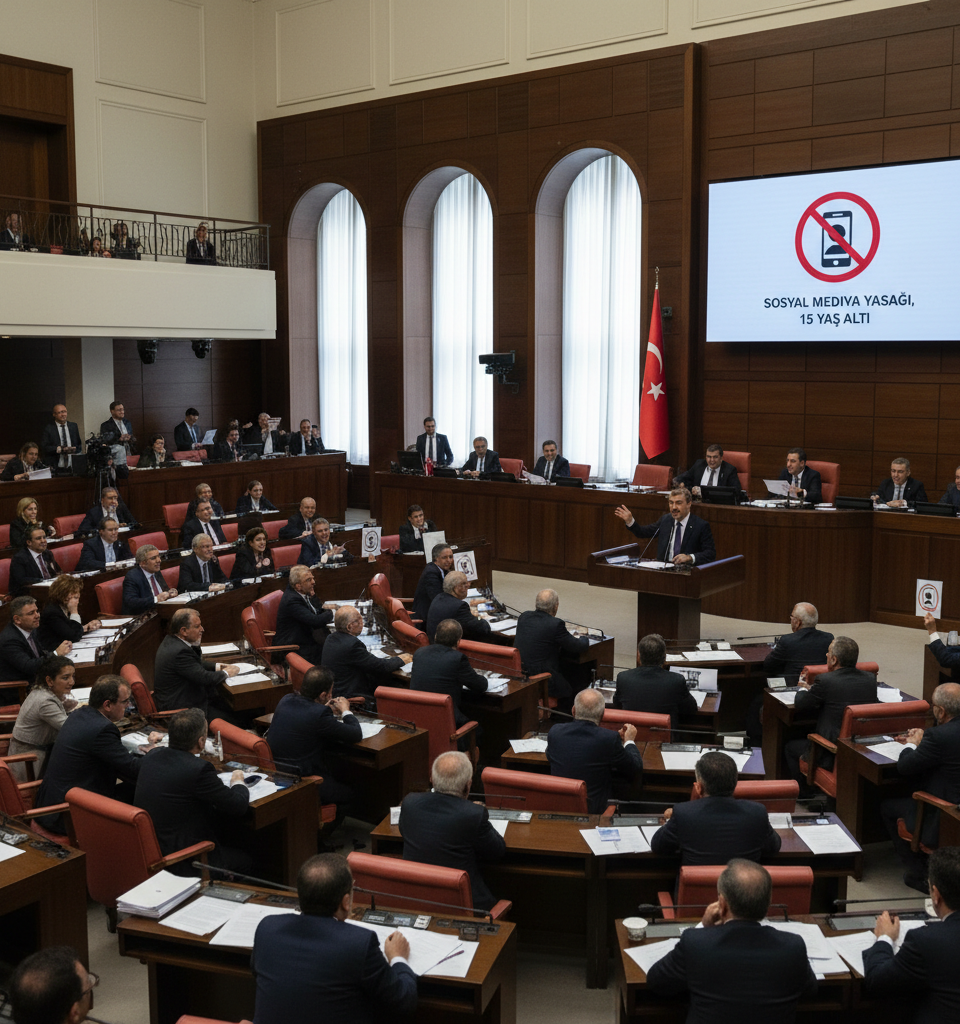
Ankara, Turkey – In a move that has ignited a fierce national debate, Turkey's Grand National Assembly has approved highly anticipated legislation banning individuals under the age of 15 from accessing social media platforms. The bill, passed just a week after a tragic school shooting, now awaits President Recep Tayyip Erdoğan's signature within the next 15 days to become law, with its full implementation slated for six months after its publication in the Official Gazette. While proponents frame the measure as a vital step in safeguarding minors online, critics, including the main opposition Republican People's Party (CHP), contend it represents a thinly veiled expansion of governmental control over online discourse under the guise of child protection.
This legislative action comes at a sensitive time for Turkey, grappling with the aftermath of a devastating school shooting and an increasingly polarized political landscape. The government's immediate response to the tragedy has included calls for tighter control over various aspects of public life, including digital spaces. However, the timing and scope of this social media ban have raised significant concerns regarding freedom of expression and access to information, especially given Turkey's history of implementing digital restrictions during periods of social and political unrest.
Past instances include the blocking of platforms like Instagram and Roblox, as well as significant restrictions during protests involving Istanbul Mayor Ekrem İmamoğlu. Key provisions of the new legislation stipulate that social media companies will be obligated to implement robust age verification systems and actively enforce the ban, although the specifics of these mechanisms and the penalties for non-compliance are yet to be fully detailed. The CHP, a prominent voice of opposition, explicitly condemned the bill during parliamentary debates, with spokesperson Selin Sayek Böke stating, "This is not about protecting our children; it is about extending political censorship into the digital lives of our youth."
Rights groups have also voiced similar concerns, pointing to the potential for selective enforcement and the broad interpretation of online content that could be deemed harmful. The implications for the broader digital landscape in Turkey are significant. Social media companies, many of which are global entities, will need to rapidly adapt their operations to comply with the new regulations, potentially leading to increased operational costs and a re-evaluation of their presence in the Turkish market.
This could also usher in a new era of content moderation challenges and legal disputes, particularly if the implementation is perceived as arbitrary or politically motivated. Furthermore, the ban could inadvertently push younger users towards less secure or unregulated platforms, creating new risks that the legislation aims to mitigate. Digital rights experts and independent analysts have largely expressed skepticism about the true intent and effectiveness of the ban.
Dr. Ayşe Demir, a professor of digital policy at a leading Turkish university, observed, "While the idea of protecting children online is laudable, an outright ban at such a young age may prove counterproductive. It risks driving young people to bypass official channels, making them harder to monitor and educate about online safety." Many experts emphasize that comprehensive digital literacy programs and parental oversight, rather than blanket prohibitions, usually offer more sustainable solutions for safeguarding minors in the digital realm.
Critically, there's concern that without clear lines, the legislation could be weaponized to silence dissenting voices or control narratives, impacting future political discourse and youth engagement. Looking ahead, the next crucial step will be President Erdoğan's decision to sign the bill into law, which is widely expected given the ruling party's strong majority. Following its publication in the Official Gazette, a six-month period will commence for social media platforms to prepare for compliance.
During this time, further regulations and guidelines are likely to be issued by Turkey's Information and Communication Technologies Authority (BTK). Both domestic and international pressure groups are expected to continue monitoring the situation closely and advocating for revisions that prioritize both child safety and fundamental freedoms. The implementation and enforcement of this ban will undoubtedly set a precedent for digital governance not only in Turkey but potentially across other nations grappling with similar challenges of online child protection versus freedom of expression.