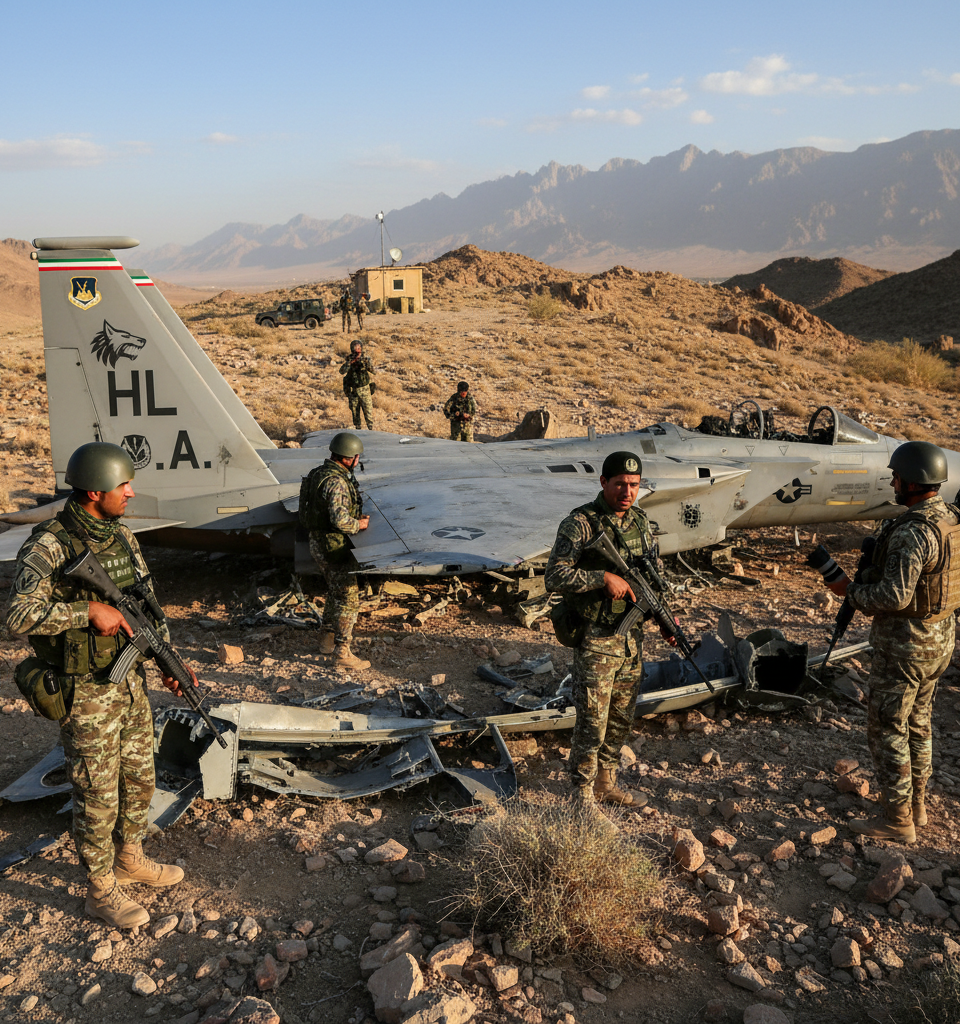
TEHRAN, Iran / LAKENHEATH, UK – A U.S. Air Force F-15E Strike Eagle fighter jet, confirmed to have been shot down over Iranian territory earlier this week, is now strongly believed to have been based at R.A.F. Lakenheath in Suffolk, United Kingdom. Military analysts, examining photographic evidence released by Iranian state media, have pinpointed distinct markings on the wreckage consistent with those of a squadron operating out of Lakenheath, one of two British airfields pivotal to the U.S. Air Force's largest fighter jet operations in the European theater. This development amplifies the geopolitical ramifications of the incident, placing renewed focus on the scope and nature of U.S. military activities in the Middle East and its relationship with allied bases.
Contextualizing a Precarious Incident
The downing of a U.S. fighter jet over Iranian airspace represents a significant escalation in an already volatile region, marking a potential flashpoint in the long-standing tensions between Washington and Tehran. While the precise circumstances of the incident remain officially unconfirmed by U.S. authorities, the apparent origination from R.A.F. Lakenheath, home to the 48th Fighter Wing – often referred to as the 'Liberty Wing' – underscores the global reach of American military power and its logistical dependencies on key allies. The incident harks back to previous periods of heightened aerial confrontation in the Middle East, though the direct loss of a U.S. combat aircraft to Iranian action would be a critical development, potentially triggering a reassessment of engagement rules and regional deterrence strategies.
Unpacking Key Identifiers and Operational Details
The identification hinges on specific squadron tail markings and unit insignia visible in images purportedly showing the remnants of the F-15E. Military aviation blogger and analyst, 'The Aviationist,' was among the first to highlight these consistent patterns, noting that the particular markings are indicative of the 492nd Fighter Squadron, an integral component of the 48th Fighter Wing at R.A.F. Lakenheath. The F-15E Strike Eagle is a twin-engine, all-weather tactical fighter that forms the backbone of U.S. air superiority and strike capabilities, often deployed for air-to-ground precision strike missions. These aircraft, each costing approximately $31 million, are routinely deployed to various forward operating locations across Europe, Africa, and the Middle East for training, exercises, and real-world operations. The deployment cycle often sees Lakenheath-based units rotating through bases in the Arabian Gulf region, such as Al Dhafra Air Base in the UAE or Prince Sultan Air Base in Saudi Arabia, which would logically serve as staging points for operations in neighboring Iranian airspace.
Broader Geopolitical and Market Ramifications
Beyond the immediate military implications, the incident could ripple through global energy markets and diplomatic channels. Iran, a major oil producer, sits astride critical shipping lanes in the Strait of Hormuz. Any substantial escalation could disrupt oil flows, potentially sending crude prices soaring. Following initial reports of the downed jet, Brent crude futures saw a modest uptick of 0.8%, closing at approximately $89.50 a barrel, reflecting market jitters. The involvement of a UK-based American asset could also complicate Anglo-American relations with Iran and potentially draw London into a more prominent diplomatic role. While current impacts are contained, a sustained crisis would have negative implications for airline stocks, defense industry contractors, and regional infrastructure projects.
Expert Consultations and Strategic Outlooks
Defense analysts are closely scrutinizing the incident for signs of intent and capability. Dr. Eleanor Vance, a senior fellow at the Royal United Services Institute (RUSI), commented, "If confirmed, the Lakenheath connection emphasizes the integrated nature of U.S. and allied operations. More critically, it raises serious questions about Iran's air defense capabilities and the intelligence surrounding this particular mission. Was it a routine reconnaissance flight gone awry, or something more proactive?" Other experts suggest this event could be a direct response to recent U.S. and allied maritime maneuvers in the Persian Gulf, serving as a forceful, albeit risky, signal from Tehran regarding its perceived red lines. The operational payload and mission profile of the F-15E would be key to understanding the full context, with analysts examining whether the aircraft was armed for strike or primarily for intelligence gathering.
The Path Forward: Diplomacy and De-escalation
The immediate focus will undoubtedly be on de-escalation and securing whatever remains of the aircraft and personnel. International diplomatic efforts, likely spearheaded by UN representatives and potentially European intermediaries, will strive to prevent a full-blown military confrontation. Washington is expected to issue a formal statement once a comprehensive assessment is complete, likely emphasizing the right to operate in international airspace while condemning any aggressive actions. Meanwhile, R.A.F. Lakenheath will likely face increased scrutiny regarding its operational protocols and the potential for a heightened threat posture. The long-term implications hinge on the responses from both Washington and Tehran, with a critical period of intense diplomatic maneuvering anticipated to determine whether this incident becomes an isolated event or a precursor to further instability in the Middle East.