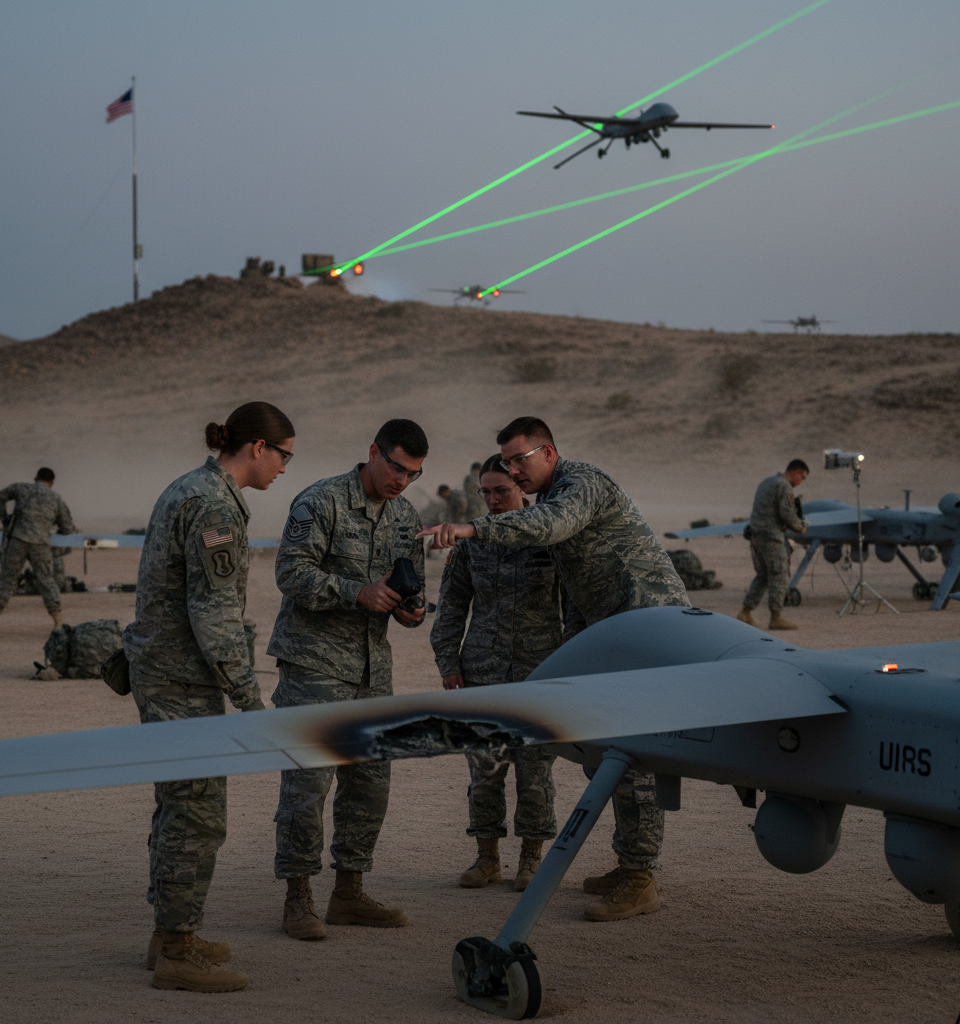
The U.S. military finds itself confronting a complex dilemma as it grapples with the escalating threat of adversary laser weapons targeting its drone fleets. Decades and billions of dollars have been poured into the development of high-energy laser systems designed to incapacitate or destroy unmanned aerial vehicles (UAVs). However, a critical oversight appears to be the comparatively limited focus and investment in understanding and mitigating the consequences of similar laser attacks launched by potential adversaries.
Shifting Dynamics in Modern Warfare
This emerging challenge underscores a significant shift in the dynamics of modern warfare, where advanced technological capabilities are becoming increasingly accessible globally. For years, the Pentagon has championed its offensive laser capabilities, envisioning a future where directed energy weapons provide a cost-effective and precise counter to drone swarms and other aerial threats. Yet, the strategic implications of these very technologies being weaponized against U.S. assets have received considerably less attention until recently. The concern is particularly acute given reports of nations like China advancing rapidly in this domain, with capabilities that could significantly complicate future military operations.
The Chinese Laser Threat
Recent intelligence suggests that China is fielding a growing arsenal of laser weapons specifically designed to neutralize drones. These systems are reportedly capable of engaging targets at ranges up to 25 kilometers, posing a substantial threat to U.S. and allied reconnaissance, surveillance, and strike platforms. The development of such long-range, high-energy laser weapons by a sophisticated peer competitor introduces a new layer of vulnerability for the U.S. military's extensive drone operations, which have become a cornerstone of its intelligence gathering and combat strategies.
Industry and Strategic Implications
The implications of this evolving threat are far-reaching, impacting military doctrine, equipment procurement, and strategic planning. Defense contractors, who have primarily focused on offensive laser systems, may now need to pivot or expand their research and development efforts to include defensive counter-laser technologies. This could lead to a new market segment for anti-laser coatings, sensor hardening, and electronic countermeasures designed to spoof or deflect incoming laser attacks. The long-term impact could also reshape drone design, pushing manufacturers to incorporate more resilient materials and redundant systems capable of withstanding various forms of directed energy attacks.
The Need for Defensive Innovation
The current situation highlights an urgent need for the U.S. military to bridge the gap between its offensive laser capabilities and its defensive strategies. While the ability to burn drones out of the sky is a powerful deterrent, the lack of commensurate preparedness for reciprocal attacks introduces a critical vulnerability. Experts suggest that a renewed focus on defensive innovation, including the development of hardened drones, advanced sensor protection, and active counter-laser systems, will be crucial in maintaining technological superiority and operational freedom in contested environments. This shift would entail a significant reallocation of resources and a re-evaluation of current defense priorities.
Future Preparations and Research
Moving forward, the U.S. military is expected to intensify its research into materials science, optics, and command-and-control systems to develop robust defenses against laser-based threats. This includes exploring novel ways to detect incoming laser beams, dissipate laser energy, and protect sensitive onboard electronics. The development of layered defense systems, combining both passive and active measures, will likely become a priority. The insights gleaned from its own offensive laser programs could prove invaluable in understanding the vulnerabilities that adversaries might seek to exploit and inform the design of countermeasures. The outcome of these ongoing efforts will significantly influence the effectiveness and survivability of drone operations in future battlefields.