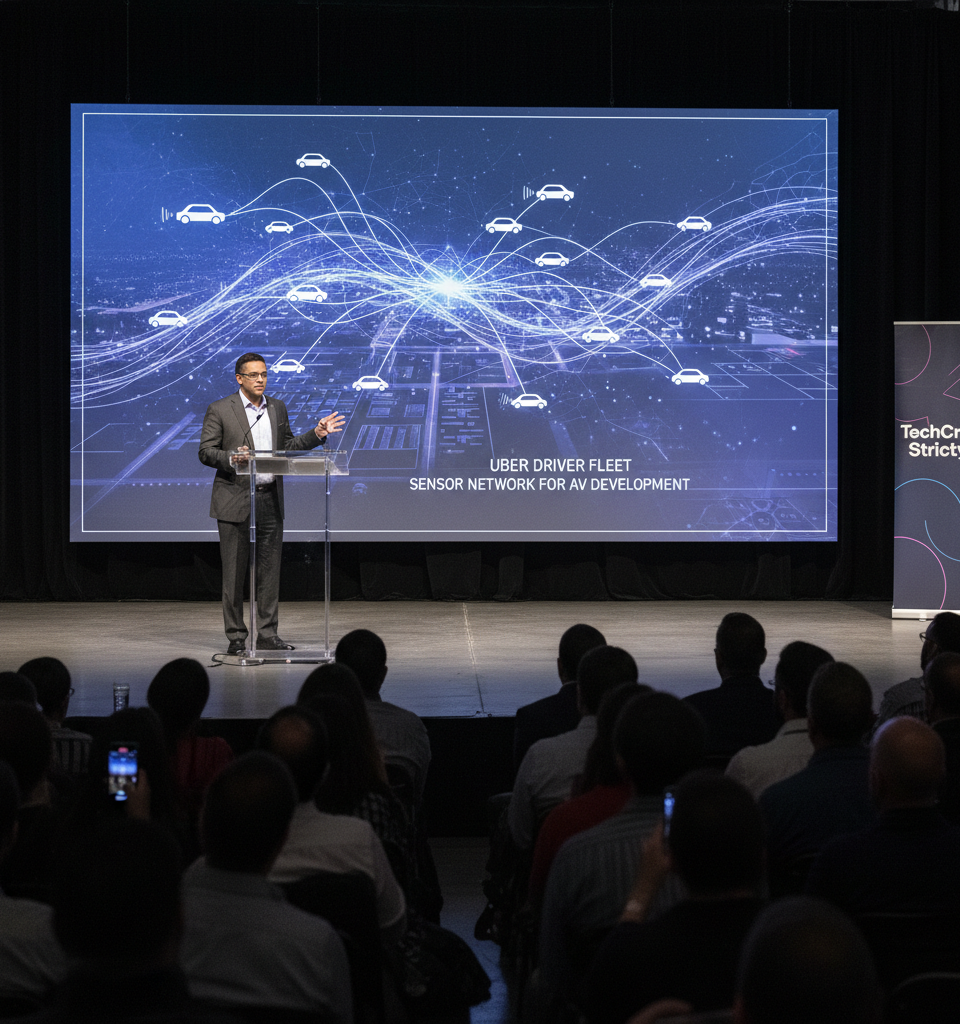
San Francisco, CA – In a bold move signaling an innovative future for autonomous vehicle development, Uber's Chief Technology Officer, Praveen Neppalli Naga, revealed plans to transform the company's extensive global fleet of drivers into a dynamic sensor network for self-driving technology. The announcement, made during an interview at TechCrunch's StrictlyVC event in San Francisco on Thursday night, positions this initiative as a significant expansion of Uber's recently launched AV Labs program, designed to bridge the gap between human-driven and fully autonomous transport.
A Strategic Pivot in Autonomous Vehicle Development
This strategy marks a distinct shift in how ride-hailing giants are approaching the complex and capital-intensive race for autonomous vehicles. Traditionally, AV development has relied heavily on dedicated, custom-equipped test fleets, often operating in limited geographies. Uber's proposal leverages its existing operational scale and real-world data collection capabilities. The AV Labs program, initially announced in late January, was conceived as a platform to allow autonomous vehicle developers to integrate their self-driving systems onto Uber's network. The idea of using human drivers as data collectors elevates this concept, providing an unprecedented volume of diverse, real-time environmental data—from road conditions and traffic patterns to nuanced driver behaviors and unpredictable urban scenarios.
Unlocking Unparalleled Data Collection
Naga elaborated on the vision, emphasizing the sheer scale of data that Uber's approximately 5 million active drivers could generate. He described this as a "natural extension" of the AV Labs initiative, suggesting that vehicles already connected to the Uber platform could be outfitted with discrete sensors or utilize existing smartphone capabilities to collect anonymized data on their surroundings. This data – including precise GPS coordinates, accelerometer readings, camera feeds, and even lidar or radar if equipped – could be invaluable for training and validating autonomous driving algorithms. The goal is to provide AV companies with a continuous stream of up-to-date, geographically diverse information that is far more comprehensive and cheaper to acquire than deploying proprietary sensor fleets across countless cities.
Impact on the Autonomous Vehicle Landscape
The implications for the broader autonomous vehicle industry are significant. For AV developers, accessing Uber's data trove could mean a faster, more efficient, and less costly development cycle. Startups and even established players often struggle with the monumental task of data acquisition and annotation. By potentially offering a data-as-a-service model, Uber could position itself as a critical enabler in the AV ecosystem, solidifying its place regardless of which company ultimately brings self-driving cars to mass market. This could also foster greater standardization in data formats and collection methods, potentially accelerating the overall progress of the industry towards Level 4 and Level 5 autonomous capabilities.
Expert Opinions on Uber's Bold Vision
Industry analysts are cautiously optimistic about Uber's audacious plan. "This is a clever play by Uber to monetize one of its greatest assets – its operational scale and data flow – without directly rebuilding its own autonomous driving division," stated Dr. Elena Petrova, a lead analyst at Global Mobility Insights. "The challenge will be in data normalization, privacy considerations, and ensuring the quality and consistency of data from such a diverse 'sensor grid.' However, if executed well, it could significantly lower the barrier to entry for AV testing and deployment, ultimately accelerating widespread adoption." Concerns also revolve around driver privacy, compensation models for data collection, and the technical complexities of integrating heterogeneous data streams into a coherent dataset for AV training.
The Road Ahead: Phased Implementation and Future Prospects
Uber's path forward will likely involve a phased implementation. Initial steps could involve pilot programs in select cities, potentially leveraging existing hardware within drivers' smartphones or through simple, add-on sensor kits. The company would need to establish robust data privacy protocols, anonymization techniques, and clear opt-in mechanisms for drivers. Monetization strategies for this data will also be critical, ranging from subscription-based access for AV development partners to more complex licensing agreements. The success of this initiative could ultimately solidify Uber's position not just as a transportation network company, but as a pivotal data infrastructure provider for the future of mobility, potentially generating billions in new revenue streams over the next decade as self-driving technology matures and scales globally.