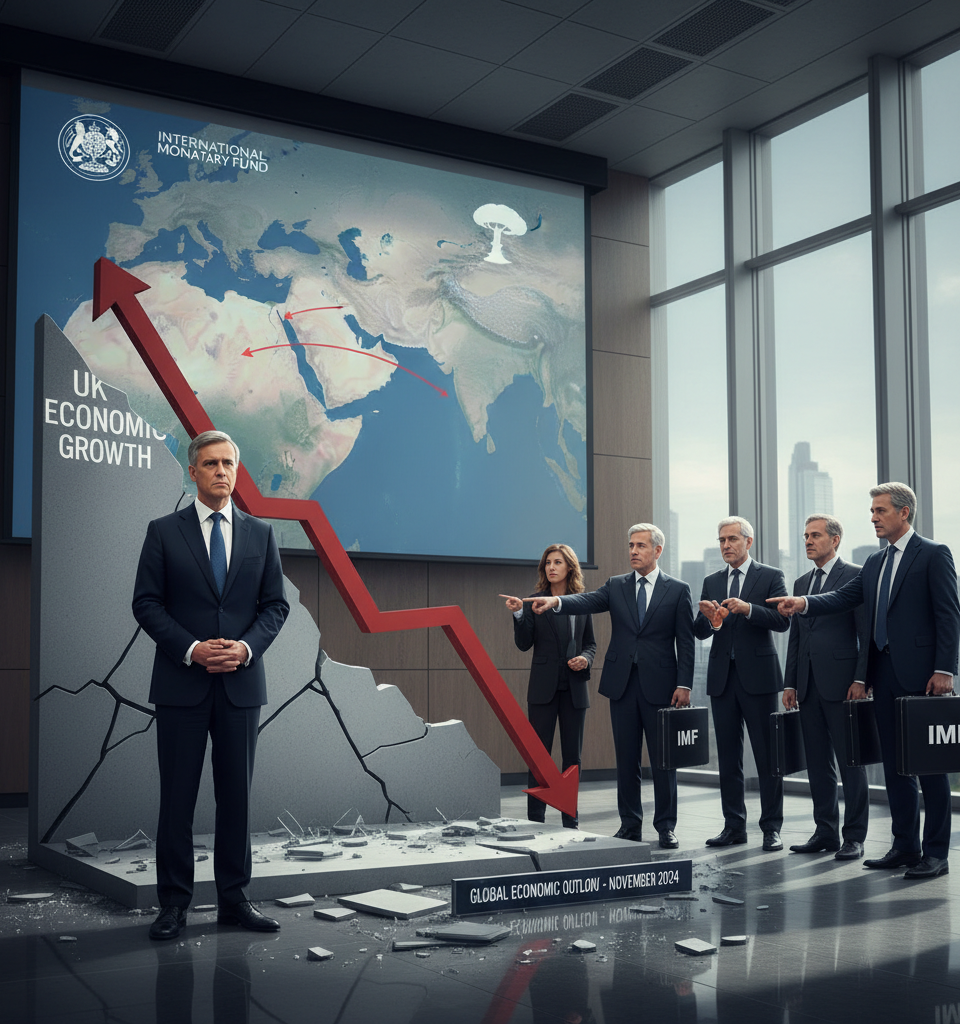
The United Kingdom is poised to endure the most severe economic growth impact among major global economies should a conflict involving Iran escalate, according to a stark warning issued by the International Monetary Fund (IMF). In its latest assessment, the influential financial institution has not only lowered its growth projections for the UK but also voiced grave concerns that the broader geopolitical instability threatens to derail the fragile recovery of the international economic landscape.
The IMF's pronouncements underscore the inherent vulnerabilities of the global economy to geopolitical shocks, particularly those emanating from critical energy-producing regions. An ongoing or intensifying conflict in the Middle East, specifically involving Iran, would almost certainly trigger a surge in energy prices, disrupt supply chains, and introduce a level of market uncertainty that stifles investment and consumer confidence worldwide. For the UK, which remains a significant importer of energy and is grappling with post-Brexit economic adjustments, the confluence of these factors presents a particularly challenging outlook. The timing of this warning comes as global economies are still navigating the complexities of inflation, high interest rates, and subdued growth following recent global events.
Global Economic Stability Under Threat
The IMF's revised forecasts paint a concerning picture, suggesting that the reverberations of an Iranian conflict would not be evenly distributed across the globe. While the precise mechanisms for the UK's disproportionate impact are not fully detailed in the current assessment, it is plausible that its advanced, open economy, coupled with existing inflationary pressures and the ongoing cost of living crisis, makes it uniquely susceptible to external shocks. A sustained period of high energy prices would hit businesses and households hard, potentially leading to reduced spending, business closures, and an overall contraction in economic activity. The warning amplifies prior concerns about the UK's long-term growth potential and its ability to weather significant international turbulence.
Financial markets are already exhibiting signs of nervousness in response to geopolitical uncertainties, with commodity prices, particularly oil, displaying volatility. Should the conflict intensify, this volatility is expected to become more pronounced, potentially triggering a broader sell-off in risk assets and a flight to safety. Such a scenario would tighten global financial conditions, making borrowing more expensive for governments, businesses, and consumers alike. The IMF's use of the phrase "throw the global economy off course" is a powerful indication of the deep-seated concerns within leading financial institutions regarding the potential for widespread disruption and a significant slowdown in global economic momentum.
Unpacking the UK's Vulnerability
The specific reasons behind the UK's anticipated significant hit could stem from several intertwined factors. Firstly, as a net energy importer, higher oil and gas prices would directly translate into increased costs for consumers and businesses, fueling inflation and eroding purchasing power. Secondly, the UK's service-led economy, while resilient in many aspects, is sensitive to global trade disruptions and investor sentiment, both of which would be negatively impacted by a major geopolitical conflict. Thirdly, the ongoing efforts by the Bank of England to tame inflation could be severely complicated by external price shocks, potentially forcing difficult monetary policy choices that could further restrain economic growth. The UK's current account deficit could also widen significantly under such conditions, exerting downward pressure on the pound.
Furthermore, the interconnectedness of supply chains in today's globalized economy means that disruptions in one region can quickly propagate worldwide. An Iranian conflict could affect shipping routes, insurance costs, and the availability of critical components, impacting manufacturing and trade far beyond the immediate region. For the UK, a nation highly dependent on international trade, these ripple effects could pose substantial challenges to its economic stability and recovery trajectory. Policymakers in London and central bankers will be closely monitoring developments, undoubtedly considering contingency plans to mitigate the potential fallout from such a severe economic shock.
Future Outlook and Policy Implications
Looking ahead, the IMF's pronouncement serves as a critical alert for policymakers globally, and particularly in the UK. Should the conflict escalate as feared, governments would face immense pressure to implement measures designed to shield their economies from the adverse effects. This could include fiscal interventions to support energy bills, subsidies for businesses, or even re-evaluations of existing green energy transition strategies in the face of immediate energy security concerns. Central banks, meanwhile, would be confronted with the difficult balancing act of combating inflation fueled by external shocks without unduly stifling economic activity.
The warning also emphasizes the urgent need for international cooperation to de-escalate tensions and seek diplomatic solutions. The economic ramifications of a prolonged or intensified conflict involving Iran are projected to be far-reaching, potentially setting back global economic progress by several years. For the UK, the imperative to build resilience into its economic framework, diversify its energy sources, and strengthen its international trade relationships becomes even more pronounced in the face of these emerging geopolitical risks.