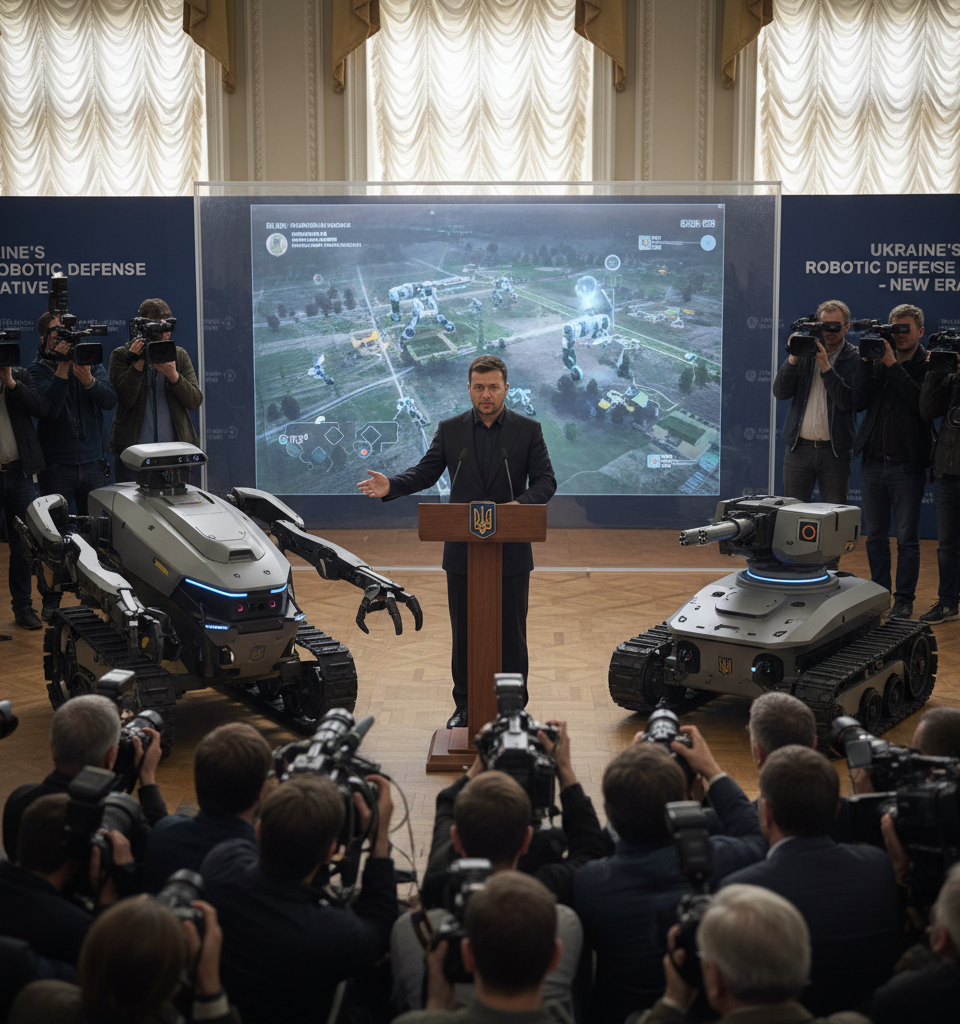
In a development poised to redefine ground combat, Ukrainian President Volodymyr Zelensky confirmed in April that his nation's armed forces executed the first-ever capture of an enemy stronghold using exclusively unmanned systems. This groundbreaking operation saw no human infantry involved in the direct assault, with drones and ground robots identifying targets, neutralizing defenses, and securing the position without a single Ukrainian soldier entering the contested zone. This strategic innovation not only minimized casualties but also showcased the increasing maturation of robotic warfare capabilities on the modern battlefield.
A Paradigm Shift in Modern Warfare
The successful robotic assault represents a critical inflection point in military doctrine. Throughout history, direct human engagement has been central to territorial acquisition, often at immense human cost. By leveraging advanced robotics and artificial intelligence, Ukraine has demonstrated a viable alternative, challenging long-held assumptions about combat efficacy and soldier deployment. This shift has profound implications for future conflicts, suggesting a move towards more technologically driven, casualty-averse strategies, particularly in high-risk environments. The operation underscores Ukraine's rapid adoption of innovative solutions in its ongoing defense.
Robotics Company Achieves Unicorn Status
The company responsible for the groundbreaking unmanned systems has experienced a meteoric rise in valuation following this display of battlefield prowess. While specific company names and detailed financial figures are often kept confidential for strategic reasons in wartime, sources close to the defense tech sector indicate that the firm, previously a promising startup, has now surpassed a $1 billion valuation. This achievement, commonly referred to as unicorn status, reflects the market's strong belief in the transformative potential of their technology and its immediate applicability in real-world combat scenarios. The surge highlights investor confidence in the future of autonomous military hardware.
The Technology Behind the Triumph
The successful assault relied on a sophisticated integration of aerial and ground-based autonomous platforms. Surveillance drones provided real-time intelligence and target acquisition, accurately pinpointing enemy emplacements and defensive fire. Concurrently, ground robots, likely equipped with small arms or specialized payloads, engaged enemy positions, suppressing resistance and ultimately securing the territory. This coordinated effort showcases the synergy between different types of unmanned systems, operating in tandem to achieve complex tactical objectives. The precision and coordination required for such an operation underscore significant advancements in AI planning and robotic control systems.
Industry Impact and Global Implications
This event is expected to reverberate across the global defense industry, accelerating research and development into autonomous ground combat vehicles and AI-powered tactical systems. Major defense contractors and emerging tech startups alike will likely intensify their focus on creating more robust, intelligent, and scalable robotic solutions. Nations worldwide, observing Ukraine's success, may re-evaluate their defense budgets and procurement strategies, allocating increased resources towards unmanned warfare capabilities. The market for defense robotics, already experiencing growth, is now poised for an even sharper upward trajectory.
Expert Perspectives on Autonomous Warfare
Defense analysts and military strategists are closely scrutinizing the Ukrainian operation. Dr. Elena Petrova, a leading expert on autonomous systems at the Global Security Institute, commented, "While ethical considerations surrounding lethal autonomous weapons systems remain paramount, Ukraine's demonstration proves the undeniable tactical advantage. The ability to achieve strategic objectives without risking human lives presents a compelling, albeit complex, argument for their broader integration." Other experts highlight the potential for these systems to reduce the psychological toll of combat on human soldiers, though concerns about accountability and the 'kill chain' persistence.
The Future of the Battlefield
Looking ahead, this milestone portends a future battlefield where human soldiers may primarily serve as overseers, commanding and coordinating sophisticated robotic units from safer distances. Further advancements are anticipated in swarm intelligence, where multiple unmanned systems operate as a cohesive, adaptive unit, and in AI's ability to navigate increasingly complex and dynamic combat environments. The development of counter-robotics and electronic warfare measures will also become crucial as nations adapt to this evolving threat landscape. Ukraine's innovation has not only secured a tactical victory but has also accelerated a global arms race in autonomous warfare, promising significant ongoing developments in military technology in the coming years.