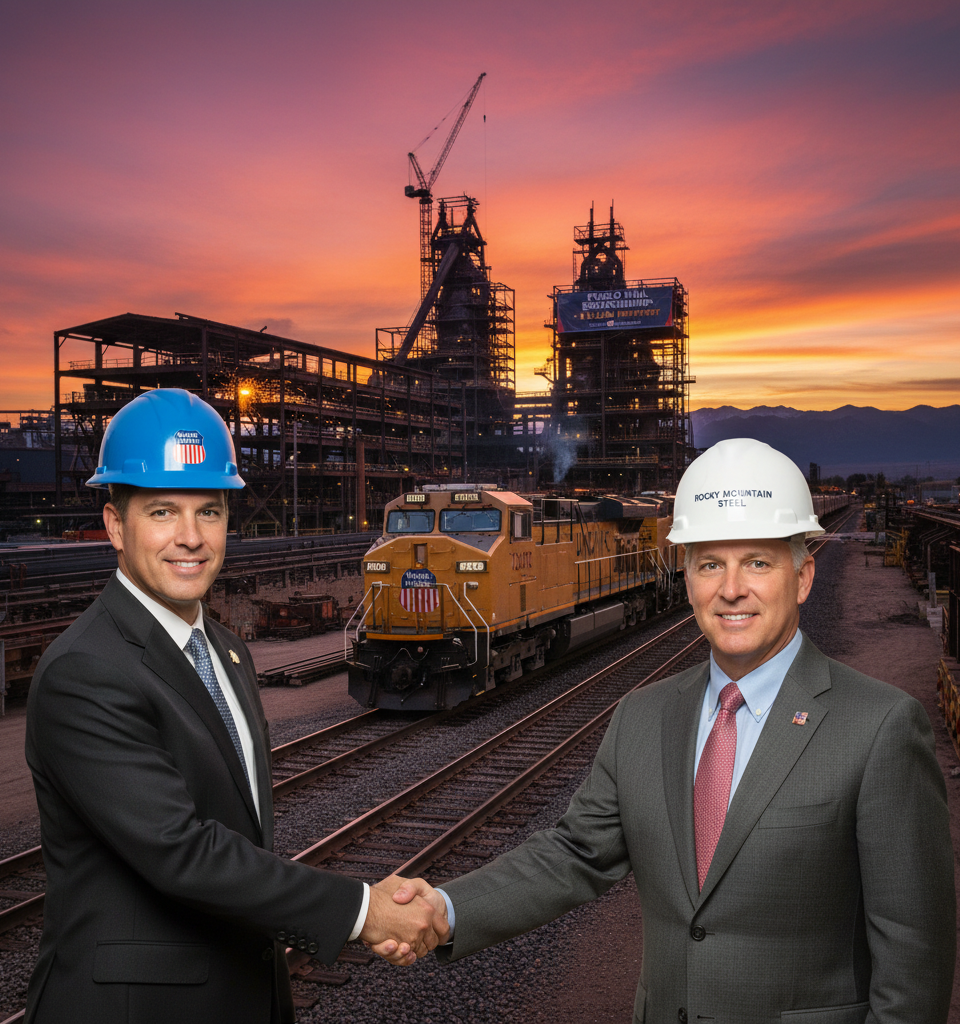
Union Pacific Railroad and Rocky Mountain Steel have officially resolved their long-standing disagreement, announcing a comprehensive seven-year commercial services agreement. This resolution is critical for the imminent operation of Rocky Mountain Steel's new, state-of-the-art long-rail mill in Pueblo, Colorado, slated to commence production later this year. The facility represents a significant component of a broader $1 billion investment aimed at bolstering domestic steel manufacturing capabilities.
A Resolution for Domestic Manufacturing
This agreement marks a crucial turning point following months of negotiations and uncertainty. The prior dispute had cast a shadow over the full operational capacity of the new Pueblo mill, a facility poised to become a cornerstone in the U.S. rail industry's supply chain. The successful resolution underscores the strategic importance both companies place on ensuring a stable domestic source for long rails, vital for maintaining and expanding the nation's vast rail infrastructure. For Union Pacific, securing a reliable supply of rails from a close geographical source enhances logistical efficiency and reduces dependence on overseas imports, aligning with broader national interests in supply chain resilience.
Investment and Economic Impact Rocky Mountain Steel's $1 billion investment in the
Pueblo plant is not just about a new mill; it's a testament to the resurgence of domestic steel production. This substantial capital injection supports advanced manufacturing technologies, promising higher quality and more efficient production of steel rails. The Pueblo facility is expected to create hundreds of direct and indirect jobs, providing a significant economic boost to the region and the state of Colorado. It also positions the United States more favorably in the global steel market, reducing reliance on foreign suppliers and mitigating risks associated with international trade fluctuations and geopolitical tensions.
Industry Repercussions and Market Dynamics
The extended agreement between Union Pacific and Rocky Mountain Steel is anticipated to have wide-ranging implications for the broader rail and steel industries. For rail operators, it secures a stable, competitively priced domestic source for rails, which are among the most critical components of railway infrastructure. This could lead to more predictable project timelines and budgeting for rail network maintenance and expansion projects. In the steel sector, it strengthens the position of domestic producers against international competitors, especially at a time when global supply chains are under scrutiny and protectionist sentiments are growing. Analysts believe this move could encourage further domestic investment in heavy industry.
Expert Insights on Supply Chain Stability
Industry analysts view this seven-year agreement as a significant step towards reinforcing domestic supply chain stability. "This long-term commitment provides both parties with much-needed predictability and certainty," stated Dr. Eleanor Vance, a supply chain economist at the Rail Transportation Institute. "For Union Pacific, it mitigates the risks of reliance on volatile international markets, while for Rocky Mountain Steel, it guarantees a substantial, long-term customer for its new flagship facility. This is a win-win that reflects a growing trend towards reshoring critical manufacturing capabilities, particularly in foundational industries like steel." The emphasis on long-term contracts helps cushion against future economic shocks and ensures consistent material flow.
The Road Ahead for Pueblo and Beyond With the agreement now cemented, Rocky Mountain
Steel is prepared to accelerate its timeline for the Pueblo long-rail mill's grand opening later this year. The focus will now shift to optimizing production, ensuring quality control, and meeting the substantial demand from Union Pacific and potentially other rail operators. This development could also catalyze further industrial growth in Pueblo, attracting ancillary businesses and skilled labor. Looking ahead, this partnership sets a precedent for how major infrastructure companies and raw material suppliers can collaborate to fortify national industrial capabilities and navigate an increasingly complex global economic landscape. The success of this venture will be closely watched as a model for future domestic industrial revitalization efforts.