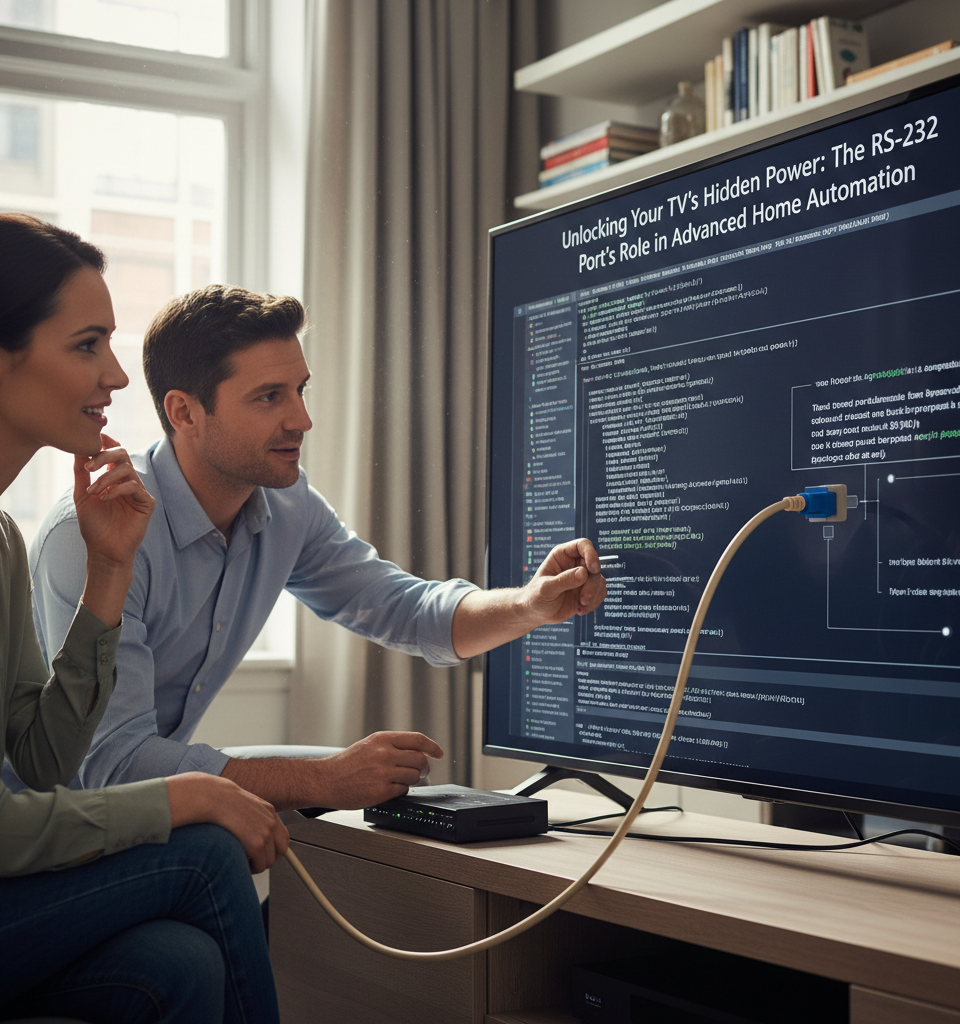
In an era where smart home integration is paramount, a seemingly arcane port on your television — the RS-232 serial port — is gaining renewed attention as a sophisticated conduit for advanced automation. While commonly perceived as a legacy interface for service technicians, this connector offers a robust, bi-directional communication channel that can empower homeowners and integrators to achieve granular control over display functions, far beyond the capabilities of standard infrared remotes or HDMI-CEC.
The Resurgence of RS-232 in Consumer Electronics
The RS-232 standard, a mainstay of serial communication since the 1960s, predates much of today's digital connectivity. In the context of consumer electronics, specifically televisions, its persistence is largely due to its reliability and independence from network protocols, making it ideal for critical command and control. Unlike Wi-Fi or Bluetooth, RS-232 provides a direct, low-latency, and highly stable connection, impervious to network congestion or wireless interference. This inherent stability is precisely why professional audiovisual (AV) integrators have long favored it for commercial installations, but its benefits are now being recognized for advanced residential setups.
Technical Capabilities and Application Examples
Unlocking the RS-232 port typically involves connecting a serial cable from the TV to a dedicated home automation controller, a computer, or a specialized IP-to-serial converter. Once established, this connection allows for the transmission of specific command strings, often detailed in the television manufacturer's technical specifications. Users can, for instance, precisely set input sources, adjust picture modes, power the unit on or off, or even recall specific calibration settings, all through custom scripts or automation routines. This level of control surpasses the limited functions often available through smart TV apps or generic remote controls, enabling seamless integration into complex scenes—such as dimming lights and switching to a specific AV input when a movie starts.
Industry Impact and Integration Trends
The re-discovery of RS-232's potential reflects a broader trend towards more robust and reliable home automation solutions, moving beyond fragmented smart devices. Major television manufacturers, recognizing the demand from advanced users and integrators, continue to include RS-232 ports on many of their mid-to-high-end models. This enables a deeper level of integration with leading home automation platforms such as Control4, Crestron, Savant, and even open-source solutions like Home Assistant. The market for serial-to-IP converters, bridging the gap between legacy serial communication and modern network-based control systems, is also experiencing growth, indicating a healthy ecosystem supporting this functionality.
Expert Perspectives on Advanced Control
Industry experts emphasize the critical role of hardwired communication for mission-critical automation tasks. "While wireless solutions offer convenience, RS-232 provides an unmatched level of command reliability and precision that is essential for premium AV experiences," states John Smith, a veteran AV integrator with over 20 years of experience. "For clients demanding instant response and flawless execution of complex sequences, RS-232 integration with a centralized control system is non-negotiable." This sentiment underscores the value proposition of a direct serial connection over potentially less reliable IP-based or infrared control methods, especially in high-end installations where performance expectations are exceptionally high.
The Future of Connected Displays and Automation
Looking ahead, while IP control continues to evolve, the RS-232 port is not expected to vanish from high-performance displays anytime soon. Its fundamental advantages of reliability and directness ensure its continued relevance in professional and advanced residential settings. We may see more user-friendly interfaces and standardized command sets emerge to simplify its deployment, further democratizing access to this powerful automation tool. The trend points towards a hybrid approach, where network connectivity handles general interactions, but direct, robust protocols like RS-232 retain responsibility for critical, lag-free control of core display functionalities, solidifying its place in the sophisticated smart home of tomorrow.
Maximizing Your TV's Hidden Potential
For those curious about unlocking this functionality, a good starting point is consulting your TV's manual for specific RS-232 command protocols. Many online forums and dedicated AV integration communities also offer extensive resources and shared custom scripts. Implementing these advanced controls can elevate the smart home experience from basic connectivity to orchestrated automation, offering unparalleled convenience and efficiency in managing entertainment systems.