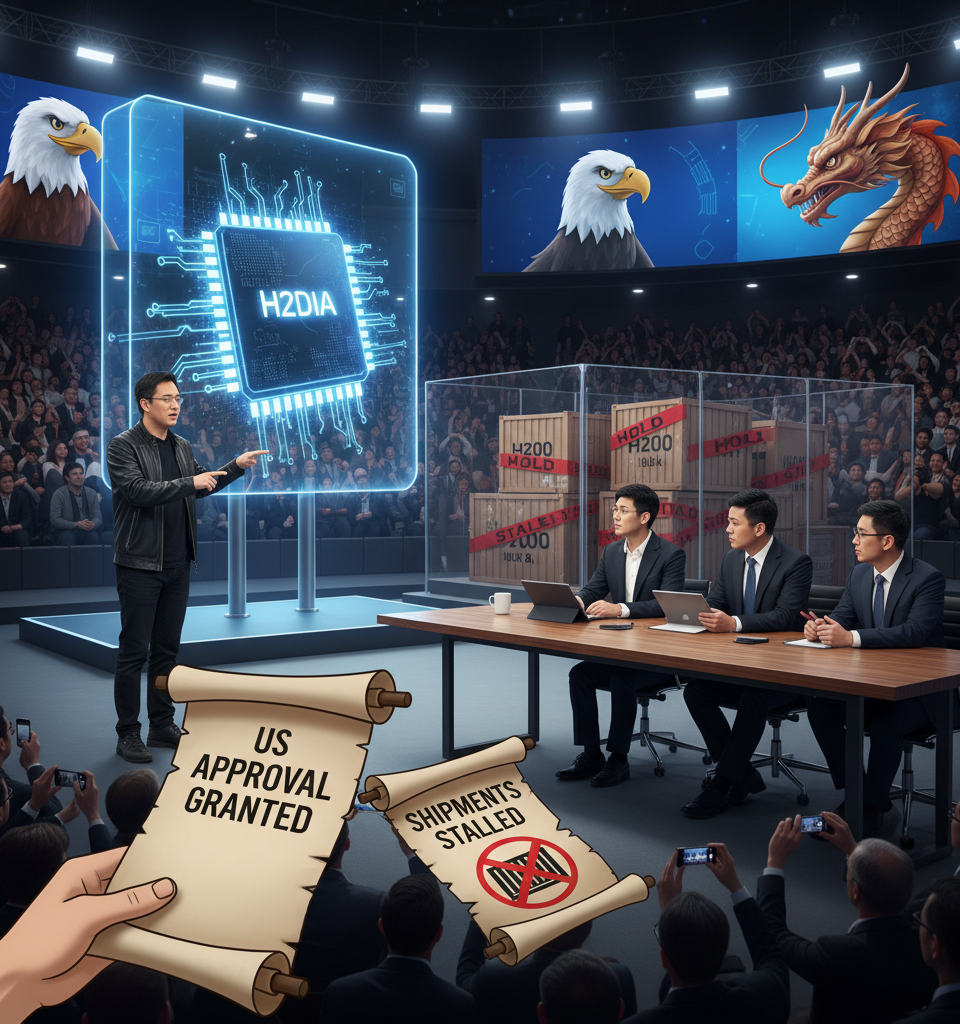
The United States government has quietly approved licenses permitting ten prominent Chinese technology companies, including industry giants Alibaba, Tencent, ByteDance, and JD.com, to acquire Nvidia's highly sought-after H200 artificial intelligence chips. These approvals, each reportedly valid for up to 75,000 units per company, represent a significant — though currently unresolved — development in the fraught landscape of US-China tech trade. Despite Washington's green light, sources indicate that Beijing has instructed its domestic tech sector to pause purchases, creating an unprecedented deadlock where demand and supply are authorized, yet flow is blocked.
Context of US-China Tech Rivalry
This development unfolds against a backdrop of escalating technological competition and export controls imposed by the US, aimed at curbing China's advancements in critical areas like AI and supercomputing. The Biden administration has increasingly tightened restrictions on the sale of advanced semiconductors and chip-making equipment to China, citing national security concerns. Nvidia's previous generation of high-performance AI chips, like the A100 and H100, were subjected to these restrictions, leading Nvidia to develop downgraded versions, such as the H20 and L20, specifically for the Chinese market. The H200, an even more powerful successor to the H100, boasts enhanced memory bandwidth and capacity, making it crucial for cutting-edge AI model training.
Key Details and Unshipped Chips
The ten Chinese firms collectively hold licenses to purchase hundreds of thousands of these advanced H200 chips. Specifically, each of the ten companies is authorized for up to 75,000 units, totaling a potential maximum of 750,000 H200 units. Despite this substantial approval, no units have reportedly been shipped. The primary reason for this standstill is Beijing's alleged directive to its tech companies to exercise caution and defer purchases. This instruction from the Chinese government is particularly noteworthy, given the immense global demand for these chips and their strategic importance for AI development. Industry observers suggest this might be a tactical move by Beijing to gain leverage or reassess its domestic AI strategy, possibly eyeing indigenous alternatives or seeking more favorable terms.
Industry and Market Impact
The impasse has significant ramifications for both the US and Chinese technology sectors. For Nvidia, the potential loss of hundreds of thousands of chip sales to a crucial market presents a substantial revenue setback, despite robust global demand. For Chinese tech giants, access to state-of-the-art AI accelerators is paramount for maintaining their competitive edge in developing large language models and other AI applications. Delays in acquiring these chips could hinder their progress and widen the technological gap with their Western counterparts. The situation also underscores the geopolitical risks embedded in global supply chains for critical technologies, forcing companies to tread carefully between the demands of two economic superpowers.
Expert Perspective
Technology analysts are closely watching this unfolding situation. "This isn't just about chips; it's about control over the future of artificial intelligence," noted one expert from a leading technology consultancy. "Beijing's instruction to hold off on purchases, despite US approval, indicates a deeper strategic play than just procurement. It suggests China might be signaling its displeasure with US export controls or perhaps bolstering its domestic chip aspirations." Another analyst highlighted the precarious position of companies like Nvidia, caught in the crossfire of geopolitical tensions, having to navigate complex regulatory landscapes while balancing shareholder expectations and strategic market access.
What's Next: Jensen Huang's Beijing Trip and Future Implications
Adding another layer to this intricate situation, reports suggest that Nvidia CEO Jensen Huang has been included in former President Donald Trump's upcoming itinerary for a potential visit to Beijing. While direct confirmation from both parties is pending, the inclusion of such a high-profile technology executive on a sensitive diplomatic trip hints at a concerted effort to break the current deadlock. The outcome of any potential discussions involving Huang could significantly influence the future trajectory of AI chip sales to China.
Moving forward, the industry will be monitoring whether Beijing eases its stance, if a diplomatic resolution emerges, or if Chinese companies will increasingly rely on less powerful, domestically-produced alternatives, which could accelerate China's indigenous chip development efforts in the long term. This situation is a microcosm of the broader technological and economic decoupling trend between the two global powers.