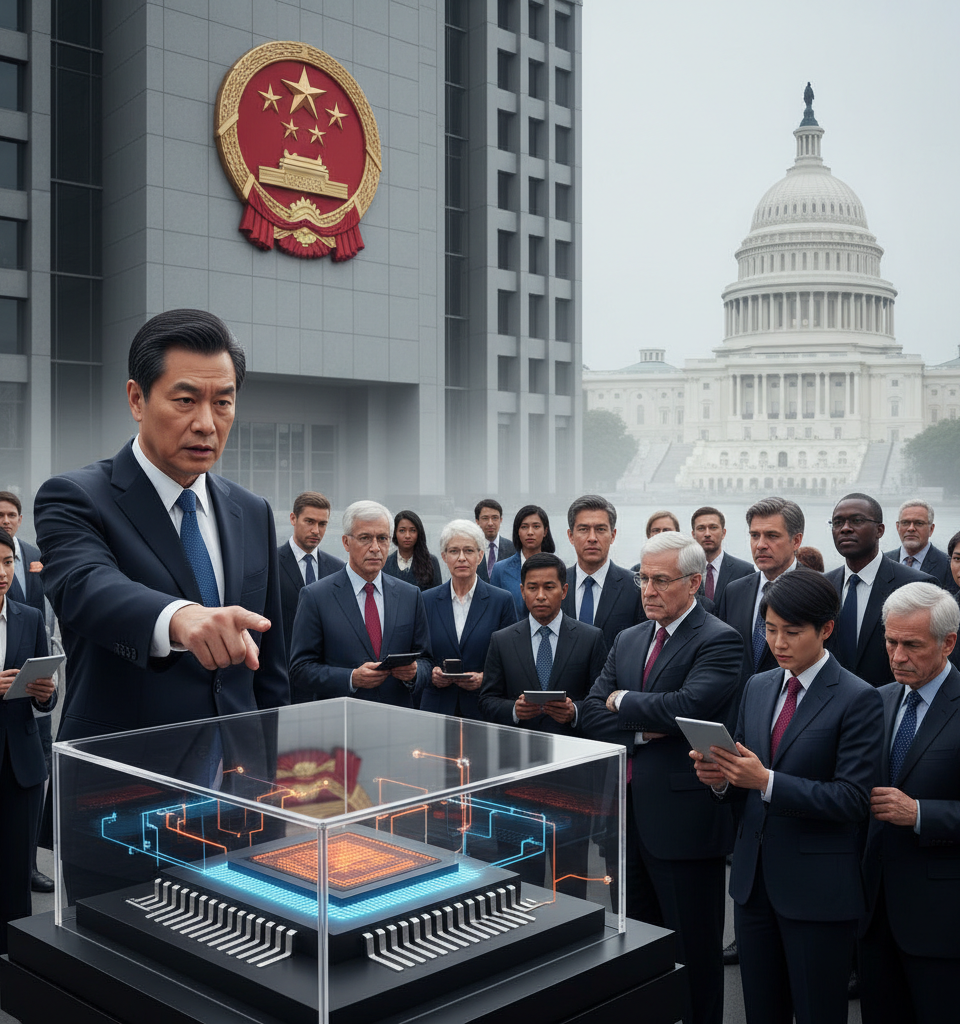
Beijing has forcefully pushed back against proposed US legislative efforts to restrict China's access to semiconductor manufacturing equipment, warning that such measures would unleash widespread disruption across the global economy. Last Friday, China's Ministry of Commerce declared that the Multilateral Alignment of Technology Controls on Hardware (MATCH) Act, currently advancing through the US Congress, would profoundly "severely disrupt the international economic and trade order and seriously undermine the stability of the global semiconductor industry chain and supply chain." This latest verbal volley underscores the deepening chasm between the world's two largest economies over technological dominance, specifically in the critical semiconductor sector.
For years, the US has expressed national security concerns over China's rapid advancements in chip manufacturing, fearing potential military applications and economic leverage. China, in turn, views these restrictions as an attempt to stifle its technological progress and maintain American hegemony, vowing to achieve self-sufficiency in chip production. The MATCH Act, following its passage in the House of Representatives, seeks to formalize and expand export controls on advanced semiconductor technology, equipment, and intellectual property to adversarial nations, primarily targeting China.
Proponents of the bill argue it is essential to prevent advanced technology from falling into the hands of competitors who could pose a threat to US interests. The legislation aims to coordinate these controls with international partners, ostensibly to create a united front against technology transfer. However, the potential ramifications for the global tech supply chain are immense.
The semiconductor industry is inherently interdependent, with design, manufacturing, and assembly processes often spanning multiple countries. China's role as both a massive consumer and an increasingly sophisticated producer of chips means that any significant disruption to its access or output could send shockwaves throughout industries reliant on semiconductors, from consumer electronics to automotive manufacturing and telecommunications. Analysts estimate that a severe decoupling could wipe out hundreds of billions of dollars in global economic output over several years.
Industry experts are divided on the long-term efficacy and wisdom of such aggressive measures. "While the US intends to hobble China's advanced chip capabilities, the reality is that the global semiconductor ecosystem is so interconnected that an attempt to sever one major node will inevitably ripple across the entire network," stated Dr. Evelyn Chang, a senior analyst at Tech Insights Inc. "
Companies from South Korea, Taiwan, Japan, and European nations that supply crucial equipment and materials to both the US and China will face immense pressure, and likely significant financial losses, ultimately leading to higher costs and potentially reduced innovation across the board." She added that the move could inadvertently accelerate China's drive for indigenous technological breakthroughs, creating a more robust, if isolated, domestic industry. The immediate future will see intensified lobbying efforts on both sides of the Pacific.
US lawmakers will continue to push for the MATCH Act's passage through the Senate, while the Biden administration will attempt to rally international support for a coordinated approach to technology controls. Meanwhile, Beijing is expected to strategize potential retaliatory measures, which could include export restrictions on rare earth minerals essential for high-tech manufacturing, or intensified domestic investment in its own semiconductor R&D and production capabilities, aiming to reduce its reliance on foreign technology. The global tech industry is bracing for a period of heightened volatility, as the struggle for semiconductor supremacy continues to escalate.
The long-term implications could redefine global trade patterns and technological alliances. If the MATCH Act becomes law and leads to a more fractured semiconductor supply chain, countries may be forced to choose sides, potentially creating distinct technological blocs. This division could lead to a less efficient, more costly, and ultimately less innovative global technology landscape, fundamentally altering how advanced electronics are designed, manufactured, and distributed for decades to come.