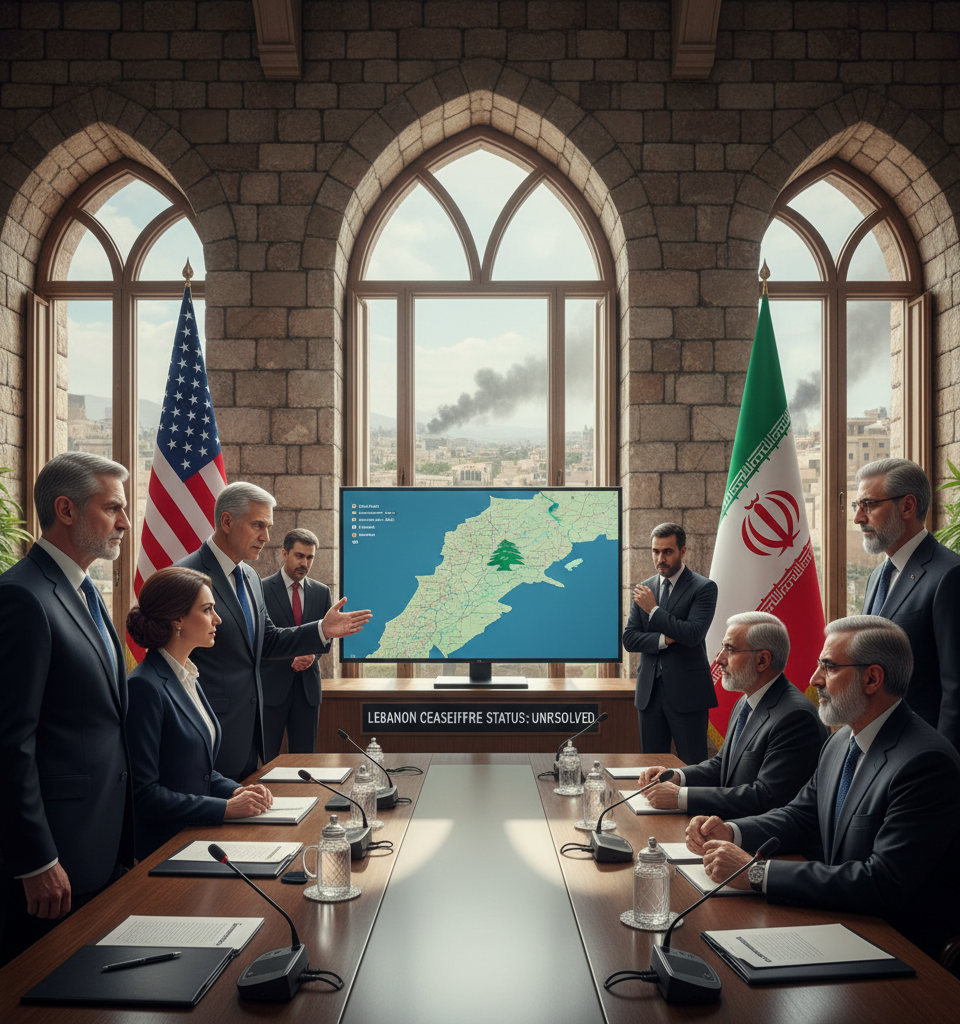
Washington D.C./Beirut – A nascent international effort to de-escalate regional conflict faces immediate peril as a fundamental disagreement over Lebanon's inclusion in a recently brokered ceasefire agreement pits the United States against Iran. While U.S. officials maintain the accord, designed primarily to halt hostilities in another major theater, explicitly excludes Lebanon, Tehran and its regional proxies assert the deal's comprehensive reach. This burgeoning semantic and diplomatic battle is unfolding against a backdrop of continued Israeli military operations in south Lebanon, highlighting the precarious nature of regional stability and Iran's strategic imperative to signal unwavering support for its allies.
The Unraveling Thread of De-escalation
The dispute casts a long shadow over the efficacy of international diplomatic initiatives aimed at calming a volatile region. At its core, the disagreement stems from differing interpretations of a ceasefire agreement whose specifics are not fully public but were understood by Washington to be geographically delimited. Iran, however, is leveraging the ambiguity, or perhaps a deliberately broad interpretation, to assert its influence and reassure its Lebanese ally, Hezbollah, that it remains a crucial component of broader regional considerations. This divergence of understanding threatens to render the entire ceasefire meaningless in a critical area, potentially triggering a wider conflagration.
Contradictory Claims and Renewed Bombardments
Sources close to the U.S. State Department, speaking on condition of anonymity due to the sensitivity of ongoing negotiations, firmly stated that the draft and final language of the ceasefire agreement unambiguously pertained to a distinct conflict zone, excluding Lebanon. Conversely, Iranian Foreign Ministry officials have publicly insinuated, and in some instances, directly claimed, that the ceasefire’s scope extends to all fronts where Iran's 'Axis of Resistance' is engaged. This diplomatic tug-of-war is not merely rhetorical; it has direct implications for the ground reality. Israeli forces have reportedly intensified strikes in southern Lebanon over the past 48 hours, with reports indicating at least 15 separate aerial bombardments targeting suspected Hezbollah positions, resulting in an estimated $50 million in infrastructure damage and displacing thousands of civilians in border towns.
Broader Regional Ramifications
Beyond the immediate cessation of hostilities, the inclusion or exclusion of Lebanon holds significant strategic implications for the wider Middle East. For Iran, ensuring Lebanon's coverage under any ceasefire is a fundamental demonstration of its commitment to its proxy networks, particularly Hezbollah, a critical non-state actor in its regional strategy. The perception of abandonment could severely undermine Iran's credibility and influence. For the U.S. and its regional allies, an expanded ceasefire that inadvertently grants concessions to Iran's proxies could be viewed as a diplomatic misstep, emboldening actors that Washington seeks to contain. This complex interplay directly impacts regional energy security, international shipping lanes, and the already fragile peace processes across several flashpoints.
Expert Analysis: A Perilous Diplomatic Dance
Dr. Elaine Chen, a senior fellow at the Middle East Institute, observes, "This isn't merely a misunderstanding; it's a deliberate strategic ambiguity employed by Iran to project strength and exert pressure." She adds, "The U.S. position seeks to isolate specific conflicts, while Iran's overarching goal is to present a unified front of resistance. The success of any ceasefire hinges on clearly defined parameters, and the lack thereof in the Lebanese context is an immediate vulnerability. We could see a significant escalation if both sides dig in." Analysts suggest that Iran's stance is also intended to rally domestic support and demonstrate unwavering commitment to its foreign policy objectives to its own populace and regional partners.
What Lies Ahead: Escalation or Redefinition?
The immediate future of the ceasefire agreement now hangs precariously. Diplomats are scrambling behind the scenes to clarify the precise geographical scope of the agreement, but the public posturing makes such a re-definition challenging. Failure to resolve this dispute could see a rapid escalation of Israeli-Hezbollah hostilities, potentially drawing in other regional actors. The U.S. may be forced to re-engage with Iran directly on this specific point, a prospect that carries its own diplomatic challenges. Observers anticipate intensified diplomatic shuttles and potentially a revised, more explicit agreement attempting to salvage the broader ceasefire. The alternative is a return to full-scale conflict, with severe humanitarian and economic consequences for an already beleaguered Lebanon and the wider region.
Economic and Human Costs
Lebanon, grappling with its own profound economic crisis—a 90% currency devaluation since 2019 and over 80% of its population living below the poverty line—can ill afford an expanded conflict. Renewed hostilities could obliterate nascent recovery efforts, further destabilize its fragile political landscape, and exacerbate a humanitarian crisis already straining regional resources. The international community watches anxiously, aware that the stakes involve not just regional peace but global economic stability tied to energy markets and shipping. The coming days will be crucial in determining whether diplomacy triumphs over ambiguity or if the region descends further into protracted conflict.