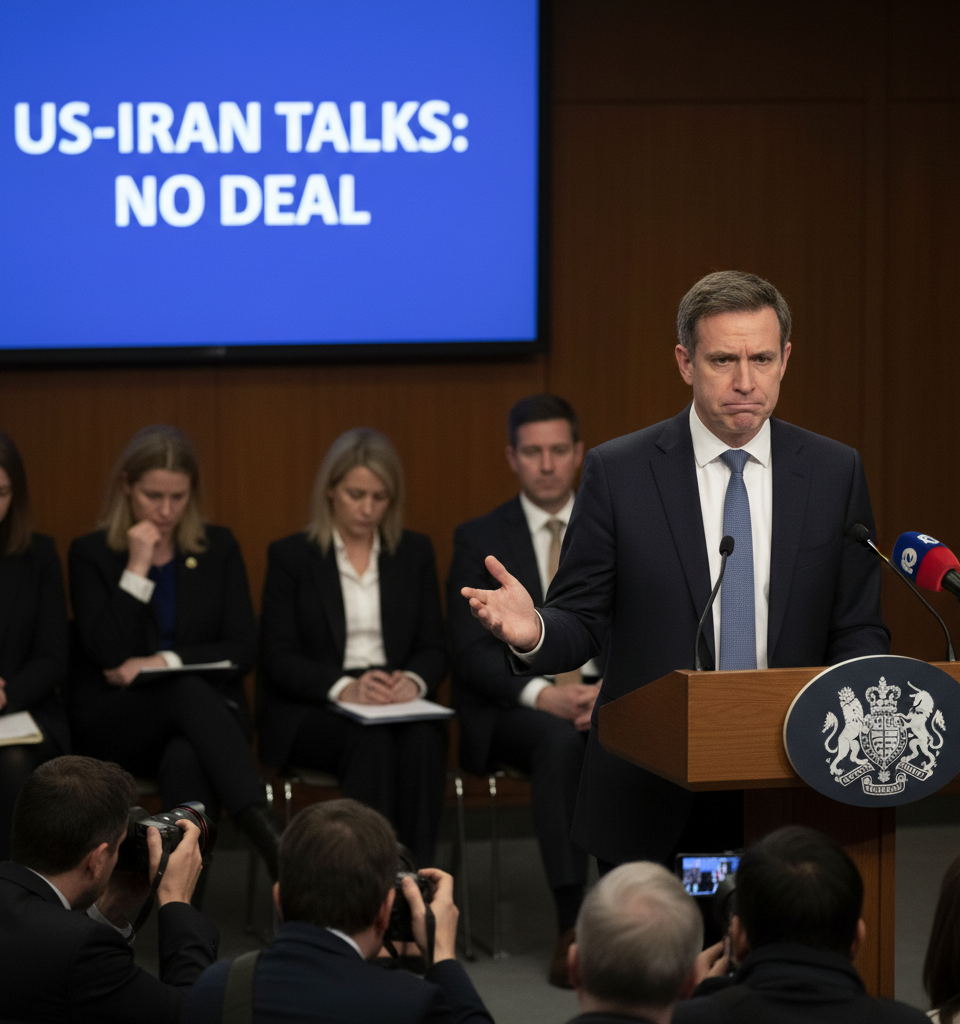
London, UK – May 19, 2026 – Reports circulating today indicate that critical negotiations between the United States and Iran have concluded without a significant breakthrough, a development that has elicited disappointment from the United Kingdom. Health Secretary Streeting articulated the UK's position, underscoring the nation's keen interest in seeing a resolution that effectively curtails Iran's nuclear aspirations, despite not being a direct participant in the current round of discussions.
The lack of a definitive agreement following these high-stakes talks marks a crucial juncture in the ongoing international efforts to manage Iran's nuclear program. The UK's sentiment, as conveyed by Streeting, reflects a broader international concern regarding the implications of a stalled diplomatic process and the potential for increased regional instability if a nuclear deal remains elusive. The persistent stalemate poses significant challenges for global non-proliferation efforts and underscores the complex geopolitical dynamics at play.
Geopolitical Stakes and UK's Indirect Role
The UK, while not formally at the negotiating table for this specific bilateral engagement between Washington and Tehran, has historically been a significant voice in the P5+1 group that brokered the original Joint Comprehensive Plan of Action (JCPOA). Its continued engagement on the issue, even from an observer status, highlights the interconnectedness of international security and the perceived threat of a nuclear-armed Iran. Streeting's comments serve as a reminder that major global powers collectively bear responsibility for upholding non-proliferation treaties and seeking peaceful resolutions to such complex issues.
The health secretary's intervention, though from a portfolio not directly responsible for foreign policy, signals the cabinet's unified stance on this critical international matter. It emphasizes that the potential ramifications of Iran's nuclear program extend beyond immediate security concerns, touching upon broader global stability and the international order. The UK's expressed desire is not merely for a temporary halt but for an enduring framework that permanently dismantles any possibility of Iran developing nuclear weapons, aligning with international consensus on the matter.
The Unresolved Nuclear Ambitions
The core of the international community's concern revolves around Iran's enrichment activities and its growing stockpile of enriched uranium. Without a robust agreement, fears persist that Iran could potentially shorten its 'breakout time' – the period required to produce enough fissile material for a nuclear weapon. The talks aimed to address these concerns through a combination of sanctions relief for verifiable restrictions on Iran's nuclear program, but the reported outcome suggests significant gaps remain between the two sides.
The failure to secure a deal at this juncture could have ripple effects across the Middle East. Regional allies of the United States, particularly those that view Iran's nuclear program as an existential threat, will be closely watching for Washington's next steps. Similarly, Iran's regional adversaries may interpret a prolonged stalemate as an escalation of risk, potentially leading to increased tensions and a more volatile security environment in an already fragile region.
Broader Implications for Global Diplomacy
Beyond immediate security considerations, the absence of a deal also casts a shadow over the efficacy of international diplomacy in resolving complex, long-standing disputes. The US-Iran talks have been a bellwether for the international community's ability to navigate deep-seated mistrust and conflicting national interests. A continued deadlock could inadvertently embolden other states to pursue their own nuclear programs, viewing diplomatic channels as less effective in preventing such proliferation.
For the global energy markets, particularly given the backdrop of fluctuating oil prices, the outcome of these talks also holds significance. The potential return of Iranian oil to global markets, contingent on sanctions relief tied to a nuclear agreement, could influence supply dynamics. The current impasse, therefore, removes a variable that could have provided some stability to energy prices, leaving market analysts to recalibrate their forecasts based on continued uncertainty.
What Lies Ahead: Awaiting Further Developments
Looking forward, the immediate implications are a continuation of the status quo, marked by international pressure on Iran and further diplomatic efforts to bridge the divide. It remains unclear what specific mechanisms, if any, will be employed to restart or reframe negotiations. The UK's position, as stated by Streeting, indicates a willingness to continue supporting diplomatic solutions that ultimately result in a verifiable and permanent end to Iran's nuclear weapons program.
The prospect of renewed talks, perhaps with different intermediaries or a revised agenda, cannot be ruled out. However, the reported conclusion of this round without an agreement means that the international community, led by states like the UK, will likely intensify its strategic deliberations on how best to de-escalate tensions and bring Iran back into full compliance with international nuclear norms. The coming weeks will be critical in observing any shifts in diplomatic strategy from Washington, Tehran, and other involved global powers.