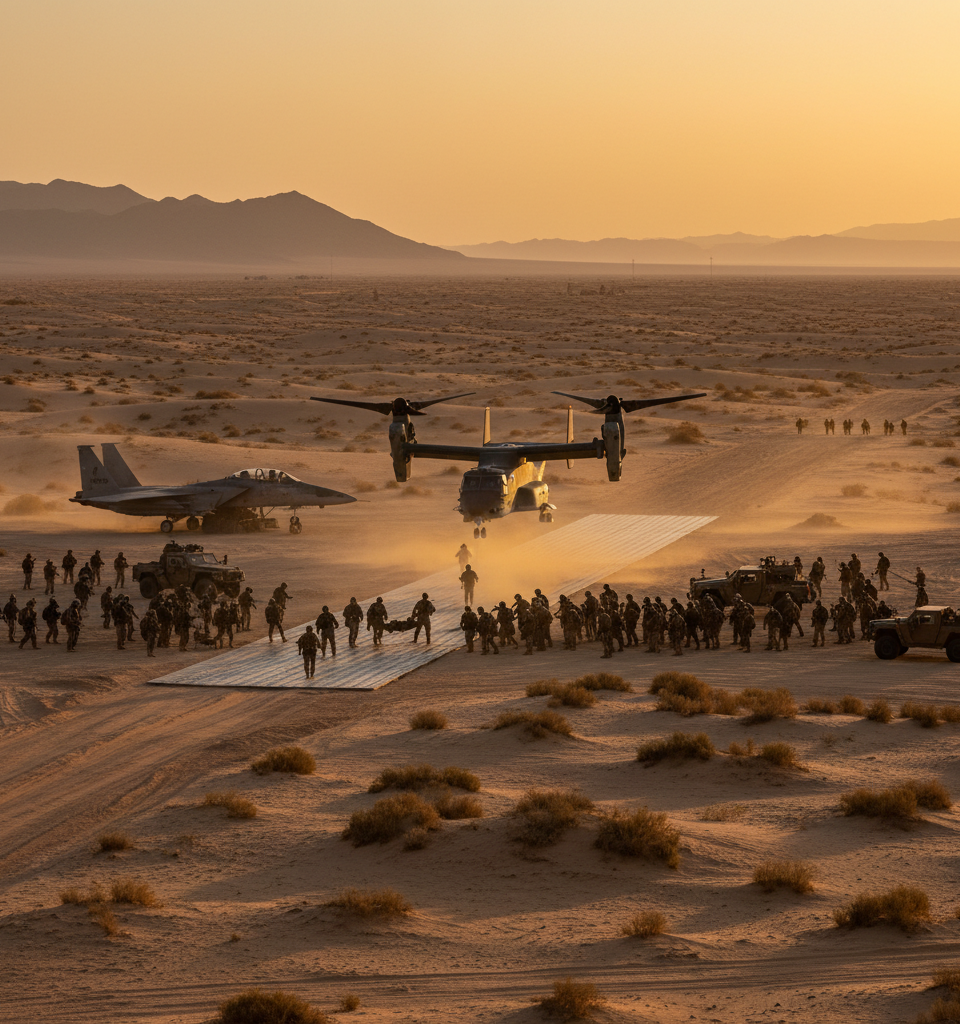
TWENTYNINE PALMS, CA – The specter of a downed U.S. F-15 pilot needing rescue deep within Iranian territory recently formed the crucial backdrop for a novel military exercise, as U.S. Marines demonstrated their capability to construct and operate an improvised airfield in a austere desert environment. This high-stakes simulation, conducted over the past 48 hours, provides a stark and potentially unsettling preview of the logistical and operational challenges inherent in any future U.S. ground intervention against Iran. The scenario, centered on the urgent extraction of a combat pilot, underscores the Pentagon's ongoing preparedness for complex, high-risk operations in contested regions, offering unprecedented insight into the scope and potential for achievement of such missions.
This recent exercise draws a direct parallel to historical and hypothetical scenarios where access to established infrastructure is denied, forcing military planners to consider unconventional solutions. The U.S. military has long grappled with the strategic dilemma of operating within heavily defended enemy territory, particularly against nation-states with sophisticated air defense systems and established ground forces. The simulation indirectly acknowledges Iran's layered air defense capabilities, including Russian-made S-300 systems and domestically produced equivalents, which could severely complicate traditional air rescue missions from forward operating bases. Past incidents, such as the 1980 'Eagle Claw' mission during the Iran hostage crisis, highlight the immense challenges and risks associated with complex, clandestine operations in hostile environments.
Key to this recent exercise was the Marine Air-Ground Task Force (MAGTF) concept, showcasing the rapid deployment and construction of a rudimentary landing strip capable of supporting tactical transport aircraft, such as the C-130 Hercules. While specific details on the number of personnel involved or the exact timeline for airfield construction were not publicly disclosed, the exercise emphasized speed, stealth, and self-sufficiency. The ability to quickly establish an operational airstrip, even for a limited duration, dramatically expands the options available for combat search and rescue (CSAR) and special operations forces (SOF) missions. This capability is paramount in scenarios where conventional airbases are too distant, compromised, or are subject to intense interdiction by enemy forces.
From a broader geopolitical perspective, the implications of such a demonstrated capability are significant. It signals to adversaries, and allies alike, the U.S. military's commitment to projecting power and rescuing its personnel in even the most challenging circumstances. For defense contractors and the broader aerospace industry, this emphasis on rapid, expeditionary airfield construction could spur further innovation in portable aviation infrastructure, rapid deployment technologies, and specialized ground support equipment. The market for lightweight, durable materials capable of withstanding extreme environmental conditions, as well as advanced sensor technologies for covert site assessment, is likely to see renewed interest and investment. Companies specializing in modular construction and austere logistics could find new avenues for growth.
Defense analysts are quick to point out the dual message embedded in such exercises. Dr. Eleanor Vance, a senior fellow at the Center for Strategic and International Studies (CSIS), commented, "This isn't just about pilot rescue; it's a clear signal of the U.S. military's resolve and increasing adaptability for unforeseen contingencies. It complicates the calculus for any potential adversary planning to deter or isolate U.S. forces, demonstrating an asymmetric response capability that can bypass conventional defensive layers." She further noted the potential for such techniques to apply to other high-value asset recuperation or limited-duration infiltration/exfiltration operations.
Looking ahead, this demonstration suggests a continued evolution in how the U.S. military plans for and executes complex operations in non-permissive environments. Future developments could involve further integration of advanced drone technology for reconnaissance and security, refined techniques for camouflage and deception, and enhanced capabilities for medical stabilization and rapid evacuation in the field. The focus will likely remain on reducing the logistical footprint while increasing the operational reach and combat effectiveness of small, highly trained units. This exercise serves as a potent reminder that even as technological warfare advances, the fundamental challenge of operating on hostile ground remains a critical component of military strategy.
The implications extend beyond Iran, offering a template for operations in other contested regions such as the South China Sea or Eastern Europe. The ability to quickly establish temporary air access points could prove invaluable in any future conflict involving peer or near-peer adversaries, where air superiority cannot be guaranteed, and infrastructure is often a primary target. The continuous refinement of these expeditionary capabilities ensures that the U.S. military maintains a flexible and formidable posture across the global theater.