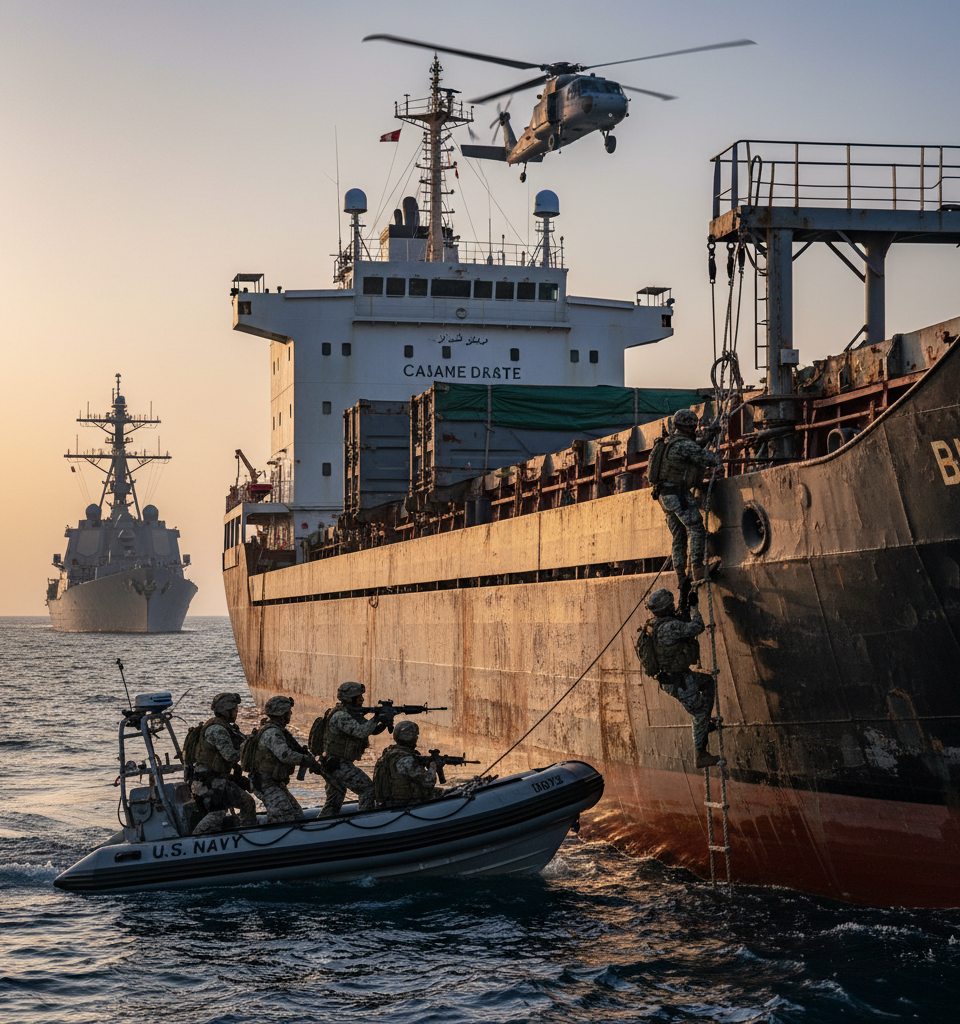
WASHINGTON D.C. — The United States military is poised to commence boarding and seizing commercial vessels in international waters suspected of involvement in Iran-linked illicit activities, according to a report by The Wall Street Journal. Citing unnamed U.S. officials, the operation is anticipated to unfold in the coming days, marking a substantial escalation in the U.S.'s ongoing efforts to disrupt Tehran's revenue streams and exert pressure through maritime enforcement.
This impending action underscores a deepening commitment by the U.S. to counter what it perceives as Iran's destabilizing regional influence, particularly its alleged role in supplying weaponry and funding to proxy groups. The historical backdrop for these maritime interdictions includes years of U.S. sanctions aimed at crippling Iran's oil exports and financial networks. Previous incidents, such as the frequent harassment of commercial shipping in the Persian Gulf and Strait of Hormuz by Iran's Islamic Revolutionary Guard Corps (IRGC), lay the groundwork for these assertive U.S. countermeasures. The U.S. Fifth Fleet, based in Bahrain, has repeatedly warned about Iranian threats to maritime security in the region.
Key details surrounding the planned operation remain under wraps, with officials declining to specify the exact locations or types of vessels being targeted. However, the report suggests a focus on oil tankers and other commercial ships suspected of circumventing international sanctions. This preemptive move aims to deter further illicit trade, particularly crude oil sales which provide a vital source of foreign currency for the Iranian regime. While specific numbers are not yet available, similar past seizures have involved millions of barrels of oil, with estimated values in the hundreds of millions of dollars, a significant blow to Iran's sanctioned economy.
The potential for widespread seizures carries substantial implications for global shipping and the energy markets. Analysts anticipate increased insurance premiums for vessels operating in the Persian Gulf and surrounding areas, already a high-risk zone. A sustained campaign of interdictions could further tighten global oil supplies, potentially leading to upward pressure on crude prices. The Strait of Hormuz, a critical chokepoint for approximately 20% of the world's oil supply, could see heightened volatility and security concerns, directly impacting consumer prices and industrial costs worldwide.
Maritime security experts and geopolitical analysts are closely monitoring these developments. Dr. Eleanor Vance, a senior fellow at the Carnegie Endowment for International Peace, commented, "This is a clear signal from Washington that the era of passive observation regarding Iranian sanctions evasion is over. While impactful, it also carries inherent risks of miscalculation and potential confrontation in one of the world's most sensitive waterways." Others suggest that the move is a calibrated response to what they view as Iran's continued defiance of international norms and its nuclear enrichment program.
Looking ahead, the immediate future will see intensified naval presence and surveillance in critical maritime corridors. The success of these operations will likely be measured not only by the number of seizures but also by their deterrent effect on future Iranian illicit activities. Potential Iranian retaliation, whether direct or through proxy attacks on commercial shipping, remains a significant concern, necessitating a delicate balance between assertive enforcement and de-escalation strategies. International reactions, particularly from major oil importers and regional allies, will be crucial in shaping the long-term impact of this intensified U.S. maritime strategy.
Potential Diplomatic Repercussions
The U.S.'s assertive stance could also have significant diplomatic repercussions. While some allies may welcome stronger enforcement against Iran, others might express concerns about the potential for escalating tensions in an already volatile region. The timing of this action also coincides with ongoing, albeit stalled, efforts to revive the Joint Comprehensive Plan of Action (JCPOA), or Iran nuclear deal. A series of successful interdictions could complicate future diplomatic overtures, further entrenching positions from both Washington and Tehran.
Economic Sanctions and Their Efficacy
This maritime enforcement builds upon a foundation of comprehensive economic sanctions against Iran, led primarily by the U.S. Despite these sanctions, Iran has consistently sought ways to export its oil and generate revenue, often through sophisticated networks involving shell companies and clandestine shipping routes. The effectiveness of these sanctions has been a perennial debate, with proponents arguing they are essential to curb Iran's nuclear ambitions and regional adventurism, while critics point to their humanitarian impact and limited success in fundamentally altering Tehran's policies. The current boarding strategy represents a more direct and confrontational approach to enforcing these existing economic pressures.
U.S. Naval Presence and Preparedness
The U.S. Navy maintains a robust presence in the Middle East through its Fifth Fleet, headquartered in Bahrain. This fleet is equipped with a wide array of assets, including destroyers, patrol craft, and aerial surveillance capabilities, designed for maritime security operations. The decision to undertake boarding operations suggests a comprehensive intelligence assessment and readiness to execute complex maneuvers involving international law, naval protocols, and potential resistance. This preparedness is critical given the inherent risks involved in interdicting vessels on the high seas and the potential for a hostile response. The U.S. military's goal is to conduct these operations with professionalism and to minimize unintended consequences, while effectively achieving its strategic objectives.