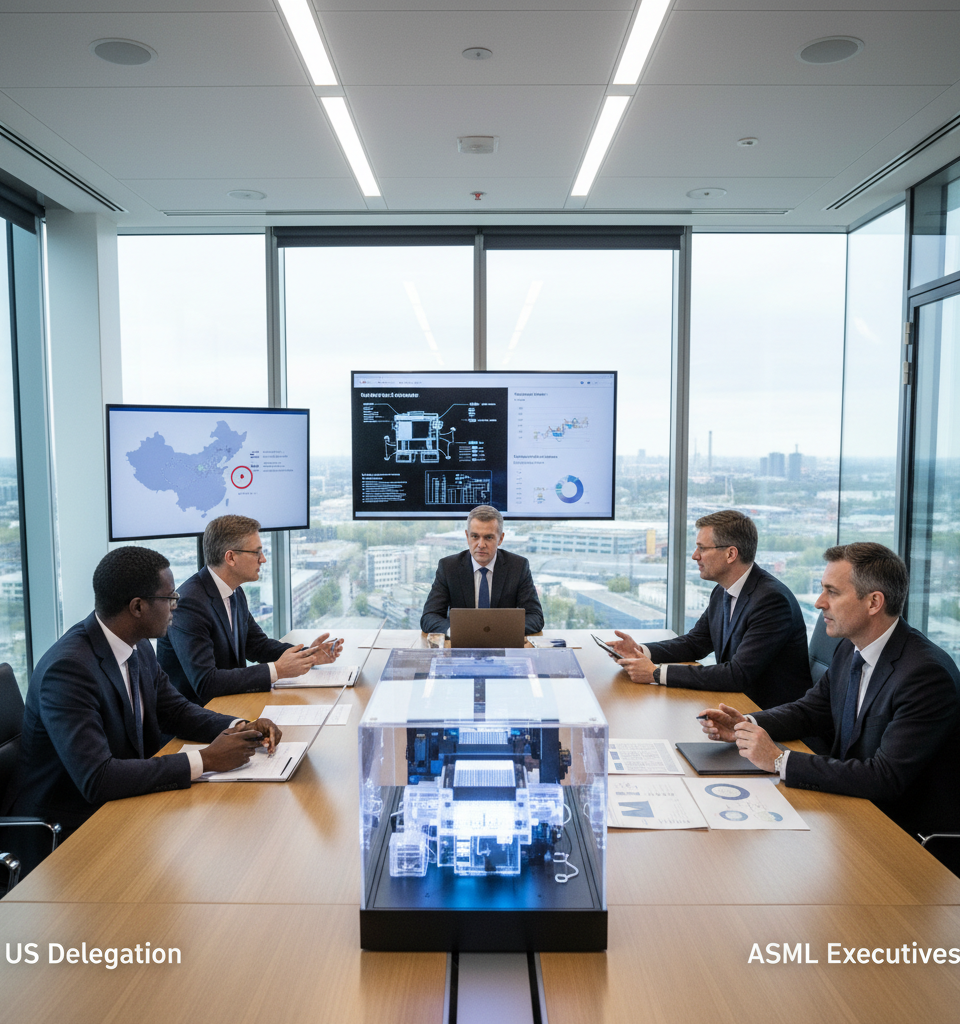
A notable divergence in statements has arisen between the United States government and Dutch semiconductor equipment giant ASML Holding N.V. regarding the potential presence of ASML’s most advanced chip manufacturing technology within China. The United States has indicated its belief that one of these cutting-edge tools may be in China, a assertion that ASML has explicitly refuted. This dispute underscores the persistent tensions surrounding technology transfer and export controls in the global semiconductor industry, particularly concerning Beijing's ambitions to enhance its domestic chip production capabilities.
Context and Background
The semiconductor industry remains a critical arena for geopolitical competition, with advanced chipmaking tools at its heart. ASML, as the world's sole manufacturer of extreme ultraviolet (EUV) lithography machines and a leading producer of deep ultraviolet (DUV) systems, holds a pivotal position. The US, along with allies, has been increasingly focused on restricting China's access to advanced technologies that could have military applications, applying pressure on companies like ASML to comply with stringent export controls. The current disagreement highlights the complexities of monitoring the supply chain for such sophisticated equipment.
Key Details
At the core of the issue is the specific classification and destination of ASML's top chip tool. While the US government has suggested the possibility of such a tool being in China, ASML has maintained a clear and consistent denial. The company's stance is not merely a defensive one; it is underscored by a strong commercial logic. Exporting its most advanced machinery to a restricted market like China, potentially in violation of international agreements or US-imposed guidelines, would entail significant risks for ASML. Such a move could jeopardize its crucial export licenses, particularly those allowing it to operate in the lucrative US market and beyond, where its cutting-edge technology is in high demand.
Industry and Market Impact
This discrepancy could have ripple effects across the global semiconductor supply chain and diplomatic relations. Should the US assessment prove correct, it would signal a potential loophole or circumvention in current export control regimes, possibly triggering a tightening of regulations. Conversely, if ASML's denial holds true, the ongoing friction itself could create uncertainties for chip manufacturers worldwide who rely on ASML’s technology. The market for advanced chipmaking equipment is highly concentrated, and any disruptions or intensified scrutiny could impact production timelines and R&D efforts globally.
Future Implications
The unfolding situation demands careful observation. The US is expected to continue its vigilance over technology transfers to China, potentially increasing pressure on equipment suppliers to ensure compliance. ASML, for its part, is likely to reiterate its commitment to adhering to all relevant export regulations, navigating a delicate balance between commercial interests and geopolitical pressures. The outcome of this particular disagreement could either reinforce existing export control frameworks or necessitate recalibrations in how advanced technology transfers are monitored and enforced by international bodies and individual nations. This underscores the ongoing struggle to control the proliferation of dual-use technologies in a globally interconnected economy.