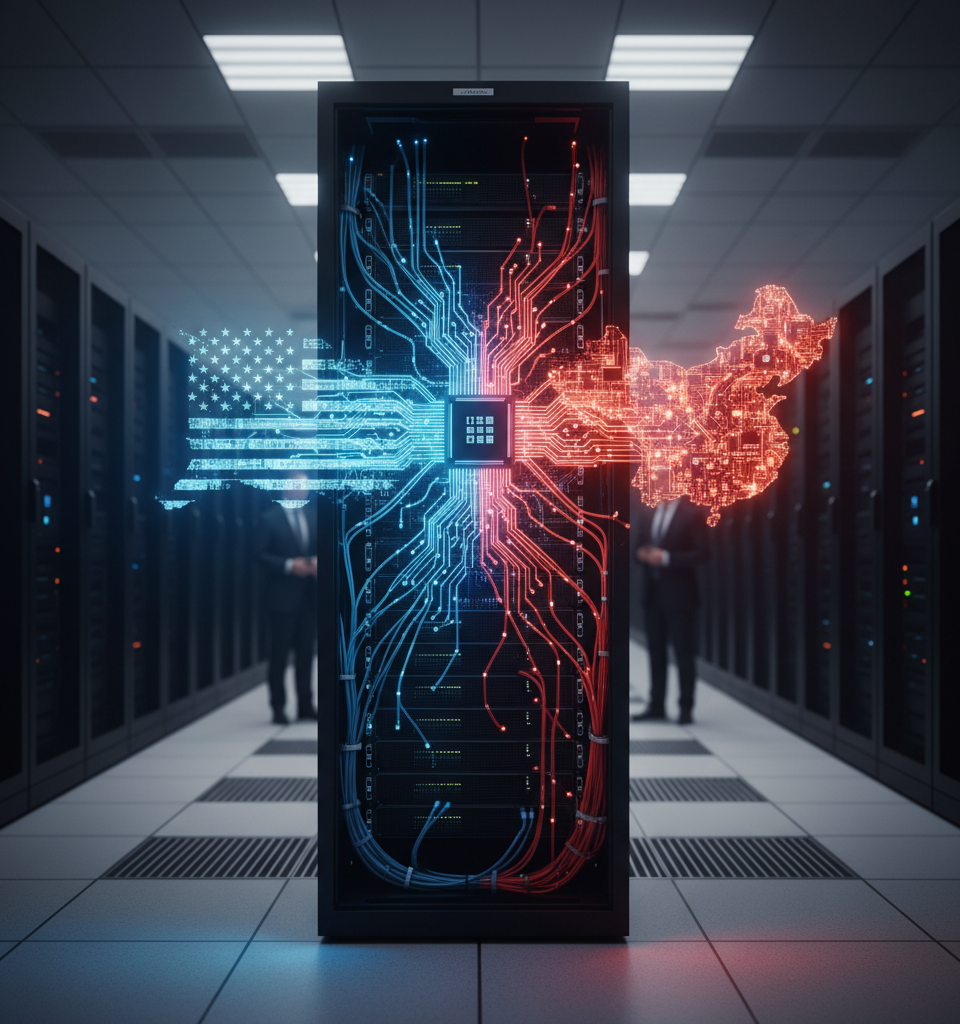
WASHINGTON D.C. / BEIJING — The global contest for artificial intelligence (AI) supremacy is unfolding along two divergent yet fiercely competitive fronts, with the United States establishing a commanding lead in foundational AI model development and China demonstrating significant acceleration in practical AI applications. This strategic bifurcation, evident in recent government reports and industry analyses, underscores a fierce geopolitical and technological rivalry where neither nation intends to cede AI leadership, setting the stage for a dynamic and unpredictable technological competition.
This evolving scenario carries profound implications beyond technological innovation, touching upon economic leadership, national security, and global influence. Historically, the pursuit of cutting-edge technologies has often been a barometer of a nation's future power. The current AI race, frequently likened to a new space race or an arms race, represents a critical juncture where the victor could dictate future technological standards, ethical frameworks, and economic opportunities for decades to come. Both nations have poured billions into research, development, and strategic policy initiatives to secure their respective advantages, recognizing AI as a transformative force across all sectors.
Key details highlight the distinct strengths of each superpower. The U.S. advantage in highly technical, foundational AI models, particularly large language models (LLMs) and advanced machine learning algorithms, is evident through the pioneering work of companies like OpenAI, Google DeepMind, and Meta AI. These firms have repeatedly pushed the boundaries of AI capabilities, demonstrating unprecedented progress in areas such as natural language processing, generative AI, and complex problem-solving. Meanwhile, China has shown remarkable agility and investment in integrating AI into real-world scenarios, leveraging vast datasets and an expansive ecosystem for surveillance, smart cities, and manufacturing automation. Reports indicate China's annual AI patent filings have consistently outpaced the U.S. in recent years, albeit with a focus on application rather than pure algorithmic breakthroughs. Data from the Stanford-Hoover AI Index Report 2023 shows venture capital investment in AI reaching over $60 billion globally in 2022, with both the U.S. and China continuing to lead in attracting significant portions of this funding.
The implications for the broader industry and global market are substantial. U.S. dominance in foundational research drives the global standard for AI innovation, influencing API access, cloud AI services, and developer ecosystems worldwide. Conversely, China's aggressive application of AI technology, particularly in areas like smart manufacturing and autonomous systems, presents a compelling model for rapid adoption and scaling in emerging markets. This dual-pronged development creates a complex global market where companies must navigate differing regulatory environments, technological standards, and ethical considerations. The semiconductor industry, for instance, finds itself at the critical nexus of this competition, with U.S. export controls aimed at restricting China's access to advanced AI chips, spotlighting the strategic importance of hardware in the AI ecosystem.
Technological ethicists and geopolitical experts are closely observing these developments. Dr. Kai-Fu Lee, a prominent venture capitalist and AI expert, has frequently noted China's advantage in data and engineering talent while acknowledging U.S. leadership in fundamental research and algorithmic innovation. Other analysts, such as those at the Center for Security and Emerging Technology (CSET), frequently highlight the U.S.'s enduring advantage in attracting top global AI talent and its robust university research ecosystem. However, they also caution about China's comprehensive national strategy for AI development, which integrates government funding, state-owned enterprises, and private industry in a more unified manner. Geopolitical strategists emphasize that the competition extends beyond technology to include standards-setting bodies, talent pipelines, and ethical norms for AI governance worldwide.
Looking ahead, the trajectory of this AI race is expected to witness continued strategic investments from both nations, coupled with escalating regulatory scrutiny and potential for further technological decoupling. The U.S. Department of Commerce has recently reiterated its commitment to advanced computing export controls, while China continues to funnel billions into domestic AI chip production and talent development programs. Future developments will likely include a push for 'AI sovereignty' by both powers, leading to the creation of distinct technological blocs. Innovations in quantum computing and neuromorphic computing could also introduce new dimensions to the competition, potentially reordering current strengths and weaknesses. The global community watches closely, understanding that the outcome of this contest will profoundly shape the geopolitical and economic landscape of the 21st century.
The ongoing competition also raises critical questions about global collaboration and potential for a unified approach to AI ethics and safety. As both nations continue to advance, the potential for AI to address pressing global challenges, from climate change to healthcare, remains immense. However, the current competitive framework suggests that a fragmented AI technology landscape with differing ethical and regulatory standards is a more likely near-term outcome, posing challenges for the broader international community.
Ultimately, the ability of either the U.S. or China to maintain or extend its lead will hinge on continuous innovation, effective policy implementation, and the capacity to attract and retain top-tier talent. The race is far from over, and its dynamic nature means that either side could yet pull ahead, cementing their position as the undisputed global leader in artificial intelligence.