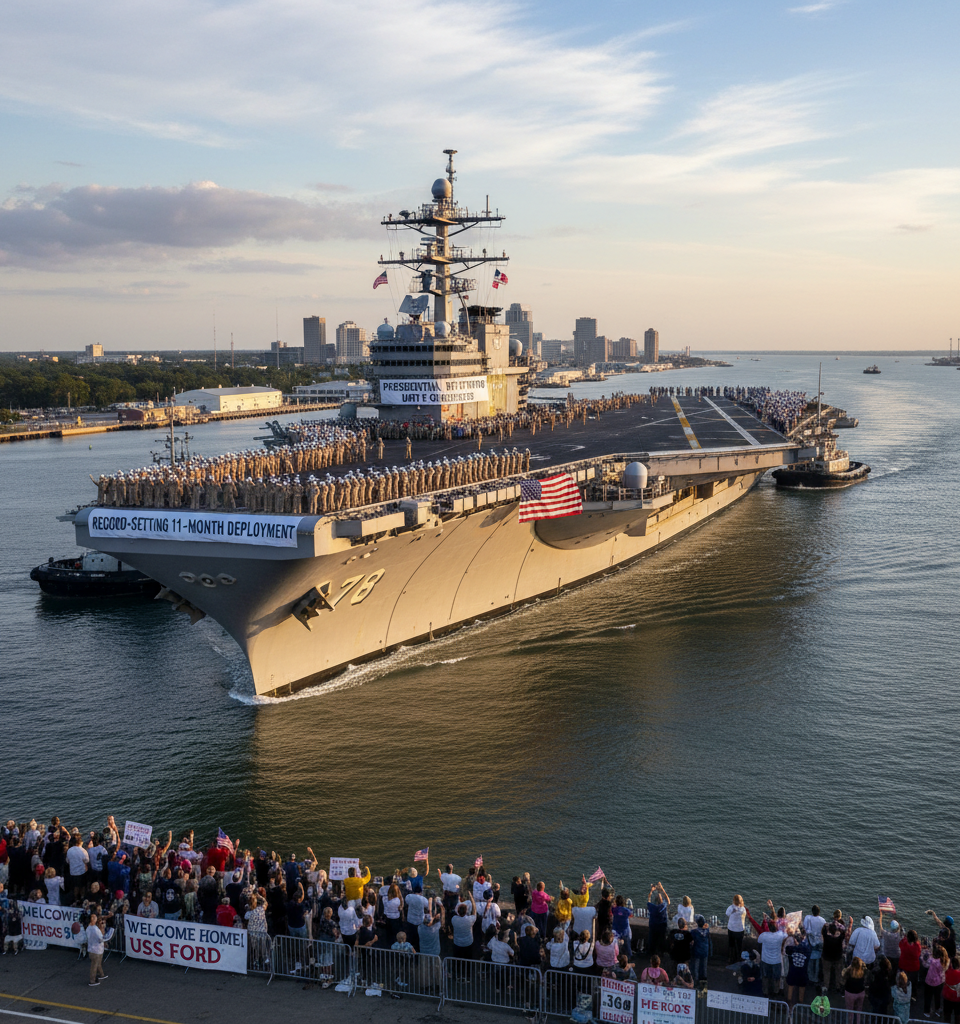
The USS Gerald R. Ford (CVN-78), the lead ship of its class and the U.S. Navy’s most advanced aircraft carrier, has successfully concluded an extraordinary 11-month deployment, returning to Norfolk, Virginia, this week. This marks the longest single deployment for a U.S. carrier since the Vietnam War era. The protracted mission saw the Ford Carrier Strike Group (CSG) operate across multiple theaters, notably in response to escalating tensions in the Middle East following the recent conflict and in support of broader strategic objectives against state-sponsored threats, including those emanating from nations like Iran and activities linked to the Venezuelan regime under Nicolás Maduro. For its sustained operational excellence and pivotal contributions during these challenging periods, the Ford CSG has been awarded the coveted Presidential Unit Citation.
Historical Context and Strategic Importance
The extended deployment of the USS Ford carries significant historical weight, underscoring the dynamic and often unpredictable nature of modern geopolitical challenges. Prior to this, lengthy carrier deployments were more characteristic of eras such as the Vietnam War. The decision to keep the Ford at sea for nearly a year reflects a strategic imperative to maintain a persistent and powerful U.S. presence in critical regions. This posture is particularly vital in the Middle East, where the aircraft carrier served as a crucial deterrent and stabilization force following recent hostilities in the region. The ability to project overwhelming air and naval power from a forward-deployed carrier remains a cornerstone of U.S. foreign policy and defense strategy, providing both reassurance to allies and a clear signal to potential adversaries.
Key Operational Highlights and Recognition
Throughout its nearly year-long deployment, the USS Ford and its associated strike group, comprised of destroyers, cruisers, and a Carrier Air Wing (CVW), executed an extensive range of missions. These included sustained air operations, maritime security patrols, and exercises with allied navies, covering tens of thousands of miles across the Atlantic Ocean, Mediterranean Sea, and the Arabian Sea. The most prominent aspect of this deployment was the Ford's deployment to the Eastern Mediterranean, a direct response to a significant regional conflict, where it provided a robust platform for air superiority and intelligence gathering.
S. efforts to counter destabilizing activities by hostile state actors, including monitoring and disrupting illicit operations linked to the Iranian regime and its proxies, as well as maintaining pressure on the Maduro government in Venezuela. The Presidential Unit Citation, awarded by the President, is one of the highest honors a military unit can receive, recognizing extraordinary heroism in action against an armed enemy or extremely difficult conditions, acknowledging the unparalleled contributions and sacrifices of the sailors and aviators aboard the Ford.
Geopolitical Implications and Market Impact
From a geopolitical perspective, the USS Ford's prolonged deployment signals a recalibration of international security priorities and resource allocation. The continuous presence of such a formidable asset in volatile regions minimizes response times to emergent threats and enhances regional stability, albeit at a significant operational tempo cost. For defense contractors and the broader defense industry, this prolonged operational period highlights the demand for high-readiness, advanced naval platforms and their associated support systems. It underscores the critical need for continued investment in shipbuilding, maintenance, and advanced aerospace technologies. Companies involved in the supply chain for carrier operations, from sophisticated avionics to ship repair, are likely to see sustained demand as the U.S. Navy emphasizes readiness and forward deployment.
Expert Commentary on Strategic Endurance
Defense analysts universally acknowledge the strategic significance of the Ford's prolonged mission. Dr. S.
Navy's enduring capability to project power globally, but it also raises questions about fleet readiness and crew fatigue. S. " The successful execution of such a demanding mission, particularly for a relatively new class of carrier, also validates the technological advancements and operational efficiencies built into the Ford-class design.
Future Outlook and Naval Modernization
Looking ahead, the successful, albeit arduous, deployment of the USS Ford is expected to influence future naval doctrine and procurement strategies. S. Navy will likely analyze data from this mission to refine operational protocols, optimize maintenance cycles for next-generation carriers, and potentially adjust manning levels to mitigate crew fatigue during extended periods at sea.
There is an ongoing push for naval modernization, with continued investment in new Ford-class carriers, F-35C Lightning II strike fighters, and advanced unmanned aerial systems. The experience gained from this deployment will be invaluable in shaping the development and employment of these future assets. S.
naval fleet for years to come.