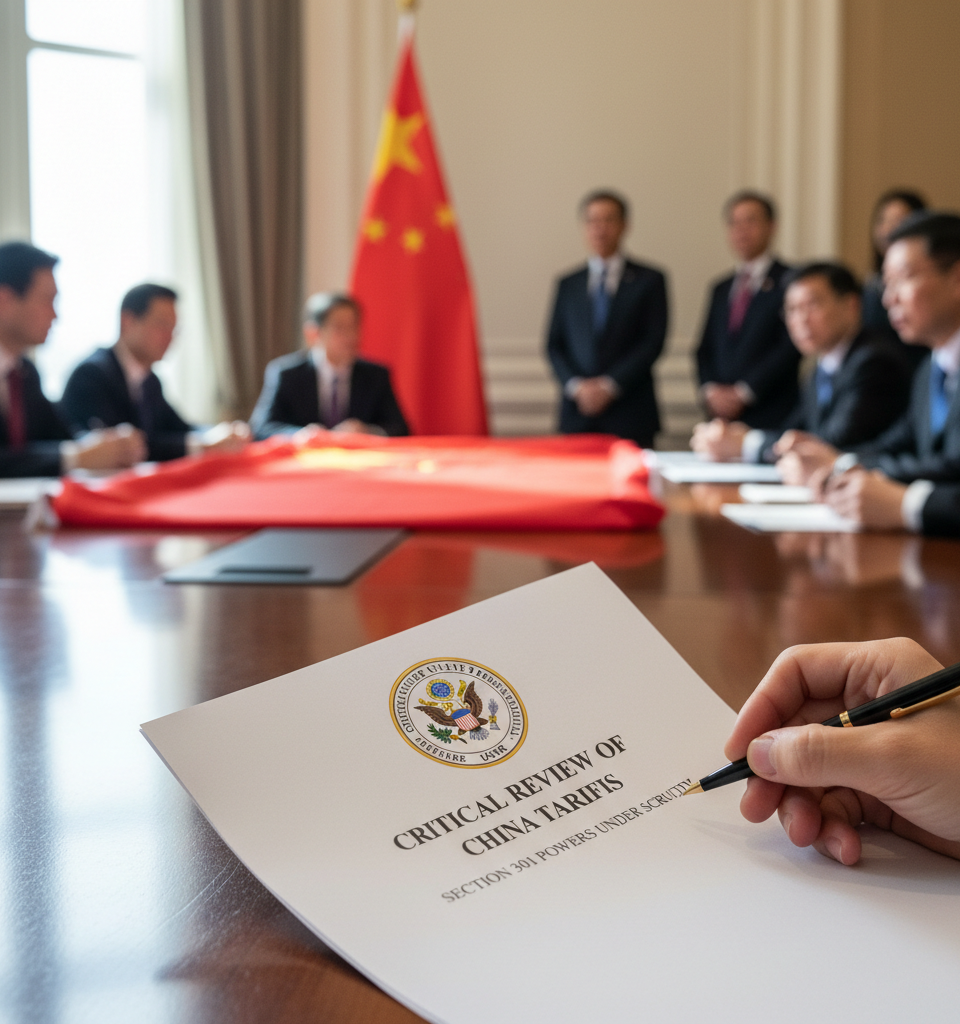
The United States Trade Representative (USTR) has officially launched its four-year statutory review of the Section 301 tariffs initially levied on goods imported from China during the first Trump administration. This procedural undertaking, mandated by the 1974 Trade Act, places the powerful Section 301 statute squarely back in the spotlight, as the Biden administration navigates complex economic and geopolitical tensions with Beijing while simultaneously advancing additional trade enforcement probes.
Historical Context and Policy Foundations
These tariffs, which currently affect approximately $370 billion worth of Chinese imports, were first imposed in tranches between 2018 and 2019 under the authority of Section 301 of the Trade Act of 1974. This section grants the USTR broad powers to investigate and respond to unfair trade practices of foreign countries. The original rationale for the tariffs stemmed from findings that China engaged in intellectual property theft, forced technology transfers, and other discriminatory practices harmful to U.S. economic interests. The current review will assess the effectiveness of these measures in achieving their objectives and their impact on the U.S. economy.
Key Details and Stakeholder Engagement
The USTR's review process began with notifications to various stakeholders, including U.S. importers and domestic industries, outlining the opportunity to comment on the scope and efficacy of the tariffs. The review specifically calls for input on whether the tariffs have been effective in eliminating China's unfair trade practices, their impact on U.S. consumers and businesses, and whether their continuation is in the national economic interest. Many U.S. businesses, particularly those reliant on Chinese components or manufacturing, have long argued that the tariffs primarily act as a tax on American consumers and businesses, raising input costs and reducing competitiveness. Conversely, some domestic manufacturers and labor unions contend the tariffs are essential to protecting U.S. jobs and industries from subsidized Chinese competition.
Industry and Market Impact Analysis
The ongoing review casts a shadow of uncertainty over numerous sectors. Industries ranging from electronics and machinery to apparel and consumer goods have grappled with increased costs and supply chain reconfigurations since the tariffs were first implemented. For example, American manufacturers importing specialized components from China face tariffs of up to 25%, often absorbing these costs or passing them on to consumers. A 2022 analysis by the Peterson Institute for International Economics estimated that the tariffs had cost U.S. importers billions of dollars. The prospect of either their removal or expansion could significantly shift operational strategies and investment decisions for companies embedded in global supply chains.
Expert Perspectives and Economic Considerations
Trade economists are closely watching the review, with opinions divided on its likely outcome. Dr. Emily Thorne, a senior fellow at the Center for Global Trade Studies, noted, "The administration faces a delicate balancing act. While removing tariffs could ease inflation and boost consumer spending, it might also be perceived as ceding leverage in ongoing strategic competition with China." Others suggest that the review provides a critical opportunity for the USTR to refine its approach, potentially targeting specific Chinese sectors more effectively while granting exemptions for goods where alternative sourcing is impractical. The political implications are also significant, with both domestic industry protection and international diplomatic relations at play.
Future Implications and Next Steps
The review process is expected to be comprehensive, involving extensive public comment periods and internal USTR analysis. While there is no fixed timeline for conclusion, similar reviews have taken several months to over a year. Potential outcomes include the continuation of existing tariffs, modifications to their scope, or even their conditional removal. Beyond this review, the USTR is also reportedly exploring new Section 301 investigations into other Chinese practices, such as state subsidies in advanced technology sectors. This suggests a broader strategic pivot towards more targeted and adaptable trade enforcement mechanisms, reflecting an evolving U.S. approach to managing its complex economic relationship with China.