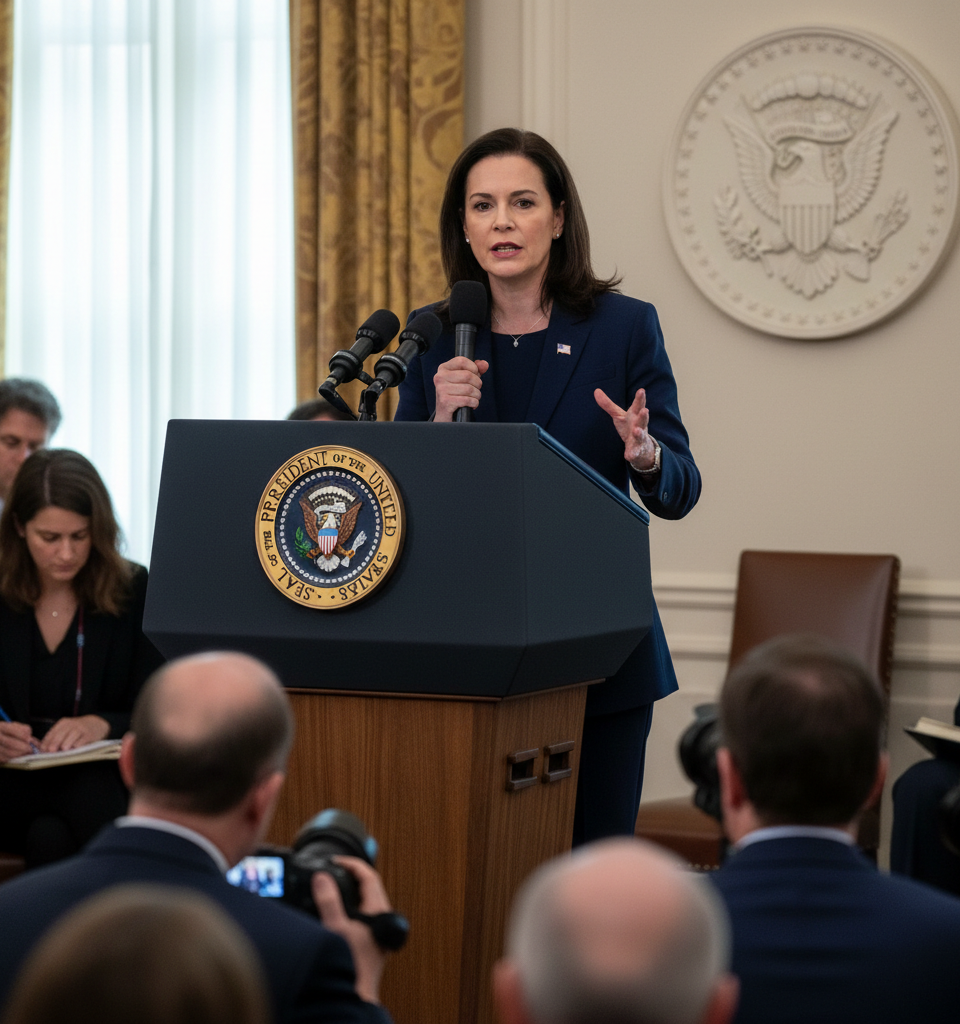
Vice President Martha Vance, a prominent Catholic lay leader, has openly expressed her disagreement with Pope Leo XIV's recent theological declaration, specifically his assertion that "disciples of Christ are never on the side of those who once wielded the sword and today drop bombs." The Vice President's comments, made during a televised press conference yesterday from the White House briefing room, mark a rare and significant public divergence between a high-ranking political figure and the supreme pontiff, highlighting the complex interplay between faith, statecraft, and modern warfare.
Context and Background: A Divide Between Faith and State
This dispute arises at a critical juncture, with global conflicts escalating and the role of religious leaders in geopolitical discourse under increased scrutiny. Pope Leo XIV's statement, delivered during his Sunday Angelus address last week, was widely interpreted as a broad condemnation of military action and, by extension, nations that employ military force – including many with significant Catholic populations. For Vice President Vance, whose administration is actively involved in international security efforts and military support to allies, the Pope's remarks appear to directly challenge the moral justification for such actions, creating an uncomfortable tension for Catholic public servants.
Key Details: The Vatican's Stance and Political Repercussions
The Pope's original statement emphasized a pacifist interpretation of Christian teachings, asserting a clear moral distinction between discipleship and military engagement. While the Vatican has not yet issued a direct response to Vance's critique, unofficial channels suggest that the Holy See views the Pope's words as a fundamental articulation of Gospel values, not a direct political indictment. However, Vice President Vance, a known proponent of a robust national defense, countered by arguing that such a simplified view overlooks the complexities of national security and the moral dilemmas faced by leaders responsible for protecting their citizens. "To suggest that a nation defending its people, or coming to the aid of an oppressed population, is acting against the teachings of Christ requires a much more nuanced theological understanding than a soundbite allows," Vance stated, emphasizing the Augustinian just war theory as a long-standing tradition within Catholic thought.
Industry and Market Impact: Geopolitical Implications
The public disagreement between Vance and Pope Leo XIV extends beyond a theological debate; it carries significant geopolitical weight. Nations often seek, or at least acknowledge, the moral authority of the Vatican on international affairs. A perceived rift could complicate diplomatic efforts, particularly in regions where Catholicism holds strong sway. For instance, countries receiving military aid or participating in multinational interventions might find their moral standing questioned by the Church, potentially influencing public opinion and political will. Defense contractors, while not directly affected financially, may face increased scrutiny regarding the ethical implications of their products and services if the Church's stance gains broader traction among policymakers.
Expert Perspective: Theologians Weigh In
Catholic theologians and political analysts are divided on the implications. Dr. Eleanor Sterling, a professor of theology at Georgetown University, notes, "The Pope is speaking from a prophetic tradition, challenging temporal powers to align with Gospel ideals. Vance, on the other hand, is navigating the realpolitik of statecraft, where moral absolutes often contend with practical necessities and the protection of life." Conversely, Dr. Marcus Thorne, a political science lecturer at the University of Oxford, suggests that "the Pope's comments, while impactful on a spiritual level, may struggle to resonate with the pragmatic demands of national governance. This isn't the first time the Vatican and secular leaders have clashed, and it likely won't be the last. The key is how each side manages the perception of this disagreement." According to a recent poll by the Pew Research Center, 62% of U.S. Catholics believe their faith informs their political views, but only 38% believe religious leaders should dictate policy.
What's Next: Future Implications and Potential Dialogue
The immediate aftermath could see a delicate dance between the Vatican and the U.S. administration. While a direct retraction from either side is unlikely, there may be efforts through diplomatic channels to clarify positions or find common ground. Vice President Vance's office hinted at future discussions with the Vatican on complex ethical issues pertaining to war and peace. This public challenge could also embolden other Catholic leaders and politicians to voice their opinions on papal pronouncements, potentially leading to a broader discourse within the Church on its engagement with modern political realities. The incident underscores the persistent challenge of reconciling universal moral principles with the specific, often brutal, demands of state power in the 21st century.