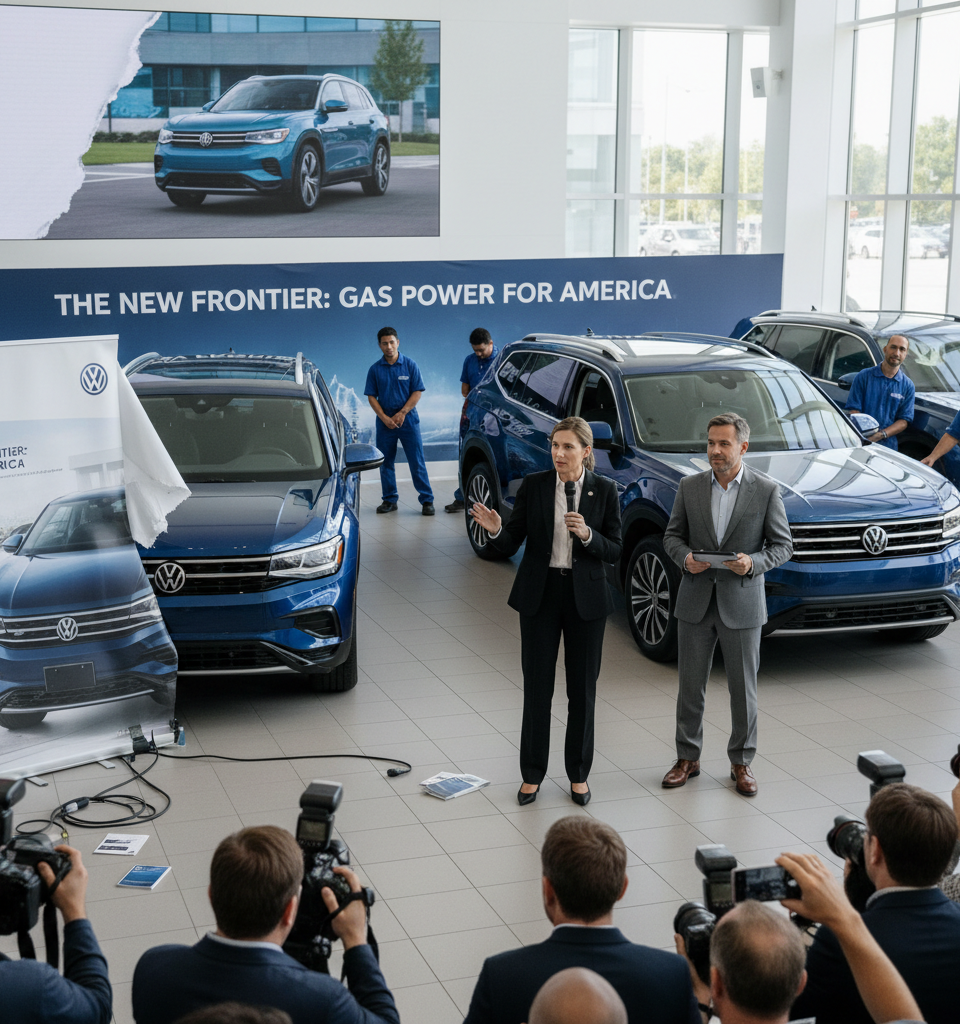
Volkswagen of America is reportedly discontinuing production of its all-electric ID.4 model within the United States, marking a significant strategic shift for the German automaker in the North American market. This decision funnels all available manufacturing resources at the company's U.S. facility towards the upcoming gas-powered Atlas SUV line, indicating a potential recalibration of Volkswagen's electrification strategy and a renewed focus on traditional internal combustion engine vehicles, particularly within the lucrative SUV segment.
This reported pivot comes at a critical juncture for both the automotive industry and Volkswagen's global ambitions. While many automakers are doubling down on electric vehicle (EV) production and investment, Volkswagen's reallocation of resources suggests a pragmatic response to perceived market demands or production efficiencies unique to its U.S. operations. The move could reflect a careful balancing act between long-term electrification goals and immediate profitability concerns, especially against a backdrop of varying consumer adoption rates for EVs across different regions.
Strategic Reallocation of Resources
According to reports, the entirety of Volkswagen's U.S. manufacturing capabilities, previously contributing to the ID.4's output, will now be exclusively dedicated to the production of the new Atlas SUV. The Atlas, a well-established and popular model in Volkswagen’s U.S. lineup, is a critical pillar of its sales strategy, especially in a market with a strong preference for larger, more versatile vehicles. This concentrated effort on the Atlas suggests Volkswagen aims to maximize efficiency and output for a proven seller, potentially in preparation for heightened competition within the mid-size SUV category.
The decision specifically targets Volkswagen's U.S. manufacturing arm, implying that the ID.4's availability in the American market may shift towards imported units, or that Volkswagen is evaluating its local production footprint for specific EV models. Such a move underscores the complex supply chain and production logistics involved in global automotive manufacturing, where regional strategies can diverge significantly from overarching corporate directives based on local market dynamics, regulatory environments, and consumer preferences.
Implications for Volkswagen's U.S. Market Position
The immediate impact of this strategic realignment could see Volkswagen solidify its market share in the traditional SUV segment, which continues to be a dominant force in U.S. auto sales. By dedicating its U.S. factory capacity to the Atlas, Volkswagen could aim to reduce lead times, optimize production costs, and potentially introduce enhancements to the Atlas line more rapidly. This focus might afford the company an advantage in a highly competitive segment, catering directly to a substantial portion of American consumers who still favor gasoline-powered SUVs.
Conversely, the curtailment of U.S.-based ID.4 production could raise questions about Volkswagen's commitment to localized EV manufacturing in North America, at least in the short term. While the ID.4 remains a cornerstone of Volkswagen's global EV strategy, a pause in its U.S. production could create a vacuum that competitors might fill. It also highlights the elasticity and adaptability required in navigating an evolving automotive landscape, where manufacturers must constantly assess and adjust their product portfolios and production strategies.
Industry Reactions and Future Outlook
Industry analysts will be closely monitoring the fallout from this decision, particularly how it affects Volkswagen’s overall sales figures and market perception in the U.S. The move suggests a nuanced approach to the EV transition, acknowledging that while electric vehicles represent the future, conventional vehicles still hold substantial sway in current market conditions. It also presents a case study in how global automakers are contending with the practicalities of scaling EV production while maintaining profitability from their existing, robust product lines.
Looking ahead, this strategic adjustment could be a temporary measure aimed at optimizing the production of a high-demand model before potentially re-evaluating EV manufacturing in the U.S. Alternatively, it could signal a longer-term trend of Volkswagen diversifying its production footprint globally, producing different vehicle types in regions where either demand or manufacturing efficiencies are most favorable. The coming months will likely shed more light on Volkswagen's evolving vision for its U.S. operations and its balance between electrification and traditional vehicle segments.