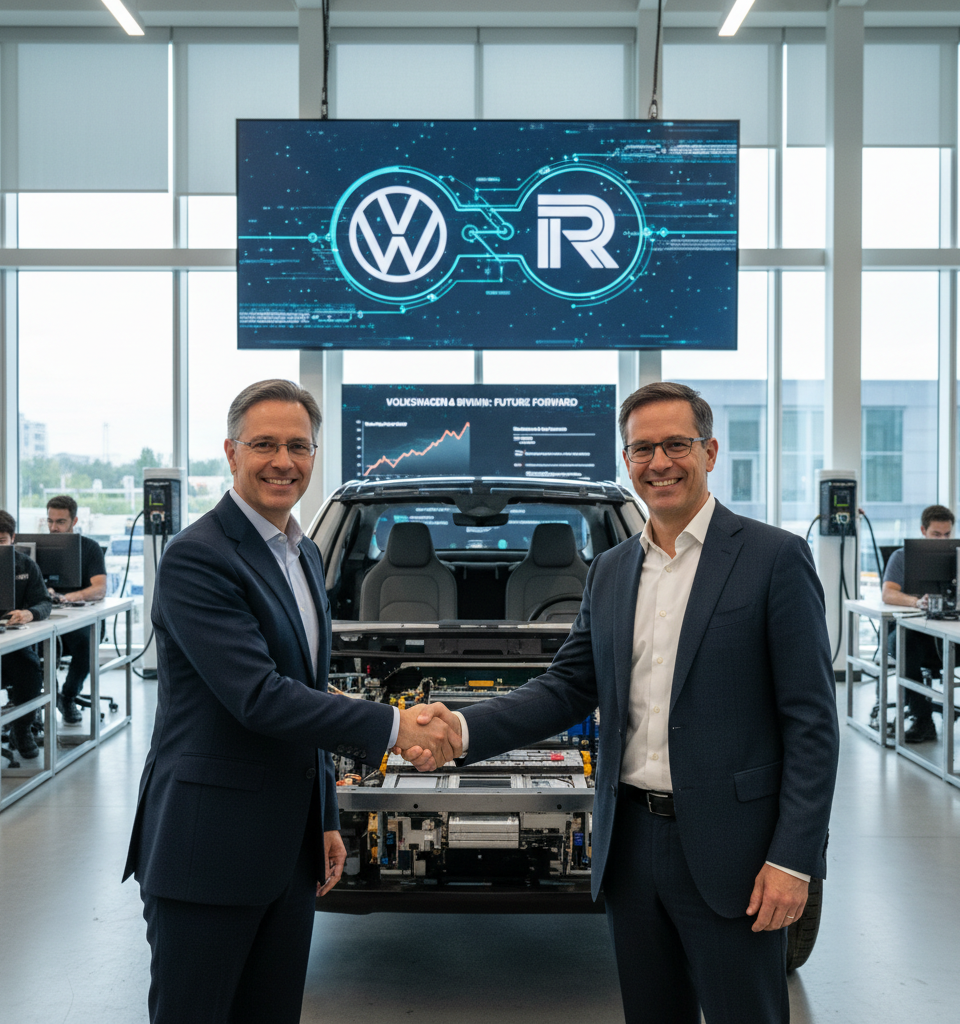
Volkswagen Group announced this week a joint venture with Rivian, initially investing $1 billion and committing to a further investment of up to $4 billion, ultimately totaling a staggering $5 billion. This landmark deal positions Volkswagen as a significant financial backer and strategic partner for the electric vehicle startup, with the core objective being the co-development and licensing of Rivian's advanced software and electrical architecture. The collaboration aims to accelerate both companies' push into the future of connected and software-defined vehicles.
Context and Background
This colossal investment underscores a fundamental shift in the automotive industry: software is now as critical, if not more critical, than hardware. For decades, Volkswagen, like many legacy automakers, has struggled to develop a cohesive and competitive software platform internally. Efforts such as the ambitious but troubled Cariad division have faced significant delays, cost overruns, and performance issues, hindering the rollout of new EV models and features. Rivian, despite its smaller scale and financial challenges, has garnered praise for its robust and intuitive software stack, a key differentiator that has attracted not only customers but now, major industry players. This move by Volkswagen signifies an acknowledgment that proprietary knowledge and speed in software development are paramount to surviving and thriving in the rapidly evolving EV landscape.
Key Details
The initial $1 billion investment from Volkswagen will be channeled directly into Rivian, with an additional $1 billion to be invested in the newly formed joint venture at closing. Subsequent investments of $1 billion each are planned for 2026 and 2027, contingent on certain milestones. The joint venture will focus on creating a new, advanced electrical architecture and software platform that will be shared across both Volkswagen and Rivian vehicles.
This platform is expected to integrate infotainment, driver-assistance systems, and connectivity features seamlessly. For Rivian, this influx of capital, estimated at $5 billion, provides a much-needed lifeline, bolstering its balance sheet and providing funds for future product development and scaling production. The company had previously raised significant capital from investors like Amazon, which initially invested $700 million in 2019 and saw its stake surge to over $15 billion when Rivian went public in November 2021.
Industry and Market Impact
This partnership could send reverberations throughout the global automotive industry. It validates the 'software-first' approach championed by newer EV manufacturers and pressures other legacy automakers to re-evaluate their internal software development strategies. For Rivian, beyond the financial injection, the deal offers valuable economies of scale and broader market adoption for its technology, potentially establishing its software as an industry standard. For Volkswagen, it's a fast-track solution to a debilitating problem, allowing it to bypass years of internal development and significant capital expenditure on a problem it has openly struggled with. Competitors like Mercedes-Benz, BMW, and General Motors, all grappling with their own software initiatives, will be closely watching the success of this collaboration.
Expert Perspective
Automotive analysts largely view this deal as a pragmatic and shrewd move by Volkswagen. "Volkswagen has clearly recognized that it's more cost-effective and quicker to buy expertise rather than build it from scratch, especially when time to market is critical," stated Jessica Caldwell, an industry analyst at Edmunds. "Rivian's software is highly regarded, and this partnership could be a game-changer for Volkswagen's future EV offerings." Others highlight the strategic benefit for Rivian. "This isn't just a bailout; it's a validation of Rivian's technological prowess and provides them with a stable financial footing to continue innovating," commented Sam Fiorani, Vice President at AutoForecast Solutions. He added that the joint venture could lead to more nuanced collaborations in areas like battery technology or modular chassis designs in the long term.
What's Next
The immediate focus will be on establishing the joint venture and integrating Rivian's advanced technology into Volkswagen's vehicle development roadmap. Consumers can expect to see the first applications of this co-developed software in future Volkswagen and Porsche EV models, potentially within the next few years. For Rivian, the challenge will be to manage this new, complex partnership while continuing to scale production of its R1T, R1S, and commercial delivery vans. The ultimate success of this collaboration will be measured by the quality and seamless integration of the new software architecture, and how effectively it can accelerate Volkswagen's transition into a truly software-defined mobility provider. This partnership also opens the door for potential future synergies, such as joint procurement or shared manufacturing expertise, though no such plans have been announced.