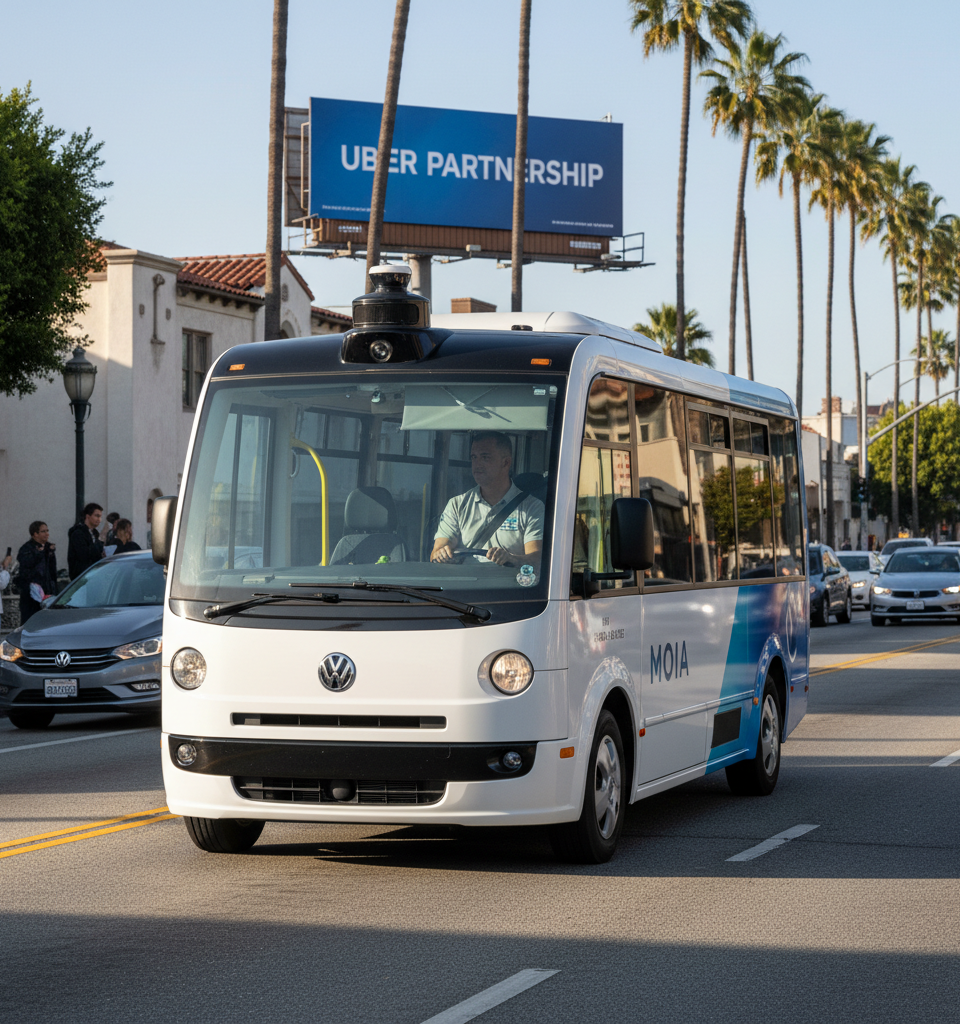
Los Angeles, California - Volkswagen Group's dedicated mobility subsidiary, MOIA America, has officially initiated public road testing of its self-driving microbuses within the sprawling urban landscape of Los Angeles. This pivotal phase represents a critical step in the company's ambitious strategy to deploy a commercial robotaxi service in collaboration with ride-sharing giant Uber. While the highly anticipated launch promises a novel urban transportation solution, the path forward remains contingent upon navigating a complex labyrinth of state and federal regulatory frameworks, underscoring the significant hurdles inherent in bringing autonomous vehicle technology to market.
A Bold Step in Autonomous Mobility's Trajectory
This move by MOIA America is not merely an incremental step but a significant indicator of Volkswagen's broader commitment to becoming a dominant player in the autonomous mobility sector. The decision to select Los Angeles as the initial testing ground is strategic, given the city's diverse and often challenging traffic conditions, which offer an ideal proving ground for autonomous systems. The partnership with Uber, announced previously, further solidifies the potential for rapid scaling and market penetration once regulatory clearances are secured, leveraging Uber's expansive user base and logistical expertise. This initiative arrives at a time when the autonomous vehicle industry, despite significant investment and technological advancements, has faced a decelerated commercial rollout due to safety concerns and the complexity of real-world implementation.
Testing Protocols and Technological Underpinnings
The MOIA America VOYAGER microbuses, which are at the heart of this testing program, are equipped with a sophisticated suite of sensors including LiDAR, radar, cameras, and ultrasonic sensors, providing 360-degree environmental awareness. These vehicles, designed for ride-sharing, aim to offer a comfortable and efficient transit experience for multiple passengers. During this initial testing phase, each autonomous microbus will operate with a trained safety driver present, ready to take manual control if necessary, adhering to standard industry protocols for early-stage public road testing. Data collected from these trials will be instrumental in refining the AI-powered driving algorithms, enhancing object recognition, prediction capabilities, and overall system reliability in varied traffic and weather conditions.
Reshaping the Urban Transportation Landscape
Should MOIA America successfully navigate the regulatory gauntlet and launch its commercial service, the impact on urban transportation could be profound. The introduction of autonomous, shared microbuses has the potential to reduce traffic congestion, lower carbon emissions per passenger mile, and provide cost-effective mobility solutions, particularly in dense urban environments. This development places Volkswagen and Uber in a competitive race against other major players like Waymo (Google's self-driving division) and Cruise (GM's autonomous unit), both of whom are already operating limited commercial robotaxi services in select U.S. cities. The success of MOIA's model could accelerate the wider adoption of shared autonomous fleets, fundamentally altering car ownership paradigms and public transit models.
Expert Insights on Regulatory Hurdles and Market Viability
Industry experts emphasize that while the technology is advancing rapidly, regulatory approval remains the most formidable barrier to widespread commercial deployment. "The regulatory landscape for autonomous vehicles is a patchwork, varying significantly state by state, and even city by city," noted Dr. Eleanor Vance, a leading analyst in autonomous transportation policy. "Companies like MOIA America face the challenge of demonstrating not just operational safety, but also a clear framework for liability, data privacy, and cybersecurity. Public perception and trust are also critical; any significant incident could set back the entire industry." Analysts project that the global robotaxi market could reach tens of billions of dollars within the next decade, with early movers gaining significant market share, provided they can overcome these regulatory and public acceptance challenges.
The Road Ahead: Phased Rollout and Expansion
The immediate future for MOIA America involves the continued rigorous testing in Los Angeles, followed by an iterative process of data analysis, system refinement, and engagement with regulatory bodies. While no firm timeline for a full commercial launch has been announced, industry observers anticipate a phased rollout, likely starting with limited geographical operational design domains (ODDs) to ensure safety and scalability. Success in Los Angeles could pave the way for expansion into other major metropolitan areas across the United States. Furthermore, the partnership with Uber may evolve to integrate these autonomous microbuses more deeply into Uber's existing ride-sharing platform, offering users both human-driven and autonomous vehicle options as they become available. Volkswagen's long-term vision includes integrating diverse autonomous solutions, from ride-sharing to logistics, positioning itself at the forefront of the future mobility ecosystem.