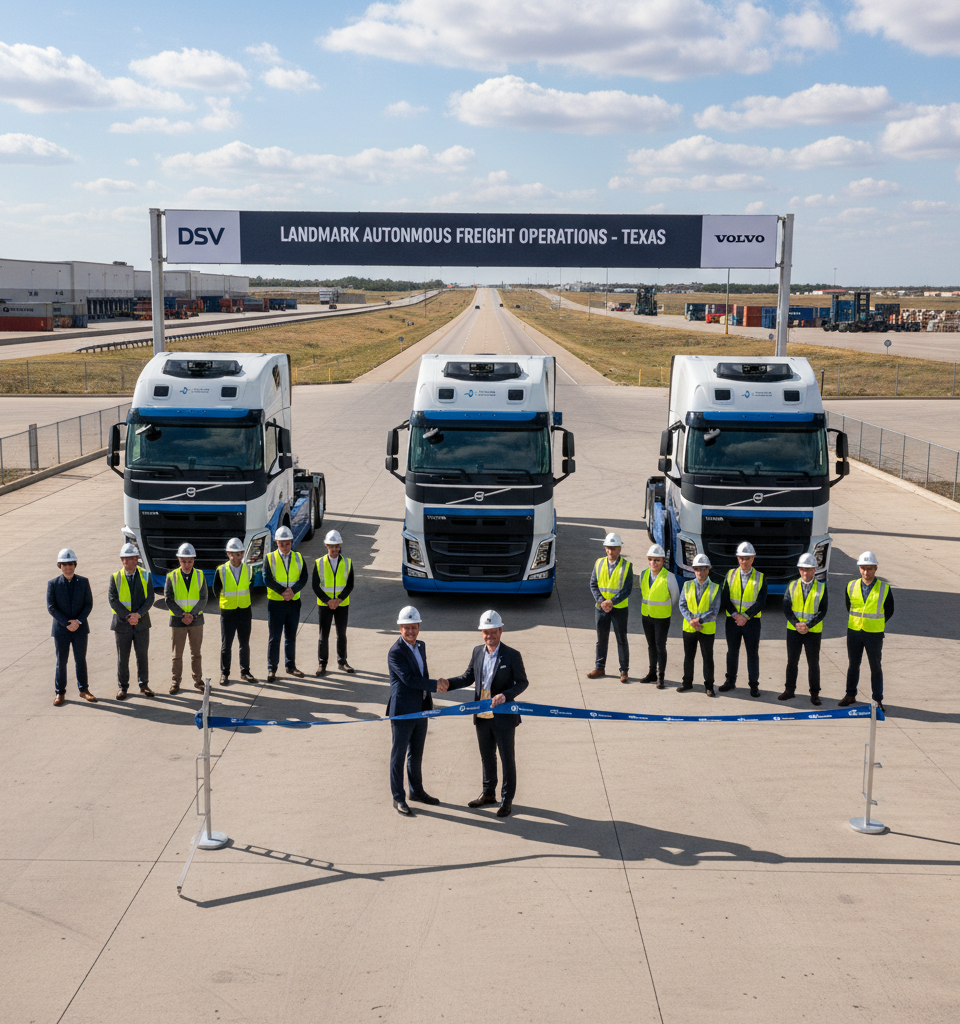
Volvo Autonomous Solutions (VAS) and global transport and logistics provider DSV have announced the launch of commercial autonomous freight operations along the critical Dallas-Houston corridor in Texas. The initiative, which began recently, leverages VAS's integrated Autona/freight solution, designed to improve efficiency, safety, and reliability in long-haul logistics. This deployment signifies a pivotal moment in the trucking industry's transition towards automation, addressing persistent driver shortages and rising operational costs.
The collaboration between VAS and DSV underpins a shared vision for modernizing the supply chain. The Autona/freight platform integrates Volvo VNL Autonomous trucks, equipped with state-of-the-art self-driving technology from industry leaders Aurora and Waabi. Operations are meticulously managed between Aurora's dedicated terminals in both Dallas and Houston, ensuring a controlled and optimized environment for the nascent technology. This strategic choice of route and partners highlights a deliberate approach to scaling autonomous trucking in a commercially viable manner.
Technology at the Forefront
At the core of these operations is the Volvo VNL Autonomous truck, a robust platform designed specifically for self-driving applications. The integration of self-driving technology from Aurora and Waabi represents a dual-pronged strategy, potentially allowing VAS to leverage the strengths of multiple autonomy developers. Aurora, known for its extensive testing and safety protocols, and Waabi, a leader in AI-driven simulation, bring sophisticated capabilities to the table.
This combined technological prowess aims to navigate the complexities of highway driving, including dynamic traffic conditions and varying weather patterns, while maintaining an unparalleled safety record. Initially, the trucks will likely operate with a safety driver onboard, a common practice in the early stages of commercial autonomous deployments, gradually transitioning to fully driverless operations as regulatory frameworks and public acceptance evolve.
Addressing Industry Challenges
The launch of autonomous freight services is not merely a technological feat; it is a critical response to systemic challenges plaguing the trucking industry. The U.S. faces a persistent driver shortage, estimated at over 80,000 drivers by the American Trucking Associations, leading to increased costs and delivery delays. Autonomous trucks offer a compelling solution by providing much-needed capacity, optimizing fuel efficiency through consistent driving patterns, and potentially operating for longer hours than human-driven vehicles. DSV's engagement underscores its proactive approach to securing robust and future-proof logistics solutions, enhancing its competitive edge in a demanding market.
Expert Perspectives on Future Growth
Industry analysts view this partnership as a strong indicator of the inevitable commercialization of Level 4 autonomous trucking. "The collaboration between a major truck OEM like Volvo and a global logistics powerhouse like DSV provides a powerful validation of the technology's readiness for prime time," commented Dr. Eleanor Vance, a lead analyst at Global Mobility Insights. "We anticipate that initial deployments will focus on specific, high-volume routes, like the Dallas-Houston corridor, before expanding more broadly. The key to scalability will be robust safety records, regulatory harmonization, and public trust." Experts project that the autonomous trucking market could reach tens of billions of dollars within the next decade, with significant uptake in line-haul operations.
Market Impact and Competitive Landscape
This move by Volvo Autonomous Solutions and DSV intensifies the competitive landscape in autonomous trucking. Other players, including Waymo Via, TuSimple (though facing recent challenges), and Kodiak Robotics, are also vying for market share. Volvo's strength lies in its extensive manufacturing capabilities and established relationships within the freight sector, coupled with its strategic partnerships with leading autonomy providers. This commercial launch sets a precedent for how traditional OEMs are adapting and integrating advanced technologies, potentially accelerating the industry-wide adoption of autonomous solutions. The Texas triangle, with its dense freight corridors and favorable regulatory environment, has become a hotbed for autonomous trucking development and deployment.
Looking Ahead: Expansion and Scaling
The initial Dallas-Houston route serves as a crucial proving ground for the Autona/freight solution. Success on this corridor will pave the way for expansion to other key logistics arteries across the United States. Future developments will undoubtedly focus on enhancing the autonomous driving stack, integrating more sophisticated AI for predictive logistics, and navigating the evolving regulatory landscape for fully driverless operations. The long-term vision includes creating a network of autonomous freight lanes that can seamlessly integrate with existing logistics infrastructure, ultimately transforming global supply chains into more resilient, efficient, and sustainable systems. The journey toward a largely autonomous freight future has definitively begun with this significant step in Texas.