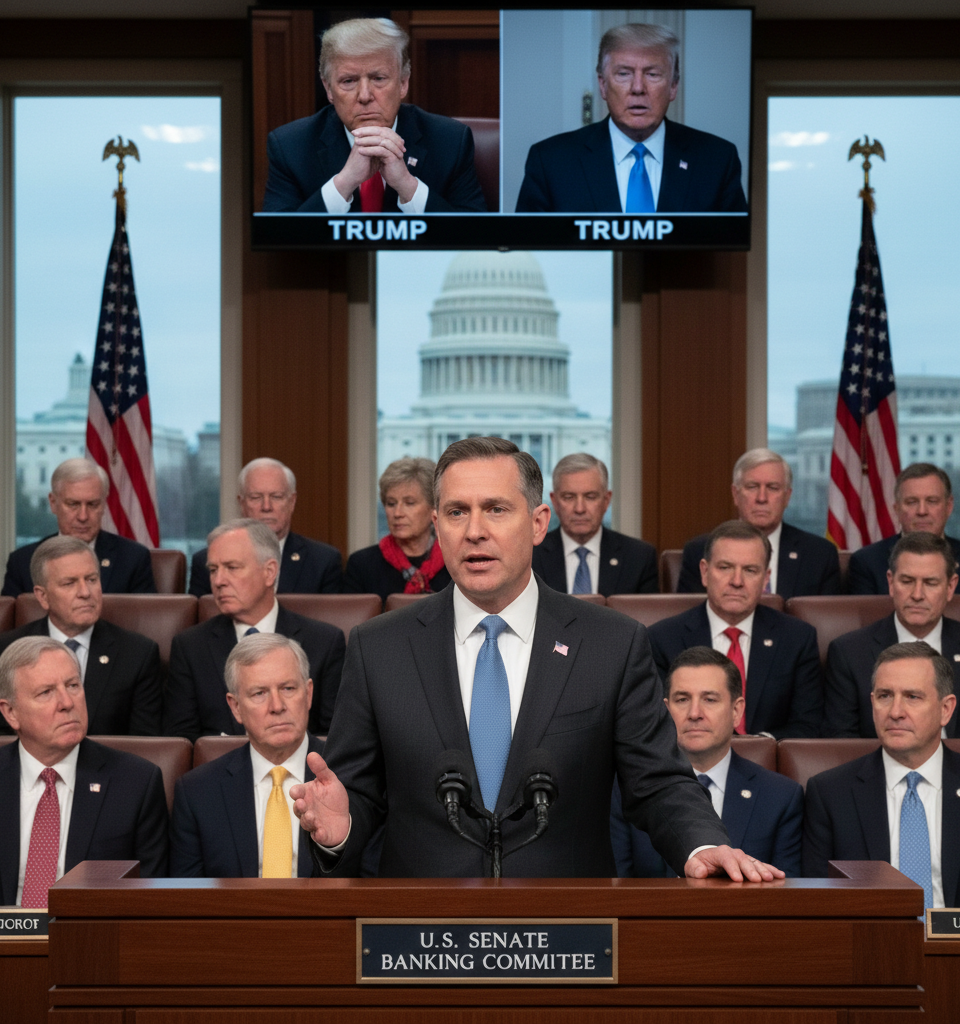
Washington D.C. - The Senate Banking Committee is poised to deliberate on Kevin Warsh's contentious nomination to the Federal Reserve Board of Governors, a move that starkly underscores the internal tug-of-war within President Donald Trump's administration over the future direction of U.S. monetary policy. The decision to advance Warsh's nomination comes despite explicit intentions by at least one prominent Republican senator, a member of the very committee, to block his confirmation. This unprecedented friction within the President's own party illuminates a brewing battle over the Federal Reserve's leadership and its independence, with significant implications for the nation's economic trajectory.
Context and Background: A President's Monetary Policy Dilemma
President Trump has frequently expressed dissatisfaction with the Federal Reserve's post-2008 policies, particularly its relatively slow pace of interest rate normalization. His public criticisms have often deviated from traditional presidential deference to the Fed's independence, fueling speculation about his preferred candidates for key roles. Kevin Warsh, a former Fed governor during the George W. Bush administration and an outspoken critic of the Fed's quantitative easing programs, aligns with some of the President's skepticism towards expansive central bank interventions. His potential appointment, therefore, represents a significant ideological shift from the continuity-oriented approach favored by some within the Republican establishment, who prioritize stability and institutional autonomy at the Fed.
Key Details: A Divided Republican Front
The most glaring immediate hurdle for Warsh's nomination is the promised opposition from within the Senate Banking Committee. While the identity of the dissenting Republican senator has not been publicly confirmed, sources close to the committee suggest concerns range from Warsh's perceived lack of experience in critical areas of monetary policy post-financial crisis to worries about his potential impact on the Fed's political independence. Warsh's tenure at the Fed from 2006 to 2011 was marked by his involvement in crisis-era decision-making, but critics argue his subsequent commentary has leaned heavily towards an overly hawkish stance, potentially clashing with the current economic landscape. His public statements have often advocated for a more restrictive monetary policy, potentially at odds with the President's stated desire for lower interest rates to stimulate growth.
Industry and Market Impact: Uncertainty in the Financial Sector
The prospect of Warsh's appointment has already introduced a layer of uncertainty into financial markets. Analysts are keenly aware that new Fed leadership could signal a significant shift in monetary policy, affecting everything from bond yields and equity valuations to the trajectory of the dollar. A more hawkish Fed, as Warsh's past statements suggest he might advocate, could imply faster interest rate hikes, potentially impacting corporate borrowing costs and consumer spending. Conversely, the market is also weighing the unpredictable nature of President Trump's influence over the Fed, given his strong opinions on interest rates. This dual uncertainty makes forecasting future market movements particularly challenging for investors and businesses alike, who thrive on predictability from the nation's central bank.
Expert Perspective: Balancing Independence and Presidential Preference
Economists and political analysts are offering varied perspectives on the implications of Warsh's potential role. Dr. Sarah Jones, a monetary policy expert at the Peterson Institute for International Economics, noted, "Warsh's nomination represents a clear attempt by the administration to shift the Fed's ideological center. While some argue this could bring fresh perspectives, others worry it could compromise the Fed's independence from political pressure, a cornerstone of its effectiveness." Many experts underscore the delicate balance required between the President's prerogative to nominate and the Senate's duty to confirm, particularly for an institution as vital as the Federal Reserve. The debate extends beyond Warsh himself, touching on broader questions of central bank autonomy in a politically charged environment.
What's Next: A Path to Confirmation or Standoff?
The immediate next step involves Senate Banking Committee hearings, where Warsh will face rigorous questioning from both Republican and Democratic senators. His past policy positions, particularly his views on inflation targets, balance sheet normalization, and the appropriate level of interest rates, will be thoroughly scrutinized. Should he clear the committee, his nomination would then proceed to the full Senate for a confirmation vote. However, the dissenting Republican vote within the committee foreshadows a potentially difficult path, raising the specter of a Republican-led filibuster or a significant delay in his confirmation. The coming weeks will be critical in determining whether Warsh can garner sufficient bipartisan support, or if President Trump will be forced to reconsider his choices for this pivotal economic role, further extending the uncertainty surrounding the Fed's future composition and agenda.
The outcome of this nomination process is not merely a personnel decision; it is a barometer of the ongoing struggle for influence over the nation's economic steering wheel and a test of the Federal Reserve's much-vaunted independence in an era of heightened political polarization. The high stakes involved ensure that every development will be closely watched by financial markets and policymakers alike.