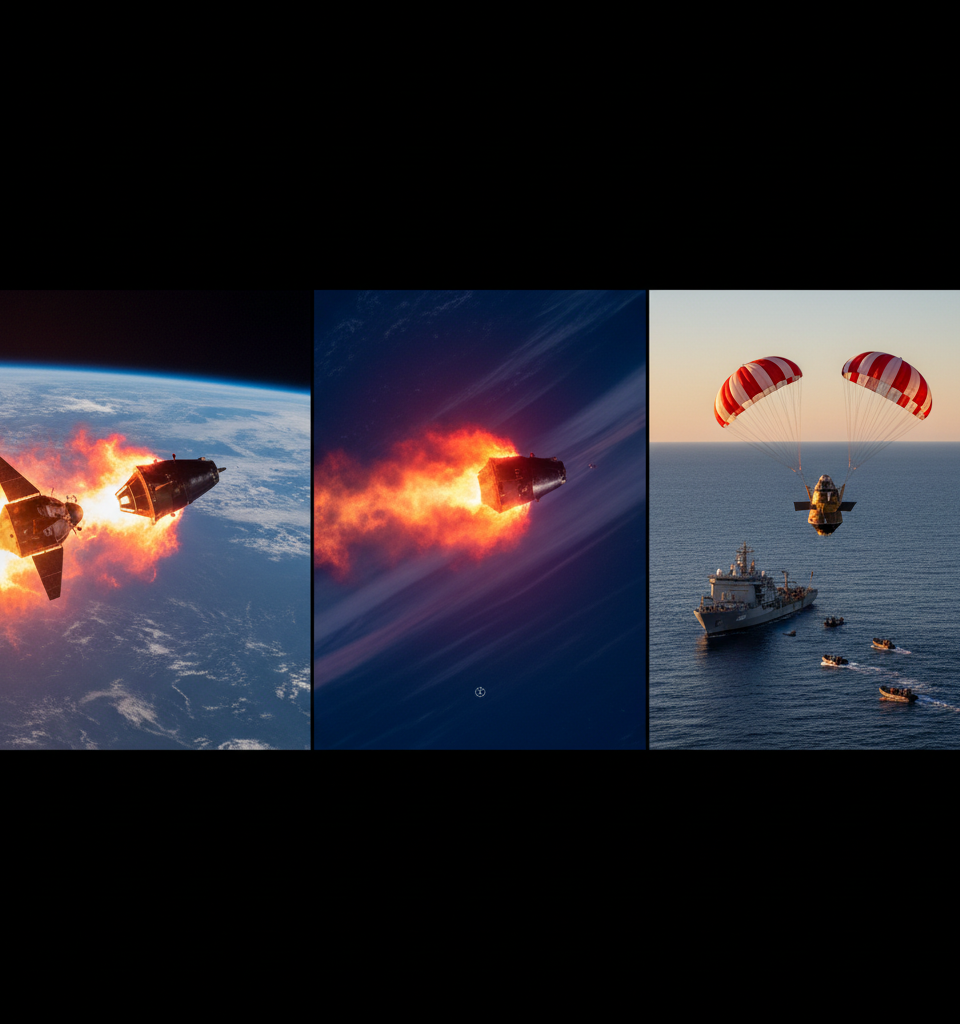
In a momentous achievement for human spaceflight, the four astronauts comprising the Artemis II crew have safely returned to Earth after completing their ambitious 10-day mission to the Moon. The successful re-entry sequence, meticulously planned and executed, involved a series of critical phases: spacecraft separation, a period of communications blackout, and the highly anticipated splashdown, bringing an end to a mission that serves as a cornerstone for future lunar and deep-space exploration.
The Return Journey: A Critical Juncture
The return of the Artemis II crew represents a significant milestone in humanity's renewed pursuit of lunar exploration. This mission, designed to test the Orion spacecraft's systems with human occupants beyond low Earth orbit, has provided invaluable data and experiences crucial for future missions, including the planned lunar landings. The precision required for a safe re-entry from lunar distances is immense, demanding flawless execution from ground control and the onboard systems. The successful navigation of these challenges underscores the advanced capabilities developed over years of research and development, setting a powerful precedent for the Artemis program's ambitious trajectory.
Re-entry Dynamics: Separation, Blackout, and Splashdown
The intricate process of returning the astronauts home began with the separation of the Orion crew capsule from its service module. This maneuver was critical, jettisoning the section of the spacecraft that provided propulsion and power during its transit to and from the Moon, leaving the crew capsule to orient itself for atmospheric re-entry. Following separation, the capsule began its fiery descent through Earth's atmosphere, enduring extreme temperatures generated by friction. This phase inevitably led to a communications blackout, a planned but tense period when ionized gases around the capsule temporarily prevent radio signals from reaching ground control. This blackout, lasting several minutes, is a standard feature of high-speed re-entries, confirming the immense thermal stress on the spacecraft. The final act was a precise splashdown in a designated recovery zone, where recovery teams were on standby to retrieve the capsule and its returning crew.
Broader Implications for Space Exploration
Beyond the immediate success of bringing the astronauts home, the Artemis II mission's completion carries significant implications for the aerospace industry and global space programs. It validates key technologies, operational procedures, and human endurance in a deep-space environment, paving the way for the Artemis III mission, which aims to land humans on the Moon. This success is expected to reinvigorate commercial interest in lunar logistics, resource utilization, and space tourism, potentially leading to increased investment and innovation within the sector. The data collected from the 10-day mission, particularly regarding radiation exposure, life support systems, and crew health, will be instrumental in designing sustained human presence on the Moon and preparing for future Mars missions.
Paving the Way for Future Lunar Ventures
The successful conclusion of Artemis II firmly establishes the United States' leadership in human space exploration in the mid-2020s. This mission, while not involving a lunar landing, was critical for proving the capabilities and safety of the Orion spacecraft with a human crew. The mission's data will directly inform the design and operational parameters for subsequent Artemis missions, particularly Artemis III, which is slated to land astronauts near the lunar south pole. The insights gained from the re-entry process, including the performance of the heat shield and parachutes, are invaluable. They ensure that future lunar explorers can return safely, building confidence in the overarching architecture of NASA's lunar exploration strategy.
Looking Ahead: The Next Phase of Artemis
With Artemis II now concluded, attention will rapidly shift to the next phases of the Artemis program. Engineers and scientists will meticulously analyze every piece of data from the mission, from launch to splashdown. This includes detailed evaluations of the Orion spacecraft's performance, the crew's physiological responses to deep space and re-entry, and the operational protocols used throughout the flight. The lessons learned will be directly applied to refine flight plans and hardware for Artemis III and beyond. The momentum generated by this successful mission is expected to accelerate development schedules for lunar habitats and mobility systems, moving closer to the vision of a sustained human presence on the Moon and eventually, expeditions to Mars. This return marks not an end, but a powerful beginning to a new era of lunar exploration.