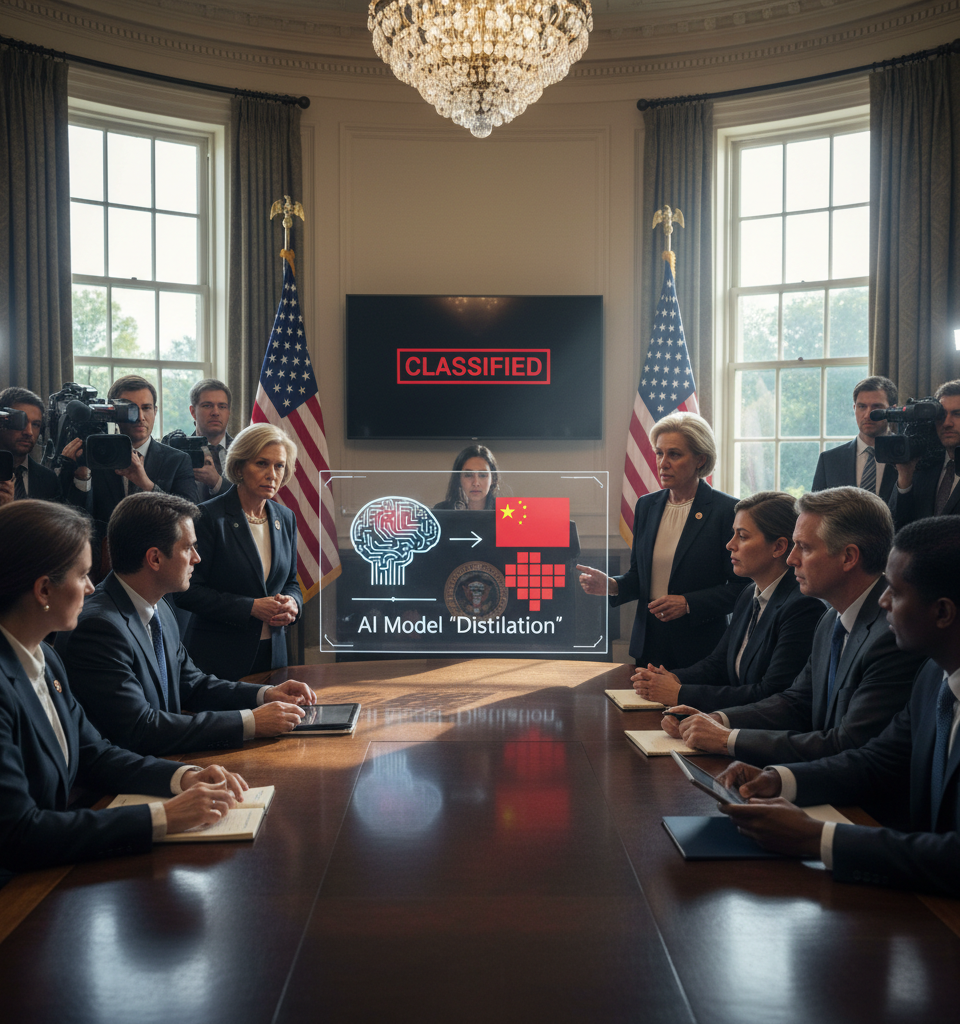
The White House Office of Science and Technology Policy (OSTP) has publicly alleged that China is engaging in "industrial-scale" distillation of American artificial intelligence models. This serious accusation, outlined in a recent policy memo, marks a pivotal moment in the escalating tech rivalry between the two global powers. In a direct strategic response, the Biden administration has committed to a new intelligence-sharing framework with key US AI companies, including OpenAI, Anthropic, and Google, while also exploring robust accountability measures against such unauthorized activities.
Escalating Tensions in AI Dominance
This development underscores the fierce competition for AI supremacy and the growing concerns within the US government regarding intellectual property theft and national security. The accusation of "distillation" posits that foreign entities are taking complex foundational AI models developed in the US, reducing their size and complexity while retaining core functionalities, effectively creating derivative models without authorization or attribution. This practice threatens the immense investment and innovation critical to maintaining America's lead in advanced AI research and development.
Industry Accusations Precede Policy Shift The White
House's announcement follows several high-profile incidents where US AI firms directly accused Chinese counterparts of illicit activities. In February, OpenAI, the developer of ChatGPT, pointed to Chinese AI company DeepSeek, alleging it had distilled its models. Not long after, Anthropic, a prominent AI research company behind the Claude chatbot, issued a stark report naming DeepSeek, MiniMax, and Moonshot AI. Anthropic claimed these firms had orchestrated a sophisticated scheme involving approximately 24,000 fraudulent accounts, which collectively generated over 16 million queries in an apparent effort to reverse-engineer or extract knowledge from their proprietary models. Such activities highlight the intricate and persistent nature of the challenges faced by American AI innovators.
Impact on the Global AI Landscape
This policy shift is poised to have significant repercussions across the global AI industry. For US AI companies, the promise of enhanced intelligence sharing with government agencies offers a potential lifeline in combating sophisticated cyber espionage and intellectual property theft. It signals a move towards a more unified front between Silicon Valley and Washington in protecting technological advantage. Conversely, for Chinese AI firms, this increases scrutiny and could lead to further restrictions on access to critical AI resources, research collaborations, and market entry, potentially bifurcating the global AI ecosystem even further. The estimated market value of the global AI industry is projected to reach over $1.8 trillion by 2030, underscoring what is at stake in this competition.
Expert Perspectives on Future Avenues
Industry analysts and cybersecurity experts largely view the White House's move as a necessary, albeit complex, step. Dr. Anya Sharma, a leading expert in computational ethics, noted, "The direct partnership between government intelligence and private AI developers is unprecedented at this scale. It acknowledges the unique, often elusive nature of AI intellectual property and the sophisticated methods employed in its appropriation." She added, "While sharing intelligence is crucial, the long-term effectiveness will depend on the agility of enforcement mechanisms and international cooperation, which currently remains highly contentious." Others, like cybersecurity firm Mandiant, have frequently documented state-sponsored cyber espionage targeting critical technologies, providing a backdrop to these concerns.
What Lies Ahead: Diplomacy, Defense, and Deterrence
Looking forward, the immediate implications involve a ramp-up in defensive strategies for US AI companies, potentially through more robust model watermarking, improved anomaly detection, and legal enforcement. The White House's commitment to exploring "accountability measures" suggests a range of options, from sanctions against offending entities to diplomatic pressure on Beijing. However, the technical challenge of definitively proving distillation and attribution remains considerable in the rapidly evolving AI landscape. This geopolitical wrangling over AI intellectual property is expected to intensify, shaping future trade policies, research collaborations, and potentially defining the next era of global technological leadership. The US government is under pressure to protect its multi-billion dollar investment in AI research and development. This aggressive stance by the US government indicates a strategic pivot towards a more proactive defense of its technological assets in the face of perceived foreign threats. The success of this new intelligence-sharing paradigm will be closely watched by innovators, policymakers, and international observers alike, as it could set a precedent for managing future geopolitical conflicts over advanced technologies.