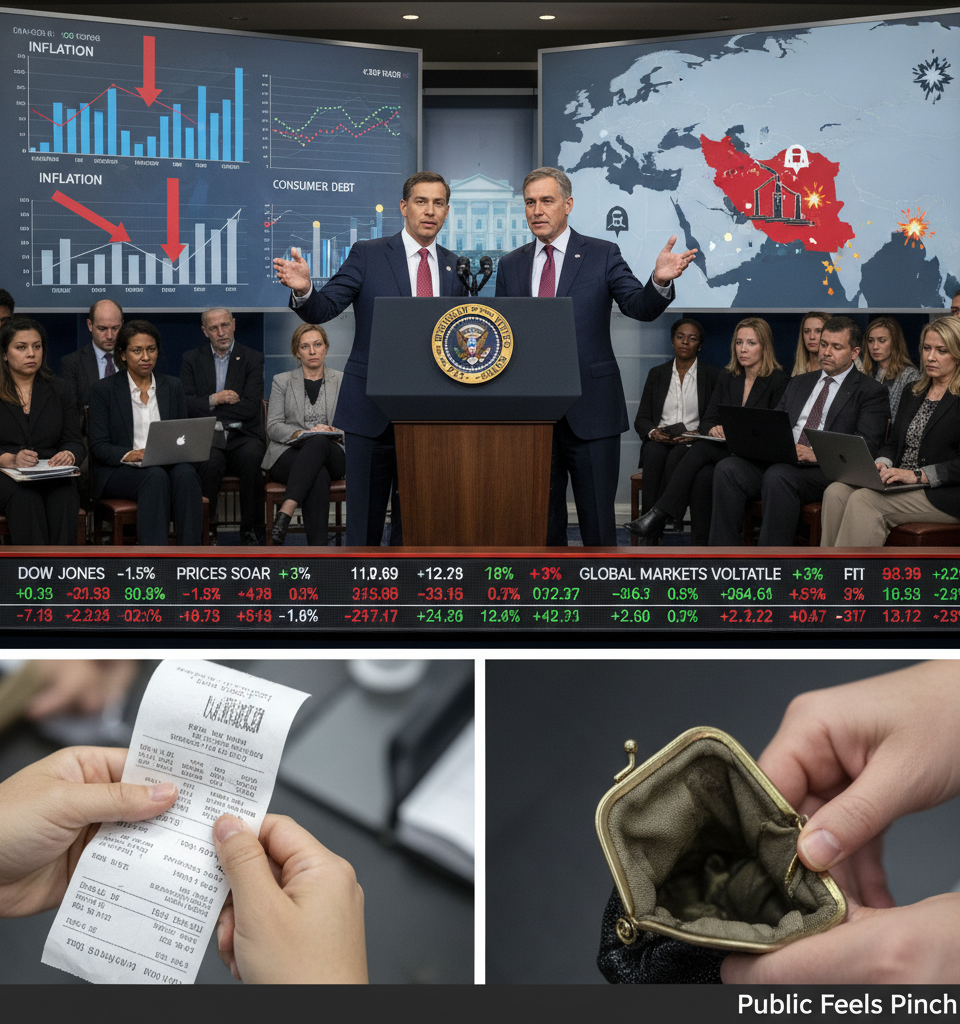
WASHINGTON D.C. — The White House is maintaining an outward stance of economic confidence, even as the protracted conflict in Iran begins to inflict tangible financial burdens on American consumers and businesses. While major stock indices have recently demonstrated renewed vigor, reaching multi-year highs, the escalating geopolitical tensions and their resultant economic fallout are painting a starkly different picture for many across the nation. This divergence between official optimism and public reality comes as the conflict stretches well beyond the initial timelines suggested by the previous administration.
The Widening Discrepancy: Market Gains vs. Main Street Struggles
The current White House narrative emphasizes a resilient domestic economy, often citing a robust job market and a resurgent stock performance as evidence of stability. However, this perspective increasingly clashes with the economic realities faced by average Americans. The war's prolonged nature has had a cascading effect, notably impacting global supply chains, energy prices, and the cost of essential goods. This discrepancy highlights a fundamental challenge for the administration: how to reconcile positive macroeconomic indicators with the growing financial anxieties of its constituents.
Economic Repercussions Ripple Through Households
Direct impacts of the Iranian conflict are now palpable in American households. Gasoline prices, a highly visible barometer of economic strain, have surged by an average of 15% nationwide since the conflict's escalation began six months ago, reaching an average of $4.10 per gallon – a 10% increase year-over-year. Energy analysts project these prices could climb further, potentially hitting $4.50 within the next quarter if geopolitical instability persists. Beyond the pump, the cost of imported goods, particularly electronics and certain agricultural products, has seen an uptick of approximately 5-8% due to increased shipping costs and supply chain disruptions exacerbated by the regional instability. A recent poll by the National Consumer Federation revealed that 62% of respondents rated their personal financial situation as 'worsening' or 'stagnant' over the past three months, directly attributing some of their concerns to the war's economic fallout.
Broader Market Volatility and Sectoral Impacts
The broader market, while experiencing recent gains, has also displayed periods of significant volatility, particularly in sectors highly sensitive to geopolitical events. The energy sector, predictably, has seen substantial gains, with major oil companies reporting record profits, yet this has come at the expense of consumer spending power elsewhere. Conversely, the transportation and logistics industries are facing increased operational costs, with some airlines reporting a 20% rise in fuel expenditures. Technology and manufacturing sectors, heavily reliant on complex global supply chains, are experiencing delays and increased input costs, leading to potential margin compression and slower production cycles for some firms. The financial markets, while appearing robust on the surface, are navigating underlying currents of uncertainty as investors weigh the long-term implications of ongoing global instability.
Expert Analysis: A Test of Economic Resilience
Economists and financial analysts offer a nuanced perspective on the current situation. Dr. Evelyn Reed, a senior fellow at the Brookings Institute, remarked, "The stock market's performance is often a forward-looking indicator, but it doesn't always reflect the immediate pain points of Main Street. The White House's optimism is understandable from a macro perspective, but ignoring the microeconomic realities for individual families could be politically costly." Others, like Mark Thompson, chief economist at Global Financial Strategies, caution that while the U.S. economy has demonstrated remarkable resilience, a prolonged conflict could test its limits. "We're seeing a bifurcation – a strong equity market driven by tech and large caps, juxtaposed against inflationary pressures and consumer belt-tightening that could eventually dampen demand," Thompson stated. He estimates that sustained high energy prices could shave 0.5% off annual GDP growth.
The Unfolding Path: Inflationary Pressures and Policy Responses
Looking ahead, the primary concern remains the sustained inflationary pressure driven by energy costs and supply chain disruptions. The Federal Reserve faces a delicate balancing act: managing inflation without stifling economic growth. Future interest rate decisions will undoubtedly be influenced by the duration and intensity of the Iranian conflict. The White House, while publicly downplaying economic concerns, is reportedly exploring strategies to mitigate the impact of rising costs, including potential releases from the Strategic Petroleum Reserve and diplomatic efforts to stabilize global oil markets. However, the effectiveness of these measures remains to be seen against a backdrop of persistent geopolitical uncertainty.
Political Ramifications and Public Sentiment
The divergence between official economic messaging and public financial struggles carries significant political ramifications, particularly as the nation heads into an election cycle. Public sentiment surveys increasingly indicate growing frustration over the cost of living, with 70% of respondents in a recent Quinnipiac poll expressing concern about inflation. Should the economic squeeze on American households intensify, the White House could face increasing pressure to adjust its economic narrative and offer more direct relief or a clearer strategy for navigating the financial consequences of the ongoing conflict.
Conclusion: Navigating a Complex Economic Landscape
The White House's optimistic economic outlook is being increasingly challenged by the real-world financial pressures stemming from the protracted conflict in Iran. While the stock market may continue to show strength, the rising cost of living for average Americans presents a critical economic and political challenge. The coming months will determine whether the administration can effectively bridge this gap, or if the economic fallout from distant conflict will further erode domestic confidence.