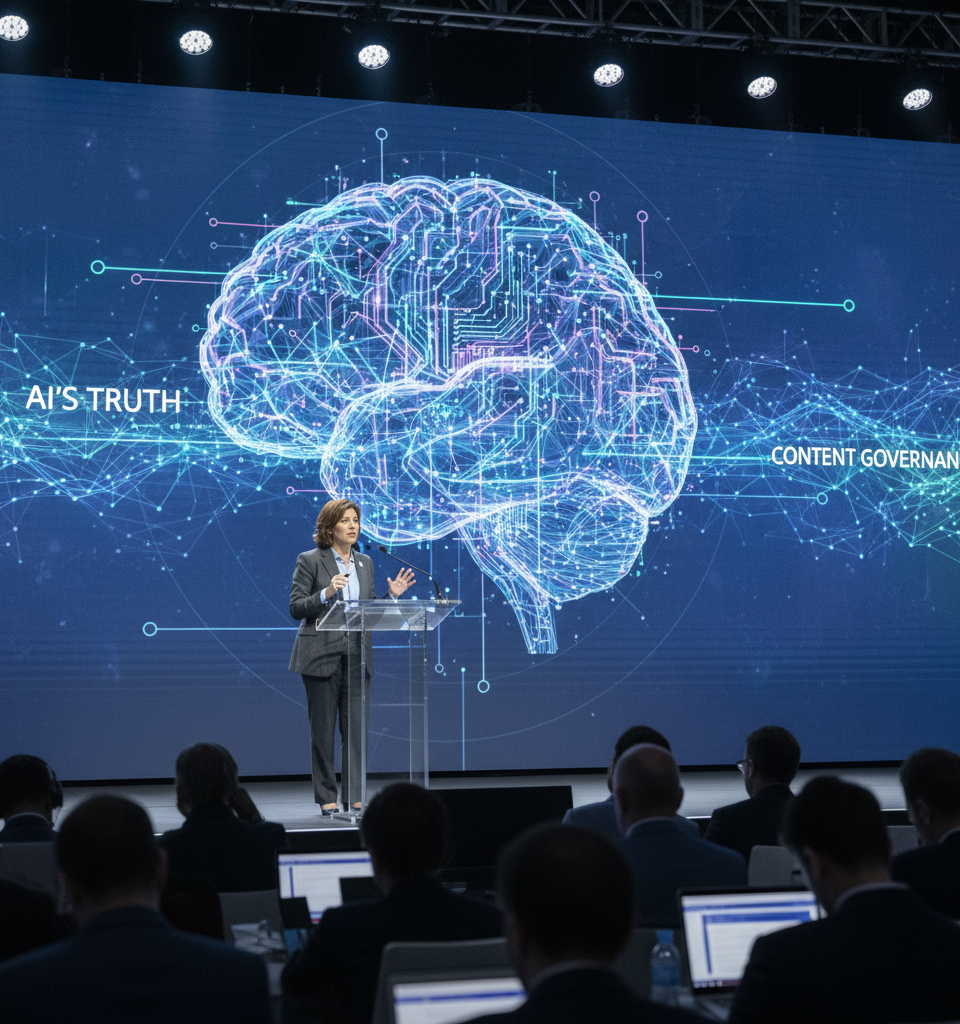
Campbell Brown, the influential former head of news partnerships at Meta Platforms, recently articulated a significant disconnect at the heart of the burgeoning artificial intelligence revolution: the chasm between the technological aspirations of Silicon Valley and the practical consumer understanding of AI-generated content. Her remarks, delivered in a recent industry discussion, emphasize that while tech giants focus on rapid advancement, the public grapples with fundamental questions of truth, bias, and control over the information AI disseminates.
The AI Content Conundrum
Brown's observations come at a pivotal moment, as generative AI models are increasingly integrated into platforms used by billions. Her tenure at Meta positioned her at the nexus of technology and media, giving her a unique vantage point on the profound implications of algorithmic content curation. The fundamental question she poses – "Who decides what AI tells you?" – transcends mere technical implementation; it delves into the societal responsibility of AI developers and deployers. This concern echoes historical debates about media gatekeepers and content moderation, now magnified by the scale and autonomy of AI systems. The rapid proliferation of AI tools, from chatbots to sophisticated content generators, has outpaced regulatory frameworks and public understanding, leaving a void in ethical guidelines and accountability.
Divergent Conversations: Tech vs. Consumer
According to Brown, the "conversation is sort of happening in Silicon Valley around one thing, and a totally different conversation is happening among consumers." This dichotomy is stark. In Silicon Valley, the focus often centers on model capabilities, efficiency, and market share – pushing the boundaries of what AI can achieve. However, consumers are primarily concerned with reliability, accuracy, and the potential for manipulation or misinformation. They want to know if the AI is a neutral arbiter of facts or a reflection of its creators' biases, whether intentional or not. This gap in understanding and priorities poses a significant challenge for companies aiming for broad adoption and trust.
Industry Impact and Ethical Imperatives
The implications for the tech industry are profound. Companies failing to bridge this gap risk eroding public trust, inviting stringent regulation, and facing consumer backlash. Major players like Google, OpenAI, and Microsoft are investing billions in AI development, yet the ethical framework for their deployment remains nascent. For instance, the recent controversies surrounding AI hallucinations and biased outputs from prominent models demonstrate the immediate need for robust content governance. As advertising dollars increasingly follow AI-driven recommendations and content generation, the integrity of these systems becomes not just an ethical concern but a core business imperative, potentially impacting revenues currently estimated in the tens of billions for AI software and services, projected to grow exponentially.
Expert Perspectives on AI Governance
Experts in AI ethics and media studies largely corroborate Brown's assessment. Dr. Sarah Miller, a researcher focusing on algorithmic accountability at the University of California, Berkeley, notes, "The technical prowess of AI is undeniable, but without a parallel advancement in ethical governance and public literacy, we're building powerful tools without a clear operating manual for society." Others point to the need for transparent data sourcing, explainable AI (XAI), and independent audits of AI systems. There's a growing consensus that a multi-stakeholder approach, involving technologists, ethicists, policymakers, and civil society, is crucial to developing standards that resonate across both technical and public spheres.
The Path Forward: Transparency and Trust
Looking ahead, the onus is on AI developers and platform owners to proactively address these concerns. Future developments will likely include more sophisticated AI explainability features, allowing users to understand how AI conclusions are reached. Furthermore, industry consortia and regulatory bodies are expected to intensify efforts to establish ethical guidelines and best practices for AI-generated content. The European Union's AI Act, while still in its early stages of implementation, represents one of the most comprehensive attempts globally to regulate AI, focusing on risk-based classifications and user rights. The future success and societal acceptance of AI will hinge not just on its intelligence, but on its trustworthiness and the clarity with which its creators communicate its capabilities and limitations to the world.
Ultimately, Campbell Brown's observations serve as a stark reminder that the conversation around AI cannot remain confined to technical specifications. It must expand to encompass the fundamental questions of truth, influence, and accountability, forging a unified understanding between those who build AI and those who rely on its outputs daily.