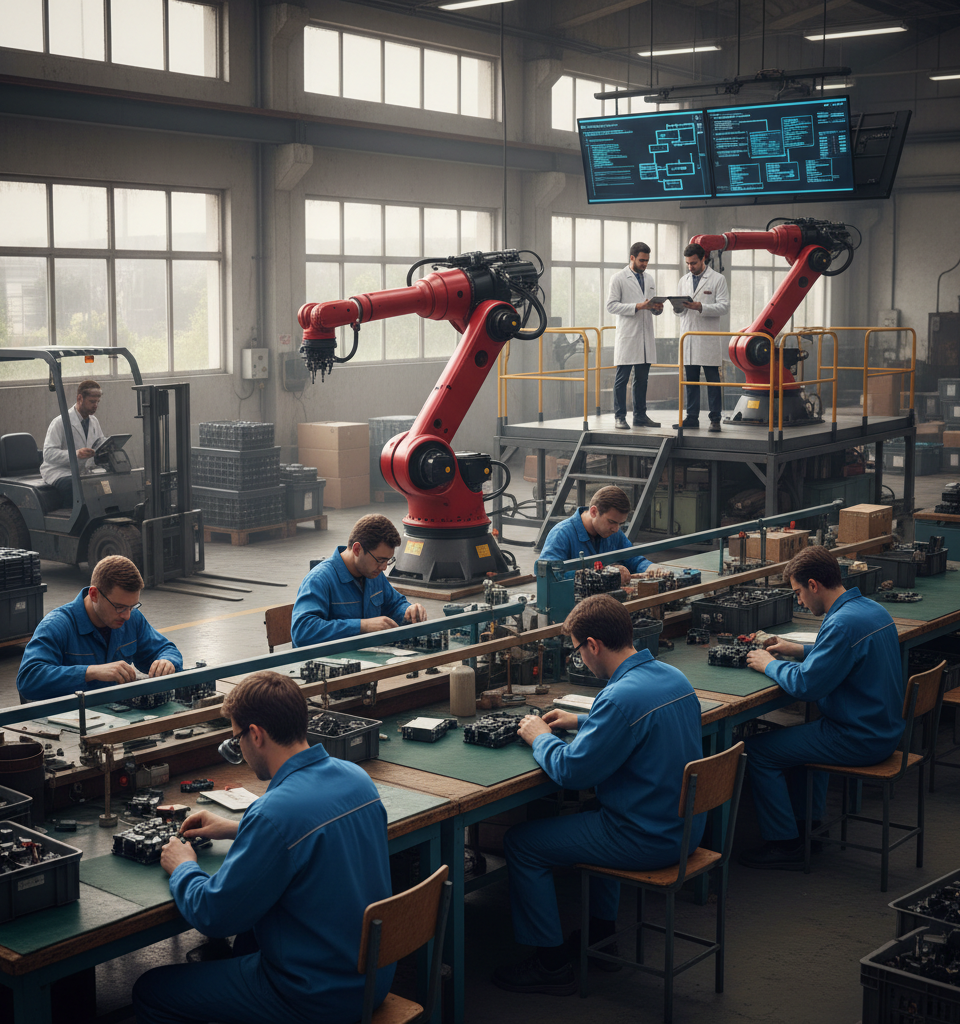
While nearly every manufacturer is engaging with the potential of artificial intelligence, a stark reality indicates that the promises of advanced technology are yet to translate into widespread operational automation. A substantial 80% of manufacturing facilities currently operate without full automation, presenting a critical bottleneck in the industry's digital transformation journey, even as 98% are actively exploring AI applications.
The Automation Paradox: A Deeper Look
This discrepancy highlights a complex situation where the aspiration for technological advancement, particularly in AI, outpaces the fundamental implementation of automation. Automation, in its simplest form, involves using technology to perform tasks with minimal human intervention, ranging from robotic assembly lines to advanced process control systems. The fact that the vast majority of manufacturers have yet to fully embrace this foundational step, despite their keen interest in AI, suggests a range of intertwined challenges.
Historically, manufacturing has been characterized by incremental technological adoption. The First Industrial Revolution brought mechanization, the Second introduced mass production and electricity, and the Third integrated electronics and information technology. We are currently in the midst of the Fourth Industrial Revolution, known as Industry 4.0, which emphasizes connectivity, data analysis, and advanced automation, including AI. The slow adoption of comprehensive automation, even while AI looms large, indicates that many enterprises may be struggling with the prerequisites or internal capacities required for such a transition.
Key Obstacles to Widespread Automation
The reasons behind this pronounced automation gap are not singular but rather a mosaic of interconnected issues. While the original source does not explicitly detail these barriers, common industry analyses point to factors such as significant upfront capital investment, the complexity of integrating new and legacy systems, a shortage of skilled labor capable of managing automated processes, and concerns about return on investment. Furthermore, fear of disrupting established workflows, data security concerns regarding connected systems, and a lack of clear strategic direction can also contribute to hesitancy.
For many manufacturers, the journey to automation is not merely about purchasing new machinery but about a comprehensive overhaul of processes, culture, and workforce skills. This often requires substantial financial outlays that smaller and medium-sized enterprises (SMEs) may find prohibitive. The integration of diverse technologies from multiple vendors can also be a daunting technical challenge, compounded by the presence of aging infrastructure that may not be compatible with modern automation solutions.
Industry and Market Impact
The implications of this widespread automation lag are significant for the global manufacturing landscape. Companies that fail to automate risk falling behind competitors in terms of efficiency, cost-effectiveness, and product quality. In an increasingly competitive global market, the ability to produce goods more quickly and with fewer errors is paramount. A lack of automation can lead to higher labor costs, increased production time, and a reduced capacity for specialized, high-volume output.
Moreover, the full potential of artificial intelligence in manufacturing—such as predictive maintenance, quality control, and optimized supply chains—can only be realized upon a robust foundation of automation. Without automated processes to generate and feed data, or to execute AI-driven decisions, the exploration of AI becomes largely theoretical, with limited practical application. This disconnect could widen the gap between technologically advanced nations and those struggling with industrial modernization.
The Road Ahead: Bridging the Gap
To bridge this significant automation gap, manufacturers will likely need to adopt multi-pronged strategies. This includes developing clear, long-term roadmaps for digital transformation, investing in workforce training and reskilling programs, and exploring more modular and scalable automation solutions. Furthermore, partnerships with technology providers and access to financing mechanisms designed to support industrial upgrades could prove crucial.
The ongoing exploration of AI, even in the absence of full automation, suggests a recognition of future imperatives. However, for manufacturers to truly harness the benefits of Industry 4.0, the focus must broaden from simply investigating advanced technologies to fundamentally transforming operational processes through comprehensive automation. The coming years will reveal whether the industrial sector can successfully navigate these complexities to realize a more automated and intelligent future.